
Uzbekistan · 7 August 2026
Southern Uzbekistan: Termez and the Kashkadarya region
Termez was the southernmost city of the Soviet empire and one of Central Asia's earliest Buddhist centres. Southern Uzbekistan has three historical layers most travellers ignore.

Termez sits at Uzbekistan’s southern edge, on the bank of the Amu Darya — the ancient Oxus of the Greeks — looking across the river into Afghanistan. During the Soviet-Afghan war (1979-1989), the Termez bridge was the crossing point for tanks and military convoys heading south. It was the southernmost city of the Soviet Empire, and that frontier position gave it for decades the atmosphere of a militarised city sealed from the outside world.
What very few visitors know is that Termez, before it became a Soviet city, was one of Central Asia’s most important Buddhist centres, with a history stretching back to the third century BCE that includes cave monasteries, stupas and sculptures matching anything Gandharan Buddhism produced in South Asia.
Buddhism on the Oxus
Buddhism reached the Termez region from India along the trade networks of the Kushans, a Central Asian power that between the first and fourth centuries CE controlled a territory encompassing Afghanistan, Pakistan, northern India and the Amu Darya valley. The Kushans were a civilisation of synthesis: Greco-Bactrian in origin, Iranian in language, Buddhist in official religion. Their coins show the Buddha alongside Heracles and Ahura Mazda on the same reverse.
The Kara-Tepe archaeological site, on the outskirts of Termez, is the most extraordinary survival of this heritage: a Buddhist monastery carved into the sandstone cliffs above the Amu Darya, with monks’ cells, worship halls, underground passages and mural paintings that archaeologists have been recovering since the 1960s. Excavations continue: Kara-Tepe has layers that archaeology has not yet reached.
Fayaz-Tepe, about three kilometres away, is a better-preserved surface Buddhist monastery, with remains of a central stupa and paintings showing Gandharan Buddhist iconography: the Buddha with Hellenistic features, bodhisattvas dressed in fabrics reminiscent of Greek sculptural drapery. These paintings date from the first and second centuries CE and are among the earliest in the Buddhist world.
Alexander on the Oxus
Before Buddhism, Termez had another historical layer: the Hellenistic one. Alexander the Great crossed the Amu Darya in 329 BCE during his Central Asian campaign and founded several cities in the region, some of which archaeology has identified. The one corresponding to ancient Termez’s site — sometimes called Alexandria-on-the-Oxus — was a Hellenistic city with temples, an agora and an aqueduct system that functioned for several centuries before being absorbed by local cultures.
What remains of this foundation is sparse — the reuse of building materials and successive layers of occupation have erased most of it — but Termez’s archaeological museum holds a collection of Hellenistic, Buddhist and pre-Islamic pieces that tells this story of cultural superimposition coherently.
Shakhrisabz: the city before the palace
Further north, before reaching Uzbekistan’s central plain, lies Shakhrisabz: Tamerlane’s hometown, which was his capital before Samarkand assumed that role. The main monument — the Ak-Saray arch — is all that remains of the gateway to the palace Tamerlane built in his native city, using artisans and materials from his conquests. The inscription on the arch, attributed to Tamerlane himself, read: “If you doubt our power, look at our buildings.” The arch stands forty metres high and was the entrance to a palace which, according to contemporary sources, was the largest in the known world.
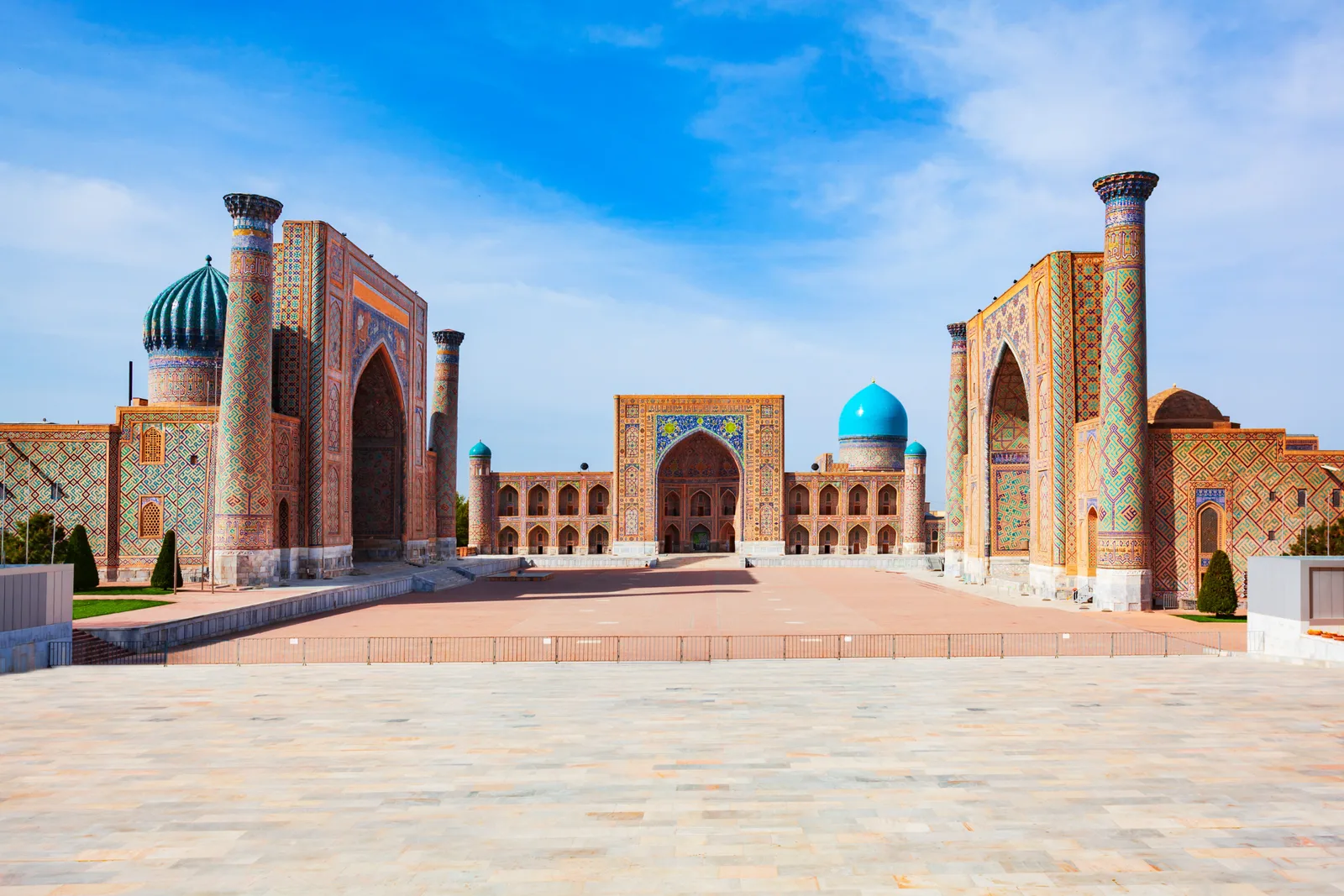
What has disappeared — the palace itself — is as vast in its absence as what remains. The two arch towers, decorated with blue-turquoise tiles in remarkable preservation, give some sense of what kind of entrance that building had. Projecting from them the scale of the ensemble behind them requires imagination, but the archaeological plans available suggest dimensions that make Samarkand’s Registan look modest by comparison.
How to incorporate the south into the itinerary
Southern Uzbekistan is not easy to fit into a two-week itinerary that already includes the classic circuit. The options are two: dedicate a full day to Shakhrisabz as a day trip from Samarkand (what most travellers who deviate from the main axis do), or add Termez as a specific destination if interest in Buddhist archaeology justifies the extra days.
Termez has flight connections to Tashkent (one hour), making it more accessible than its position on the map suggests. For those with time and Central Asian archaeology as a primary interest, spending two nights in Termez — visiting Kara-Tepe, Fayaz-Tepe, the archaeological museum and the ruins of Islamic medieval Termez — is an experience without equivalent in Uzbekistan.
Most travellers to Uzbekistan concentrate on the Tashkent-Samarkand-Bukhara-Khiva axis. That axis is the best of Uzbekistan, but it is not all of it. The south — with its three millennia of layered history, its Afghan border, its Buddhist heritage unique in Central Asia — is the reminder that the region’s history has more layers than any two-week itinerary can see.
The complete Far Guides Uzbekistan guide includes detailed Silk Road routes, interactive maps and all the practical information you need to plan your independent trip.
More on Uzbekistan
Keep reading.
Other pieces from the same destination.


Next step
Ready for Uzbekistan?
The guide is for travelling.
Offline maps, itineraries and everything that doesn't fit in an article.
Get the Uzbekistan guide