Uzbekistan · 14 August 2026
Photographing Uzbekistan: the places and the moments
The blue of the Timurid tiles, the bazaar caravans, old women with suzanis in doorways. Uzbekistan is one of the world's most photogenic destinations if you know where and when.

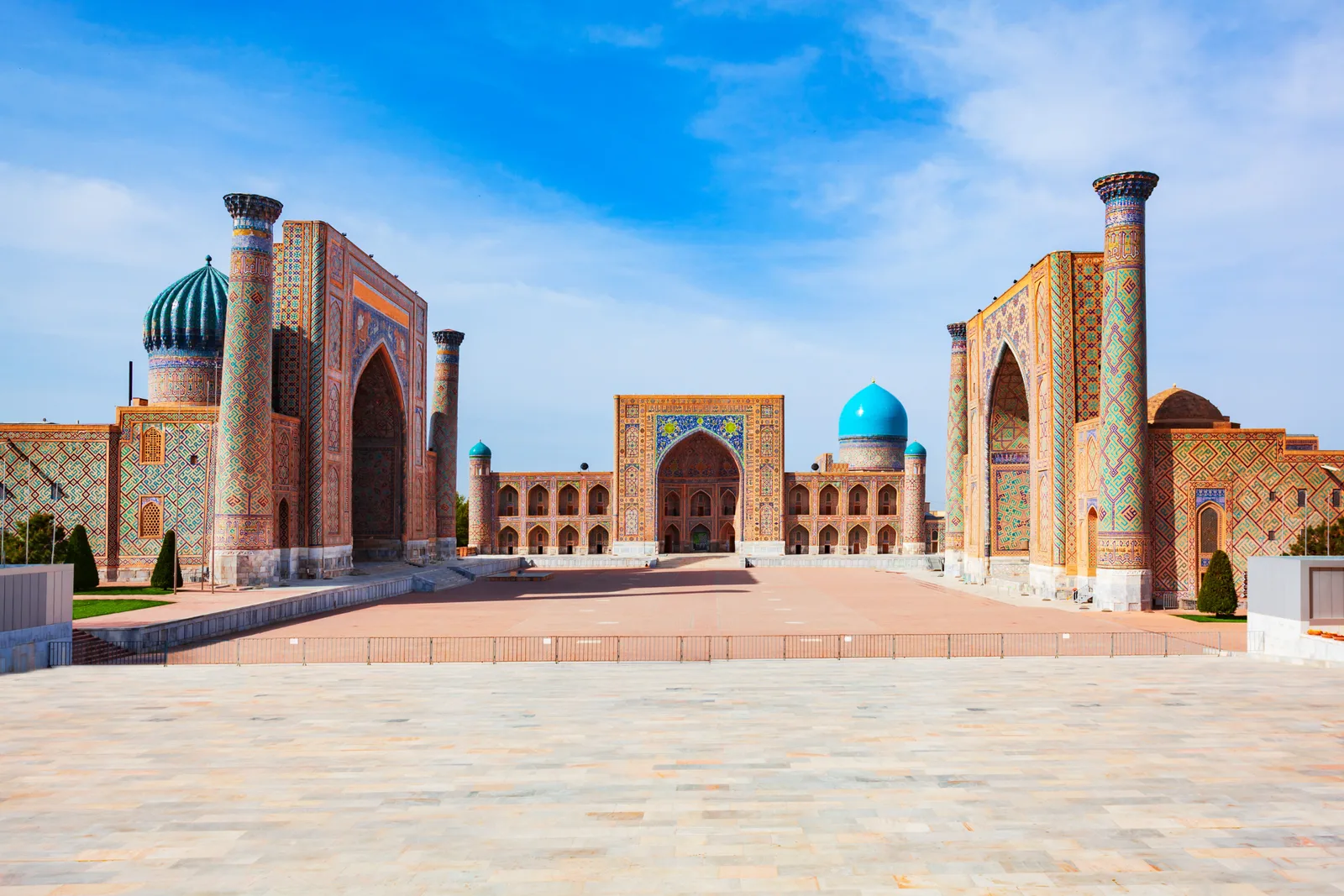
The image everyone knows of Samarkand — the cobalt blue of the Registan illuminated at dusk — is real. What the photographs do not show is the number of conditions that must align to capture it well: the exact window between the sun disappearing below the horizon and the artificial lighting switching on, the position from which all three portals align without a tourist bus blocking the foreground, the exposure time that keeps the sky coloured without blowing out the lit tiles.
Photographing Uzbekistan requires less equipment than it seems and more planning than most assume. What makes this country photogenic is not an abundance of obvious subjects — though those exist — but the specific quality of light on certain materials at certain moments.
Light and tiles
The Timurid tiles are Uzbekistan’s most complicated and most rewarding photographic subject. The problem is that cobalt blue and turquoise tend to oversaturate under direct midday sun, producing images that lose the surface detail and mosaic texture. The solution is the same as for any architectural photographer: the early morning light or the hour before sunset, when the sun enters obliquely and reveals the texture of each tile piece.
Shah-i-Zinda in Samarkand is the best example: in the early morning, when light enters laterally between the aligned mausoleums, the fourteenth-century mosaics show a depth and contrast that by noon have disappeared entirely. The difference between seven in the morning and eleven is not a matter of aesthetic preference: it is the difference between a photograph that shows what the craftsmen made and one that does not.
The Registan at night has its own character: artificial lighting emphasises the volumes of the portal and domes in a way that daytime light, more democratic, does not produce. The best night photographs of the Registan are made on a tripod in the minutes immediately after sunset, when the sky still holds a deep blue that balances the artificial illumination of the buildings.
Bazaars and portraits
Tashkent’s Chorsu offers one of the richest photographic opportunities in Central Asia. The dome’s exterior — with its pale blue tile covering against the sky — has a geometry that works in any light condition. The interior, with skylight columns falling on mountains of spices, is a scene that requires patience more than technique: the best images come when the market’s activity creates compositions that no photographer could deliberately organise.
Portraits in Uzbekistan are, for many photographers, the most satisfying part of the journey. Uzbeks have, in general, a positive attitude toward photography: if permission is requested respectfully — a gesture, a smile, pointing at the camera and the person — an affirmative response is frequent, especially with older people. Bazaar vendors, the potters in Rishtan workshops, women with suzani embroideries in craft markets: all are subjects who accept the camera with a naturalness not found everywhere.
Tashkent’s metro stations
The metro stations are one of Uzbekistan’s most underrated photographic visits. Kosmonavtlar station has Soviet astronaut mosaics of a size and quality found in no museum; Alisher Navoi has carved wooden panels that receive lateral light that practically composes the shots by itself. The problem is that during rush hour the stations are crowded and the flow of people complicates framing. The solution is to go mid-morning or mid-afternoon, when passenger flow is minimal.
Photography inside the stations is technically permitted for personal use, though some guards interpret this more strictly than others. The best approach is to photograph discreetly and without flash — which would in any case ruin images lit by the indirect lighting these stations use.
The craftspeople
The ceramics workshops in Rishtan (Fergana Valley) and the silk workshops in Margilan are the most accessible for photographing the craft process. Most workshops are accustomed to receiving visitors and allow photography without particular restrictions. The hand-thrown wheel, the application of glazes, the wood-fired kiln: the process has a natural photographic sequence that works well with available light.
The ikat silk fabrics of Margilan — with their colours that shift according to the angle of light, the result of dyeing the threads before weaving — are one of the most photographically demanding subjects in the country: they need diffused, not direct, light for the colour graduation to be visible without the silk’s sheen overexposing.
Equipment and permits
A wide-angle lens for architecture and a medium focal length for portraits and details are enough to cover ninety percent of Uzbekistan’s photographic situations. Fast lenses (f/1.8 or similar) are useful for the dark interiors of mausoleums and metro stations without needing very high ISO.
Museums typically charge an additional photography fee, usually between five and ten dollars. At the Registan and Shah-i-Zinda, access to rooftops or the interiors of some madrasas for photography also carries an additional charge that is worth paying if you are looking for angles different from the standard framing.
The complete Far Guides Uzbekistan guide includes detailed Silk Road routes, interactive maps and all the practical information you need to plan your independent trip.
More on Uzbekistan
Keep reading.
Other pieces from the same destination.


Next step
Ready for Uzbekistan?
The guide is for travelling.
Offline maps, itineraries and everything that doesn't fit in an article.
Get the Uzbekistan guide