
Uzbekistan · 8 May 2026
The Fergana Valley: Uzbekistan's best-kept secret
A guide to the Fergana Valley — the cradle of Central Asian culture that most travellers skip. Silk workshops, ceramic traditions, and a pace of life the Silk Road cities have lost.

The standard Uzbekistan itinerary — Tashkent, Samarkand, Bukhara, Khiva — is a magnificent route through some of the most important monuments in the Islamic world. But it misses something. It misses the Fergana Valley, a crescent of fertile land between mountain ranges in eastern Uzbekistan that is, in many ways, the cultural engine of the country: the place where silk is still woven by hand, where ceramics have been produced continuously for centuries, and where daily life moves at a pace that the restored, tourist-oriented Silk Road cities have largely lost.
The Fergana Valley is not unknown. Uzbeks consider it the heartland of their culture. But foreign visitors rarely go, partly because it requires a detour from the main route and partly because it lacks the monumental architecture that draws travellers to Samarkand or Bukhara. What it has instead is something equally valuable: living traditions, unpolished authenticity, and the feeling of being somewhere that has not yet learned to perform for an audience.
The geography
The Fergana Valley is a vast, flat basin — roughly three hundred kilometres long and seventy wide — enclosed by the Tian Shan mountains to the north and east and the Pamir-Alay range to the south. It is the most densely populated region of Central Asia, shared between Uzbekistan, Kyrgyzstan and Tajikistan in a border arrangement so complex that it includes several enclaves and generates periodic tensions.
The Uzbek portion contains the main cities: Fergana, Kokand, Margilan, Andijan and Namangan. For the traveller, Margilan and Kokand are the essential stops, with Fergana serving as a comfortable base.
The valley is reached from Tashkent by train (three to four hours via the new tunnel through the Kamchik Pass) or by shared taxi (similar time). The journey itself is worth the trip: the road climbs through dramatic mountain scenery, passes through the pass at over two thousand metres, and descends into the valley’s lush farmland — cotton, fruit orchards, vineyards, rice paddies. After the arid landscapes of western Uzbekistan, the Fergana Valley is startlingly green.
Margilan: the silk capital
Margilan is the reason to come to the Fergana Valley. This city of two hundred thousand people has been producing silk for at least two thousand years — it was a major station on the Silk Road and the source of some of the finest fabrics traded across Eurasia.
What makes Margilan exceptional is not that it has a silk history. Many places have silk histories. What makes it exceptional is that the silk production continues, using methods that have changed remarkably little over the centuries.
The Yodgorlik Silk Factory: This is not a museum but a working workshop where every stage of silk production can be observed. The process begins with boiling cocoons to extract the raw thread — a single cocoon yields up to a kilometre of continuous filament. The threads are wound, dyed using natural pigments (pomegranate skin for yellow, indigo for blue, walnut hulls for brown), and woven on hand looms into the ikat fabrics that are Uzbekistan’s signature textile.
Ikat — known locally as atlas or adras — is made using a resist-dyeing technique where the warp threads are tie-dyed before weaving. The result is a fabric with characteristic blurred, feathered patterns in vivid colours. The technique requires extraordinary skill: the dyer must calculate how the patterns will shift during weaving and compensate in advance. Watching an experienced dyer at work is watching someone solve a three-dimensional puzzle with thread and pigment.
The Kumtepa Bazaar: Every Thursday and Sunday, Margilan hosts one of the largest and most authentic bazaars in Uzbekistan. This is not a tourist market. It is where the people of the Fergana Valley buy their clothes, food, tools and household goods. The textile section is enormous: stall after stall of ikat fabric, embroidered suzani, cotton prints and silks in every colour and quality. Prices are a fraction of what you would pay in Bukhara or Samarkand.
The bazaar is also the best place to eat in Margilan. Plov cooked in vast cauldrons, freshly baked samsa, grilled kebabs, seasonal fruit. The atmosphere is convivial, loud and completely unperformed. You are not a tourist attraction here; you are a customer.
Kokand: the palace and the mosques
Kokand, forty kilometres west of Fergana, was the capital of the Kokand Khanate, the last independent Central Asian state to fall to Russian conquest (1876). Its most visible legacy is the Khudayar Khan Palace, built in 1871 — just five years before the conquest — and now a museum.
The palace is extravagant by Central Asian standards: a long facade of patterned tilework with nineteen turrets, and an interior of courtyard gardens and painted reception rooms that attempt to rival the great buildings of Samarkand and Bukhara. The attempt does not quite succeed — Kokand was wealthy but provincial, and the craftsmanship, while impressive, lacks the refinement of Timurid Samarkand. But that slight roughness is part of the charm. The palace feels human-scaled, personal, like the home of a ruler who wanted beauty and did his best to get it.
Kokand’s mosques are worth seeing. The Jami Mosque (1812) has a wooden ceiling supported by 98 carved columns, each one different, arranged in a vast prayer hall that recalls the forest mosques of early Islamic architecture. The Narbuta-biy Madrasa, near the bazaar, has a serene courtyard that offers relief from the summer heat.
Rishtan: the ceramic village
Thirty kilometres west of Fergana, the small town of Rishtan has been producing ceramics for over a thousand years. The distinctive Rishtan style — cobalt blue, turquoise and green on a white ground, with floral and geometric motifs — is recognisable across Central Asia and has been traded along the Silk Road since the medieval period.
Several master ceramicists in Rishtan open their workshops to visitors. The most renowned is the workshop of Rustam Usmanov, where three generations of the family produce pottery using techniques passed down since the fifteenth century. The clay is local, the glazes are made from ground stone and mineral pigments, and the painting is done freehand with a speed and precision that makes the process look effortless. It is not.
Buying ceramics directly from the workshop costs a fraction of the price in Tashkent or abroad. A hand-painted plate that would sell for thirty euros in a Samarkand tourist shop costs five to eight euros at the source. The quality is identical — or better, since you can select pieces that the master has not delegated to apprentices.
The pace of the valley
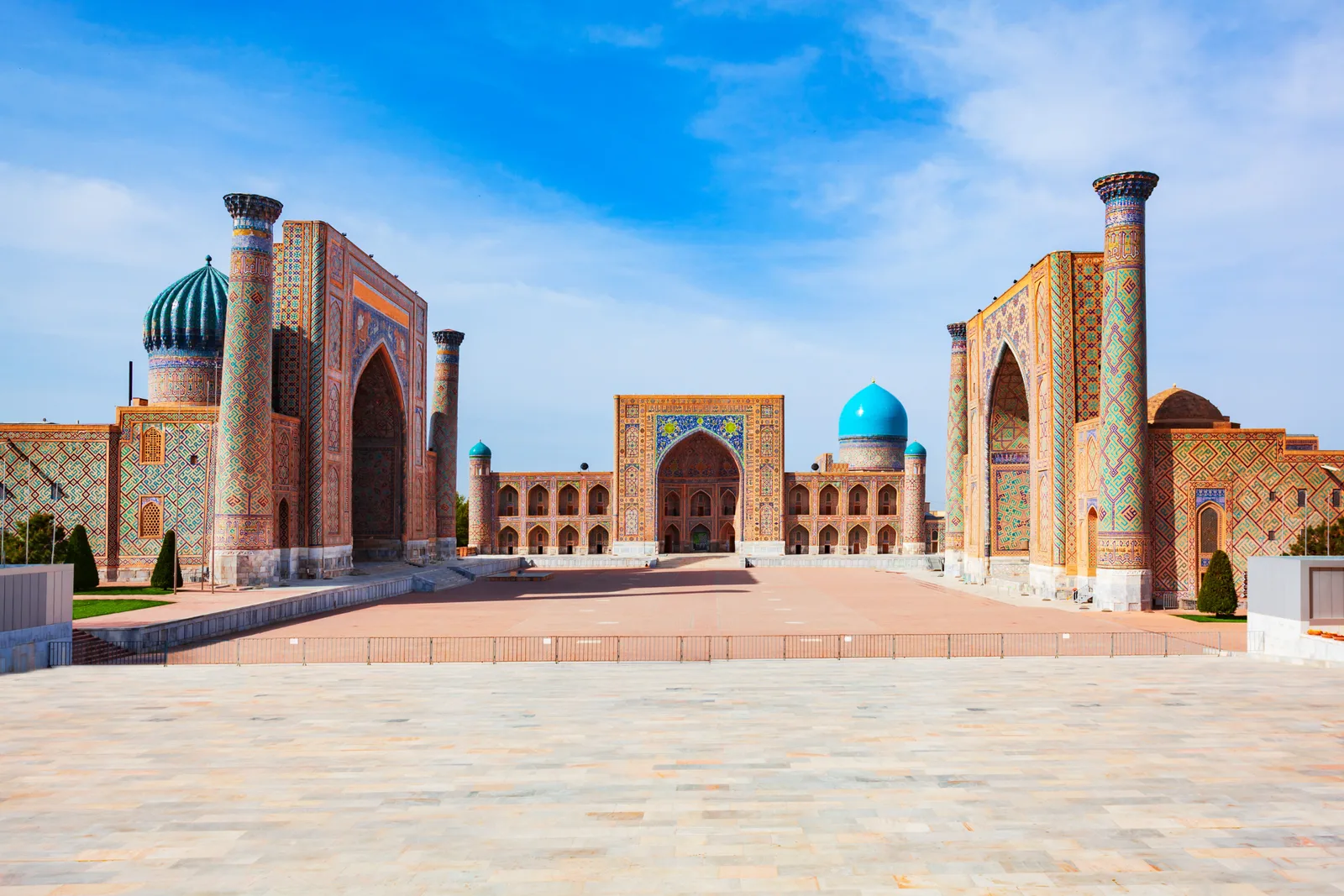
What distinguishes the Fergana Valley from Uzbekistan’s main tourist cities is not any single attraction but the cumulative effect of a region that has not been curated for visitors. In Samarkand, the Registan is floodlit and the surrounding streets have been tidied. In Bukhara, the old city has been restored with tourist-friendly cafes and boutique hotels. These are not criticisms — both cities are extraordinary. But they have acquired a polish that the Fergana Valley has not.
In Margilan, you walk through streets where families sit in their courtyards behind open doors, where chai houses are full of old men playing chess, where children stare at you with frank curiosity because foreigners are still unusual. In Kokand, the bazaar operates with no awareness of tourism. In Rishtan, the ceramic workshops are not visitor centres but working studios that happen to welcome guests.
This is what travel used to feel like before the internet optimised every destination into a curated experience. The Fergana Valley will probably change — it is already beginning to, with new guesthouses and tour operators appearing — but in 2026, it remains one of those places where the gap between the guidebook and reality is smallest, because the guidebook barely mentions it.
Practical information
Getting there: Train from Tashkent to Fergana (3-4 hours), or shared taxi. The train is comfortable and scenic.
Accommodation: Limited but adequate. Fergana has a few decent hotels (15-30 EUR for a double). Guesthouses in Margilan are appearing. Do not expect boutique standards.
Getting around: Shared taxis between valley cities cost 1-3 EUR. Hire a private car and driver for a day (30-50 EUR) for maximum flexibility.
How long: Two days minimum (Margilan + Kokand). Three days allows Rishtan and a slower pace. Four days if you want to explore Andijan or cross into the valley’s Kyrgyz sections.
Best time: Spring (April-May) and autumn (September-October). Summer is hot — 35-40°C — but tolerable if you pace yourself. The Thursday/Sunday bazaar in Margilan should anchor your schedule.
Language: Almost no English is spoken. Russian helps. The Google Translate app with the Uzbek offline pack is essential. The communication barrier is real but not insurmountable — hospitality transcends language, and Fergana Valley hospitality is extraordinary.
The Fergana Valley does not compete with Samarkand for visual drama or with Bukhara for architectural refinement. It offers something different and, for a certain kind of traveller, something better: the texture of a living culture, witnessed rather than performed.
For the full picture of every city, route and hidden corner in Uzbekistan, the Far Guides complete guide has it all: interactive maps & itineraries, information that stays up to date.
More on Uzbekistan
Keep reading.
Other pieces from the same destination.


Next step
Ready for Uzbekistan?
The guide is for travelling.
Interactive maps & itineraries and everything that doesn't fit in an article. Always the latest published version.
Get the Uzbekistan guide