
Uzbekistan · 28 April 2026
Bukhara or Khiva: which to visit first
Two Silk Road jewels with very different personalities. We compare Bukhara and Khiva so you can choose — or decide to visit both.
The question always comes up at some point when planning a trip to Uzbekistan. Samarkand is beyond discussion — everyone goes to Samarkand. Tashkent, as the capital and gateway, likewise. But then comes the decision: Bukhara or Khiva? Both? In what order? Is the detour to Khiva, which lies far from everything, actually worth it?
The short answer is yes, it is worth visiting both. They are radically different experiences. But if time or budget forces a choice, it helps to understand what each one offers. Not just what monuments they have, but what kind of city they are, what feeling they leave behind, what they reveal about the history of this part of the world.
Bukhara: the city that is still alive
For centuries, Bukhara was one of the most important cities in the Islamic world. That is not an exaggeration. Between the ninth and tenth centuries, under the Samanid dynasty, it was a centre of knowledge comparable to Baghdad or Cordoba. Avicenna was born here. Al-Bukhari, the most respected compiler of hadith in Sunni Islam, carries the city in his name. The madrasas of Bukhara trained generations of theologians, jurists and scientists for half a millennium.
That history is palpable when you walk through the city. Not because it has been turned into a museum — quite the opposite. What makes Bukhara special is that its historic centre still functions as a real city. People live in the old houses. The covered bazaars — Tok-i Zargaron (jewellers), Tok-i Tilpak Furushon (hatmakers), Tok-i Sarrafon (moneychangers) — no longer sell exactly what they did in the sixteenth century, but they remain active markets. The alleyways behind the main madrasas are not tourist routes: they are neighbourhoods where children play football and laundry is hung between brick walls.
The emotional centre of Bukhara is Lyabi-Hauz, a square built around a seventeenth-century pool. It is not a spectacular monument. It is something better: a place where the life of the city concentrates. Old men play chess beneath centuries-old mulberry trees. Waiters from the restaurants surrounding the pool set tables out at dusk. There is a madrasa on one side, a khanaka (Sufi hospice) on the other, and between them that rare feeling of being in a place that works exactly as it did three hundred years ago.
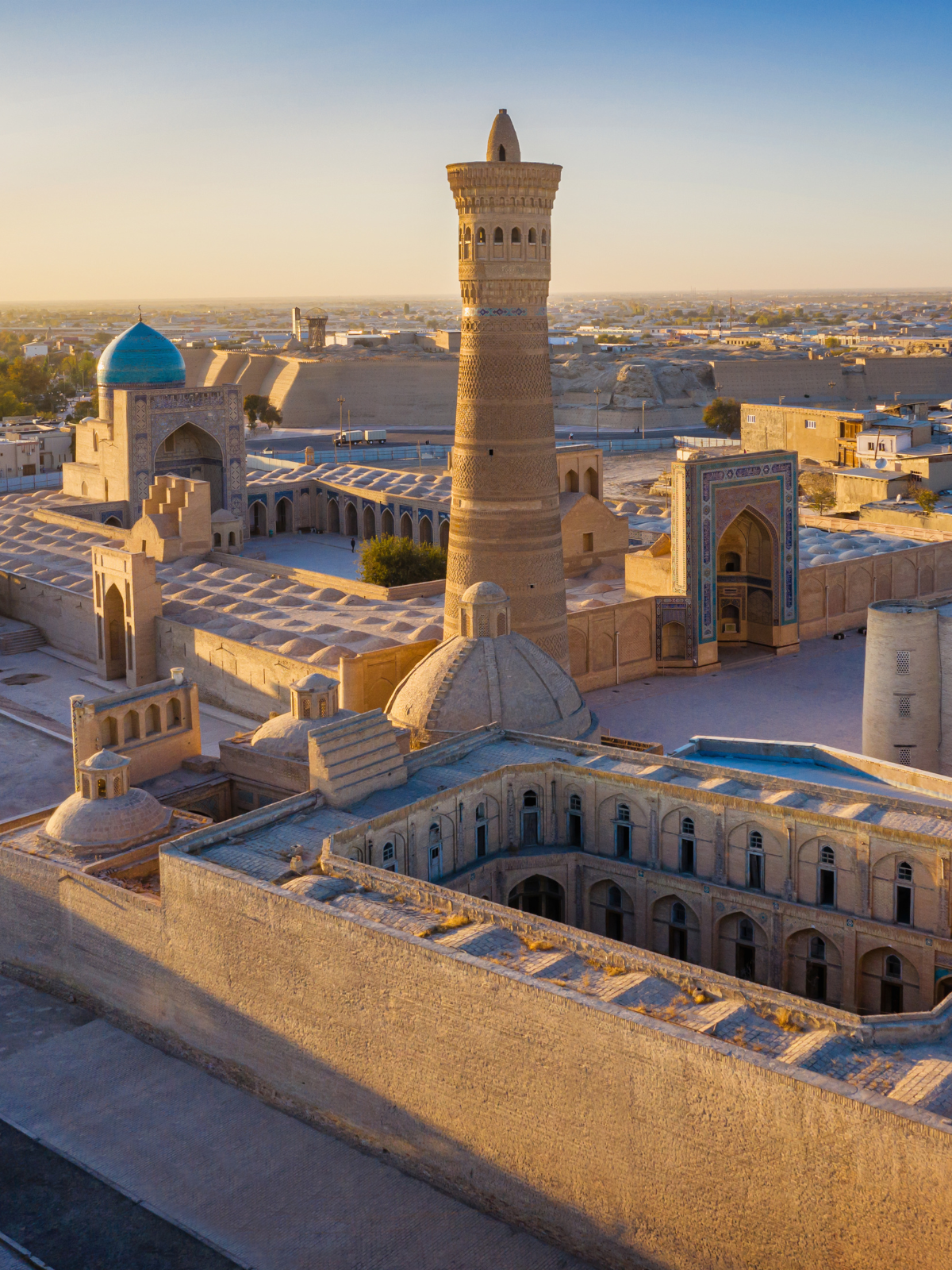
And then there is the Kalon Minaret. Forty-seven metres of fired brick, built in 1127, visible from anywhere in the old city. Legend has it that when Genghis Khan reached Bukhara in 1220, he razed the city but ordered the minaret to be spared. Whether or not it is true, the story says something real about the building: it is so imposing that even someone who came to destroy paused to look at it.
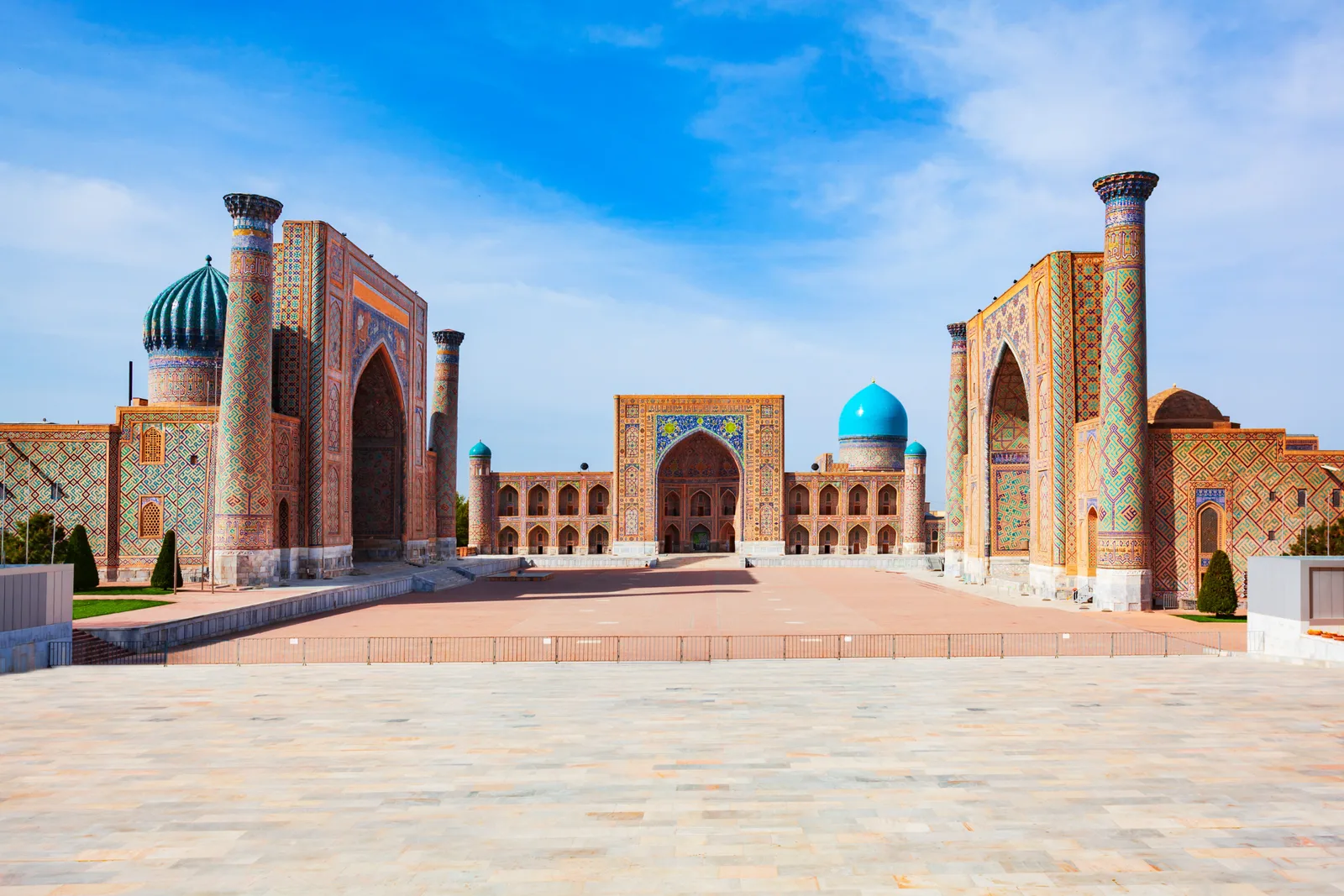
The Kalon Mosque, adjoining the minaret, and the Mir-i Arab Madrasa, facing it, form an ensemble that rivals the Registan of Samarkand in scale and beauty. But with a crucial difference: here there are no fences, no ticket booths at the entrance, none of that tourist-attraction atmosphere that the Registan, through its own fame, can no longer avoid. You can sit on the steps of the Kalon Mosque at seven in the evening, when the light is golden and the square is nearly empty, and feel as though the city belongs to you for a moment.
Bukhara is best explored on foot, without a map, getting lost. It is a city for aimless wandering through the Jewish quarter — yes, Bukhara had a significant Jewish community for centuries, and their houses with interior courtyards are among the most beautiful in the city — for entering the Ark fortress at dawn, when there is still nobody around, and for sitting in a chaikhana (teahouse) at three in the afternoon, when the heat presses down and the entire city seems to stop.
In short, it is a living city that happens to have monuments. Not a collection of monuments pretending to be a city.
Khiva: the city frozen in time
Khiva is something else entirely. Completely different. And understanding that difference is the key to enjoying both.
Ichan Kala — the inner city, the part within the mud walls — is the best-preserved historic centre in Central Asia. It has been a UNESCO World Heritage Site since 1990, and when you enter through the western gate, Ata Darvoza, you immediately understand why. It is a walled rectangle of six hundred metres by four hundred, containing more than fifty historic monuments within its walls. Madrasas, mosques, minarets, palaces: all within a space you can cross on foot in fifteen minutes.
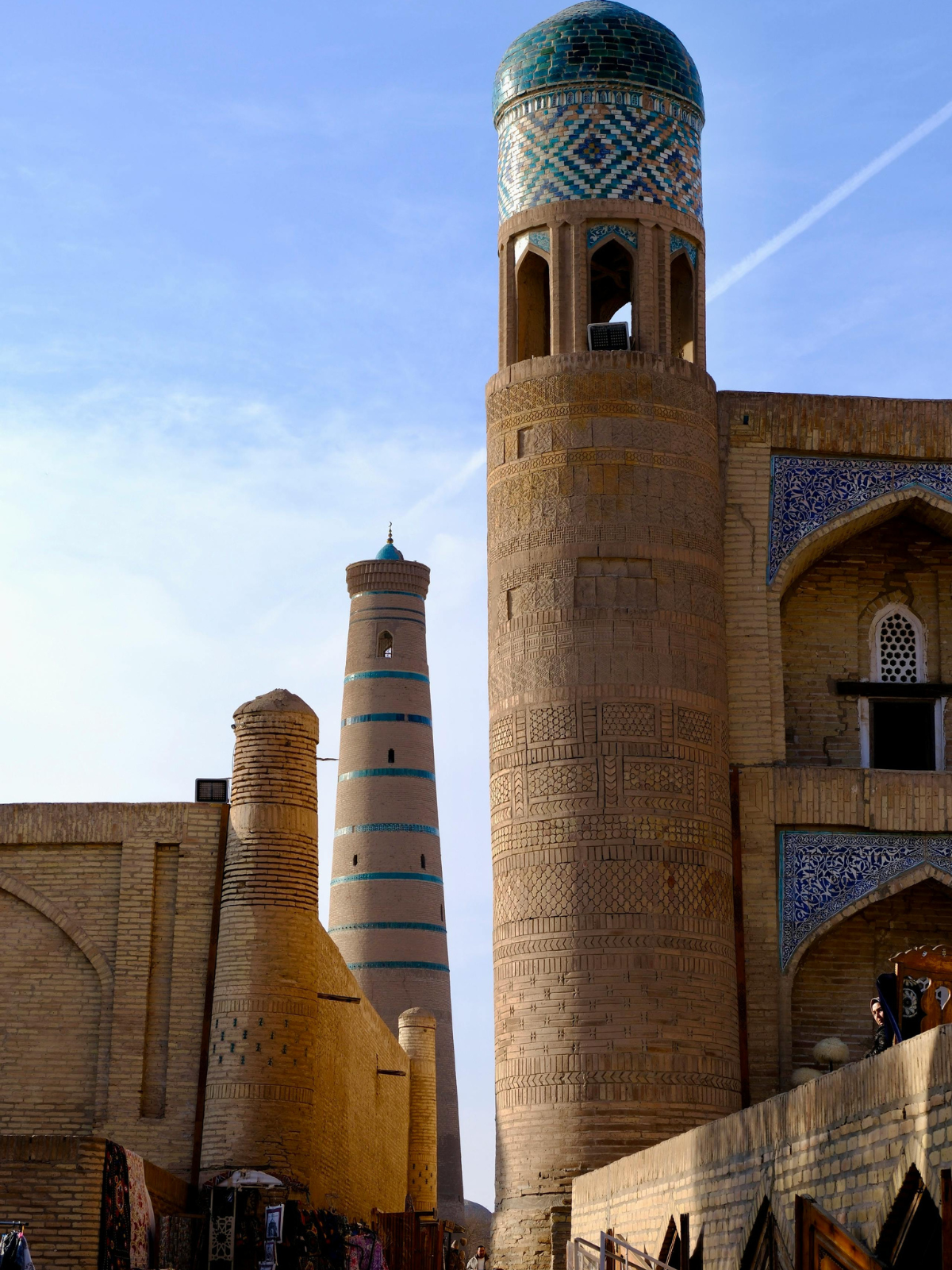
The density is astonishing. And so is the visual coherence: everything is mud-brick and fired brick, with the turquoise and green tiles that characterise the architecture of Khorezm, the historic region of which Khiva was the capital. The Kalta Minor — the fat, unfinished minaret covered in turquoise tiles — is probably the most photographed image in Uzbekistan after the Registan. It was commissioned by Muhammad Amin Khan in 1851 with the ambition of becoming the tallest minaret in the Islamic world. The khan died before it was finished, and there it stayed: a magnificent stump of twenty-six metres that was meant to be seventy.
The Tash-Hauli Palace, with its interior courtyards decorated in majolica and carved wooden ceilings, is arguably the most beautiful civic building in all of Uzbekistan. The Juma Mosque, with its 213 carved wooden columns — some dating to the tenth century — has an atmosphere unlike anything you will have seen before. Islam-Khodja, the tallest minaret in Khiva, offers from its summit a view of the walled city that justifies the steep climb.
But Khiva has a problem that Bukhara does not. Or perhaps it is not a problem so much as a characteristic you need to accept: within the walls, real life has largely disappeared. Ichan Kala is, to a great extent, a city-museum. Houses have been converted into craft workshops, souvenir shops and small hotels. The original residents have gradually moved outside the walls, where life is more comfortable and cheaper. What remains inside is beautiful, impeccably preserved, extraordinarily photogenic — but it has something of the stage set about it.
That does not mean it is not worth visiting. It means you need to adjust your expectations. Khiva will not give you the experience of getting lost in a living city. It will give you something else: the feeling of entering a place where time has been deliberately stopped. Where every corner is a perfect composition of mud, tile and sky. Where you can climb the walls at sunset and see the entire city bathed in a light that seems designed for photography.
Khiva was the last khanate of Central Asia. Until 1920, when the Red Army abolished it, it was an independent state with its own khan, its own army and its own currency. That history of late independence — of resistance, if you will — hangs in the air. It is a city that kept itself apart from the world longer than almost any other in the region. And you can feel it: there is something insular, contained, almost hermetic about Ichan Kala.
Two personalities, two rhythms
The fundamental difference between the two cities is not one of monuments — both have magnificent ones — but of rhythm and relationship with the present.
Bukhara is a city that folded its heritage into everyday life. You experience the past without leaving the present. The monuments are there, impressive, but surrounded by life: by the noise of the bazaar, the smell of bread, the children coming home from school. The experience is immersive in an organic, unplanned way.
Khiva is a city that preserved its heritage by separating it from everyday life. It is an open-air museum, with all the good and the limiting that implies. The experience is more visual, more contemplative, more silent. Also more controlled.
If you like to feel that a place envelops you, that you can become part of it even if only for a few days, Bukhara is your city. If you like to observe, photograph, move through a space where every element is in its place, Khiva will fascinate you.
The practical question: order and transport
Geographically, the most logical route through Uzbekistan runs east to west: Tashkent, Samarkand, Bukhara, Khiva. Or the reverse, west to east. Either way, Bukhara and Khiva are usually visited in sequence, not as alternatives.
The Afrosiyob high-speed train connects Tashkent with Samarkand in two hours and Samarkand with Bukhara in an hour and a half. It is comfortable, punctual and cheap (between 8 and 15 euros depending on the class). From Bukhara to Khiva, things change: there is no direct fast train, and the distance is around 450 kilometres by road. The options are the overnight train (departs Bukhara in the evening, arrives in Urgench — the modern city next to Khiva — in the morning), a shared taxi (roughly six hours, negotiable) or a flight (Uzbekistan Airways operates the route, under an hour).
The overnight train is the option with the most character. The carriages are Soviet-era, with four-berth compartments and clean sheets handed to you by the provodnitsa (the carriage attendant). It is not luxurious, but it works. And there is something unrepeatable about falling asleep to the rattle of the train and waking up in the Karakum desert, with the first cotton fields appearing through the window.
How much time to spend on each
For Bukhara, a minimum of two nights and a full day and a half. Ideally three nights: one day for the historic centre (Lyabi-Hauz, Kalon, Ark), another for the outskirts (the Samanid Mausoleum, the Sitora-i Mohi Khosa Palace, the bazaars) and a morning simply to be — to sit, to wander without a plan, to return to that corner you liked.
For Khiva, one night and a full day usually suffice. Ichan Kala can be covered in a long day. But if you enjoy photography, stay two nights: the light at dawn and at dusk transforms the city, and you will want to see it at both moments.
The honest answer
If you can only visit one of the two, go to Bukhara. It is the more complete, richer, harder-to-find-anywhere-else experience. A living city with a thousand years of visible history is something extraordinarily rare.
But if you can visit both — and on a ten-day trip to Uzbekistan, you can — do not hesitate. They are not cities that compete with each other. They are cities that complement each other. Bukhara shows you how history can coexist with the present. Khiva shows you how history can be preserved intact when it is protected from time.
Both things are valuable. And together, they tell a story about Uzbekistan that you could not understand by visiting just one of them.
For the full picture of every city, route and hidden corner in Uzbekistan, the Far Guides complete guide has it all: interactive maps & itineraries, information that stays up to date.
More on Uzbekistan
Keep reading.
Other pieces from the same destination.

Next step
Ready for Uzbekistan?
The guide is for travelling.
Interactive maps & itineraries and everything that doesn't fit in an article. Always the latest published version.
Get the Uzbekistan guide