
Uzbekistan · 31 July 2026
Uzbekistan in two weeks: the definitive itinerary
The route that lets you see Uzbekistan's essentials without rushing: Tashkent, Samarkand, Shakhrisabz, Bukhara, Nurata and Khiva in 14 well-used days.

Two weeks are enough for Uzbekistan if the time is used well, and almost insufficient if you try to see everything. The most common mistake of first-time visitors is to overload the itinerary: adding the Fergana Valley, the Aral Sea and the south to the classic circuit in the same trip. The result is a succession of transfers that leaves no time to actually be anywhere. What follows is a route that prioritises depth over quantity: four main destinations with real time to understand each one.
Days 1 and 2: Tashkent, the capital that surprises
Most travellers treat Tashkent as a compulsory stopover before the “real” destinations: Samarkand, Bukhara, Khiva. That mistake of perception causes them to pass through a city that has more to offer than its reputation suggests.
Tashkent was destroyed by an earthquake in 1966 and rebuilt at record speed as a showcase of Soviet urbanism. What remained is a city of wide boulevards, monolithic apartment blocks and a metro network that is, in itself, one of the most ambitious artistic projects in the Soviet world: each station has a different decorative theme, with mosaics, reliefs and frescoes ranging from kitsch orientalism to genuinely beautiful Constructivism. The stations of Kosmonavtlar (with its mosaic astronauts), Alisher Navoi (with its carved wooden panels) and Mustaqillik Maydoni are essential visits that appear in no monument listings but define the experience of the city.
The old quarter — Eski Shahar — partially survived the earthquake. The Hazrat Imam complex holds the oldest known Quran, the seventh-century Caliph Uthman manuscript, stained according to tradition with his own blood. The Chorsu bazaar, with its blue dome, sits at the edge of this neighbourhood.
Days 3, 4 and 5: Samarkand, the layer beneath the layer
The Afrosiyob train leaves Tashkent every morning and reaches Samarkand in two hours. Three nights in the city is the reasonable minimum to see what matters without rushing.
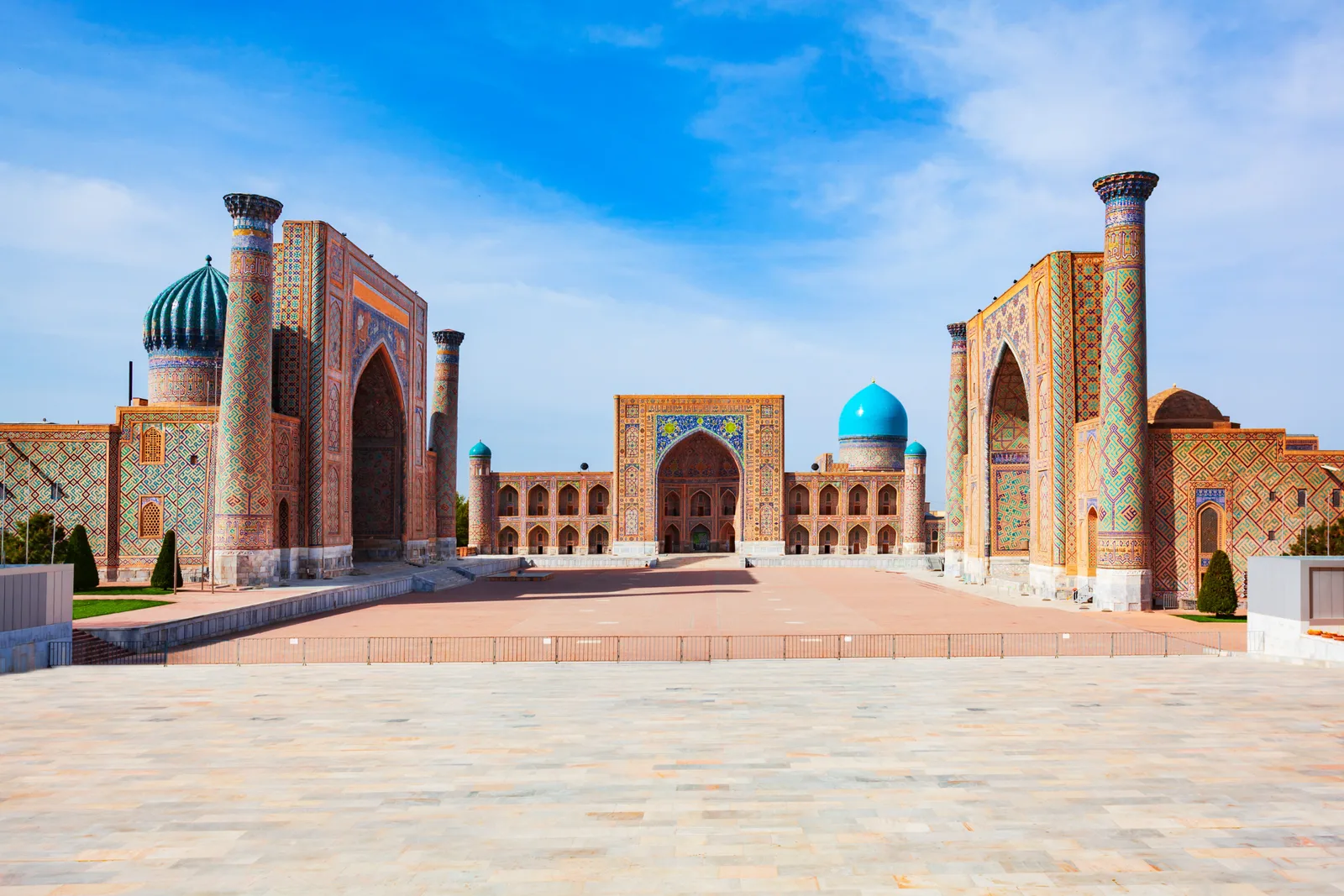
The first day for the Registan — and not in twenty minutes: the Registan needs time to be absorbed, an early morning and a sunset. The second day for Shah-i-Zinda (before eight in the morning, before the groups arrive), Bibi-Khanym and the Siab bazaar. The third day for Afrasiab and its museum of Sogdian frescoes — the layer of history beneath the Timurid history that most travellers skip — and Ulugbek’s observatory if the weather cooperates.
Day 6: Shakhrisabz, Tamerlane’s birthplace
Eighty kilometres south of Samarkand, along a road that crosses a mountain pass with spectacular views over the Kashkadarya plains, lies Shakhrisabz: Tamerlane’s hometown. The Ak-Saray arch — what remains of the entrance to the largest palace Tamerlane built, forty metres high — is one of those monuments that appears in few photographs but which, seen in person, produces an effect of scale that the Registan, for all its perfection, does not always achieve.
The excursion works as a day trip from Samarkand: taxi or minibus there, visiting the Ak-Saray and the Dorus-Saodat complex (Tamerlane’s family mausoleums), return in the afternoon. It is a long day but worth it.
Days 7, 8 and 9: Bukhara, the most alive
Bukhara is reached from Samarkand on the Afrosiyob in under an hour. Three nights — or four if time allows — are appropriate for a city that is, unlike Khiva, genuinely alive: the historic medina has restaurants, cafés, shops and residents mixed with the monuments in a way that does not exist in Khiva.
The essential monuments: the Kalyan minaret (the one that Genghis Khan reportedly spared because it was so beautiful it made him bow his head, according to legend), the Ark fortress (seat of the emirate’s power for centuries, with its clay walls), the Ismail Samani mausoleum (Uzbekistan’s oldest standing building, ninth century, with brick decoration that anticipated everything that followed), and the Lyabi-Hauz (the central pool surrounded by plane trees that is the social heart of the old city). The sixteenth-century domed covered markets — the toqi — are the visit that fewest people make but that says most about the Silk Road’s commercial history.
Day 10: transition through the desert
The transit day between Bukhara and Khiva can be managed in two ways: a direct flight to Urgench (forty minutes from Bukhara, though not available every day) or by private car via Nurata and the Kyzylkum. This second option — which adds a day but makes the journey genuinely different — allows a stop at the Nurata oasis, a continuation into the desert, and a night at a yurt camp before arriving in Khiva the following day.
Days 11, 12 and 13: Khiva, the museum that breathes
Khiva deserves two full days inside Ichan Kala plus part of a third. The first day: arrive and walk the walled precinct without an agenda, allowing yourself to be surprised by the scale and coherence of the ensemble. The second day: visit the main monuments — Kalta Minor, Islam Khoja, Tash-Hauli — with enough time to understand each one. The morning of the third day, before the groups arrive, is the moment for photographs and silence.
Day 14: the return
Urgench airport connects to Tashkent in an hour (Uzbekistan Airways operates several daily flights). From Tashkent, direct flights to several European cities. The logic of closing the loop through Urgench rather than returning by train avoids twelve hours on the overnight service and leaves the final Tashkent evening free for dinner and the metro.
The itinerary described here is deliberately conservative in the number of destinations and generous with time at each place. That is not a limitation: it is the most honest way to travel through a country that has too many layers to be seen at speed.
The complete Far Guides Uzbekistan guide includes detailed Silk Road routes, interactive maps and all the practical information you need to plan your independent trip.
More on Uzbekistan
Keep reading.
Other pieces from the same destination.


Next step
Ready for Uzbekistan?
The guide is for travelling.
Offline maps, itineraries and everything that doesn't fit in an article.
Get the Uzbekistan guide