
Greece · 1 September 2026
Nafplio: the first capital Greece chose to forget
Nafplio was Greece's first capital from 1828 to 1834. Its first president was assassinated in its streets and the capital moved to Athens. The city simply carried on being what it was.

In the early morning of 27 September 1831, Ioannis Kapodistrias — the first governor of the modern Greek state, a brilliant diplomat who had been foreign minister of Tsarist Russia before becoming the leader of independent Greece — walked down from his residence in Nafplio to attend morning mass at the church of St Spyridon. On the steps of the church, two members of the Mavromichalis clan were waiting. One stabbed him; the other shot him. Kapodistrias died where he fell.
The first head of state of the first independent Greek state was assassinated in the streets of his capital by a family of notables who considered his authority excessive. This story captures something about the Greek state in its earliest years better than any other single episode: the difficulty of building modern institutions on tribal and clan structures that had survived centuries of Ottoman rule.
The city of three fortresses
Nafplio is physically defined by three military structures from three different eras, which today coexist in a way that is almost theatrical. The Bourtzi is the most photogenic: a circular Venetian fortress built in the fifteenth century on a rocky islet three hundred metres from shore. Accessible by small boat from the harbour, its perfect silhouette reflected in the calm water of the Argolic Gulf is Nafplio’s most reproduced image. It served as a prison in the nineteenth century and a hotel in the twentieth. Today it is in restoration with limited access.
Palamidi is the most dramatic fortress. It rises above the cliff that falls directly behind the city, 216 metres up. The Venetians built it between 1711 and 1714, in just two years — a speed that reflects the constant Ottoman threat. Their haste turned out to matter: the Ottomans took it in 1715, barely a year after completion. To reach the top there are two options: 999 steps cut in the rock (the exact count varies depending on who is counting; the ascent takes twenty to thirty minutes in reasonable shape) or the road circling the cliff. The views from the top take in the gulf, the city, the mountains of the interior, and on clear days, Mycenae on the plain.
The Acronauplia fortress — the headland directly above the old town — is the oldest: there are traces of occupation from pre-Hellenic times. Greeks, Romans, Byzantines and Venetians used and extended it successively. Today there is a luxury hotel on the upper section and some accessible walls from the streets of the centre below.
The neoclassical city of independence
The centre of Nafplio was built or remodelled during the period of Greek independence, when the city was the capital and received the attention and investment of the provisional government. The streets of the centre have a regularity and a neoclassical character recalling, in small scale, the European capitals of the early nineteenth century: Schinkel’s Berlin, the Athens that Bavarian architects were then planning. The architraves, the pediments above windows, the restrained colours of the facades: this is an architecture expressing the Greek desire to join the family of modern European nation-states.
Syntagma Square — Constitution Square, the same name as the main square in Athens — is the civic heart. The old Venetian barracks building, now the Archaeological Museum, has in its main room a collection of Mycenaean bronze armour comparable in quality to the National Museum in Athens. The cafés on the square and the tavernas on the adjacent streets are where Athenians who escape to Nafplio on weekends sit eating mezedes for hours.
The transfer to Athens and what remained
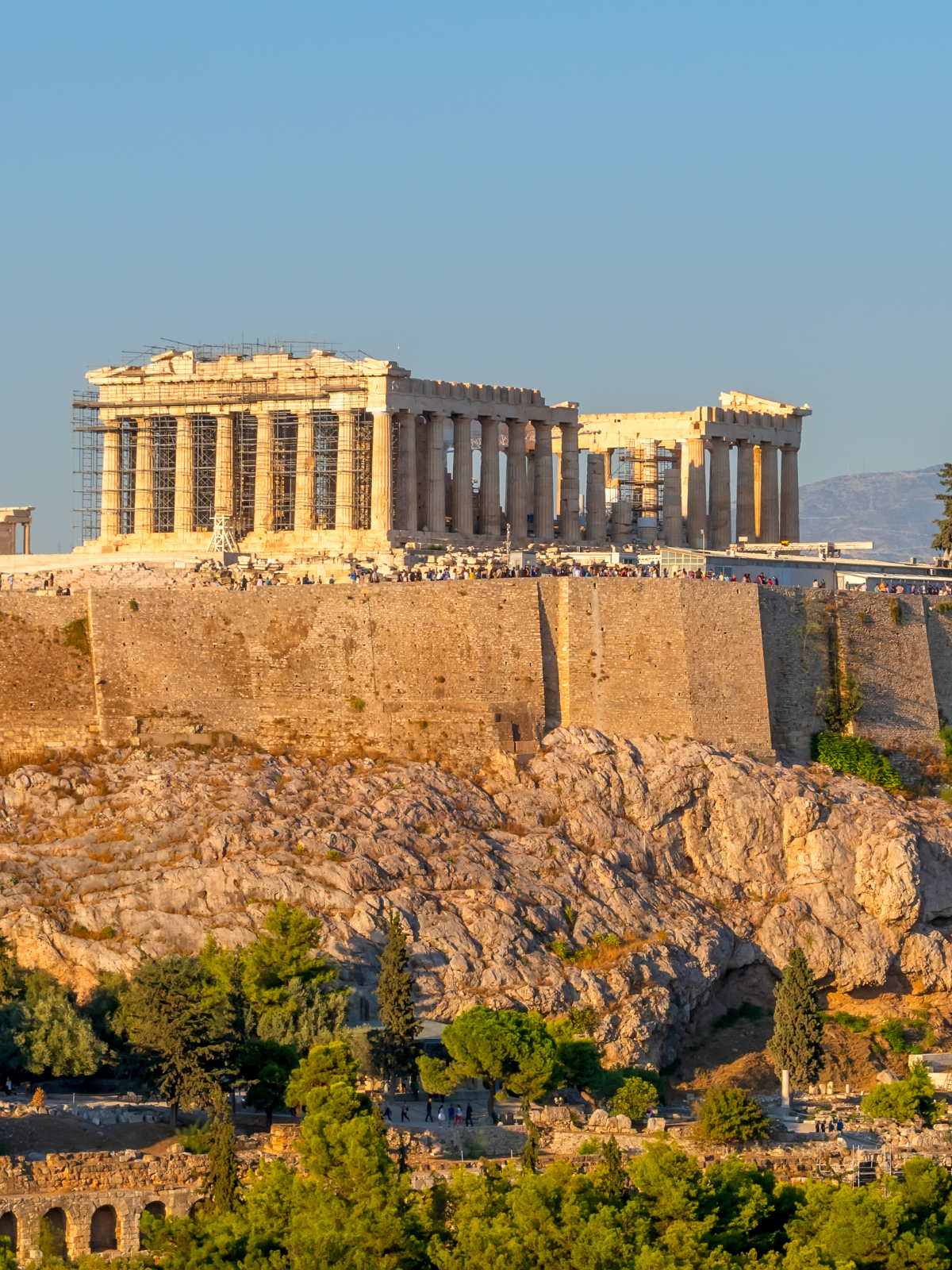
In 1834, King Otto I of Bavaria moved the capital from Nafplio to Athens. The decision was political and symbolic: Athens had six thousand inhabitants, worse infrastructure than Nafplio, and no logistical advantage whatsoever. What it had was the Acropolis. The new Greek state wanted to anchor its legitimacy in the classical inheritance, and that required the capital to be where the centre of that inheritance had been.
For Nafplio, the transfer was the moment it stopped growing in step with national politics. The city remained a regional port, an administrative centre for the Peloponnese, but without the pressure of being a capital it was preserved in its scale and character. What was a diminished destiny in the nineteenth century is precisely what makes it special in the twenty-first: a small, dense, perfectly conserved city, without the layers of chaotic growth that accompany cities that kept expanding.
Greeks know this. Nafplio is the favourite weekend escape of Athenians: two hours by car from the capital, good tavernas, Palamidi lit at night, the Bourtzi in the harbour. Hotels fill on Friday evening. On Tuesday morning the city belongs to the few independent travellers who have understood that the Peloponnese is not merely the road to the islands.
The church of St Spyridon — where Kapodistrias was assassinated — still has the bullet embedded in the wall of the porch. It is marked. It is, in its smallness, one of the most honest documents of what it meant to found a state.
The complete Far Guides Greece guide includes detailed routes across the mainland and islands, interactive maps and all the practical information you need to plan your independent trip.
More on Greece
Keep reading.
Other pieces from the same destination.


Next step
Ready for Greece?
The guide is for travelling.
Offline maps, itineraries and everything that doesn't fit in an article.
Get the Greece guide