
Greece · 7 April 2026
Athens in 3 days: beyond the Acropolis
Three days to understand Athens: the Acropolis yes, but also Exarchia, the Agora, Psyrri and a city that resembles no other in Europe.
Athens has a perception problem. Most travellers treat it as a formality: arrive, see the Acropolis, maybe stroll through Plaka, and head for the islands. It’s understandable. For decades, Athens was presented as a chaotic, noisy city, lacking the charm of Rome or the elegance of Paris. A capital that lived in the shadow of its classical past without having found a convincing modern identity.
That image is no longer true. Or rather: it was never entirely fair. Athens is a city layered like few others in the world. There are strata from the 5th century BC coexisting with Ottoman layers, neoclassical ones, post-war brutalist ones, and a contemporary effervescence that the 2010 crisis did not extinguish but, paradoxically, intensified. It’s a city where you can have breakfast looking at a temple from twenty-five centuries ago and dine in a neighbourhood that ten years ago was an empty lot and today is one of the most interesting creative hubs in the Mediterranean.
Three days are not enough for Athens. But they are enough to understand why it deserves far more than a formality.
Day 1: The Acropolis and the weight of the classical
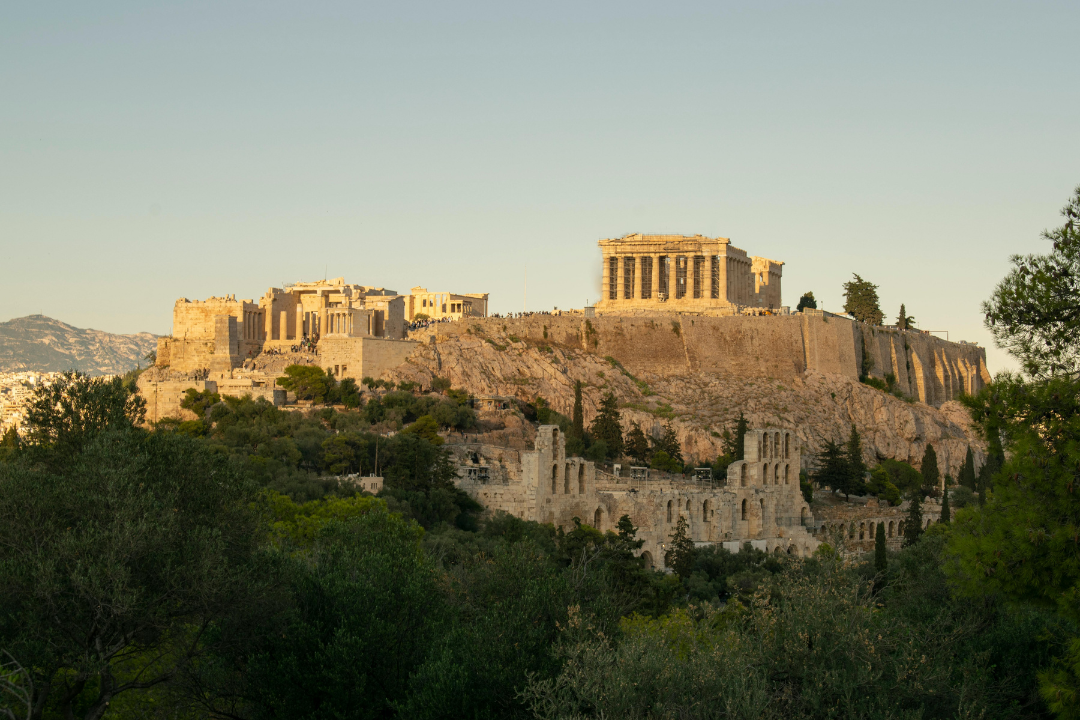
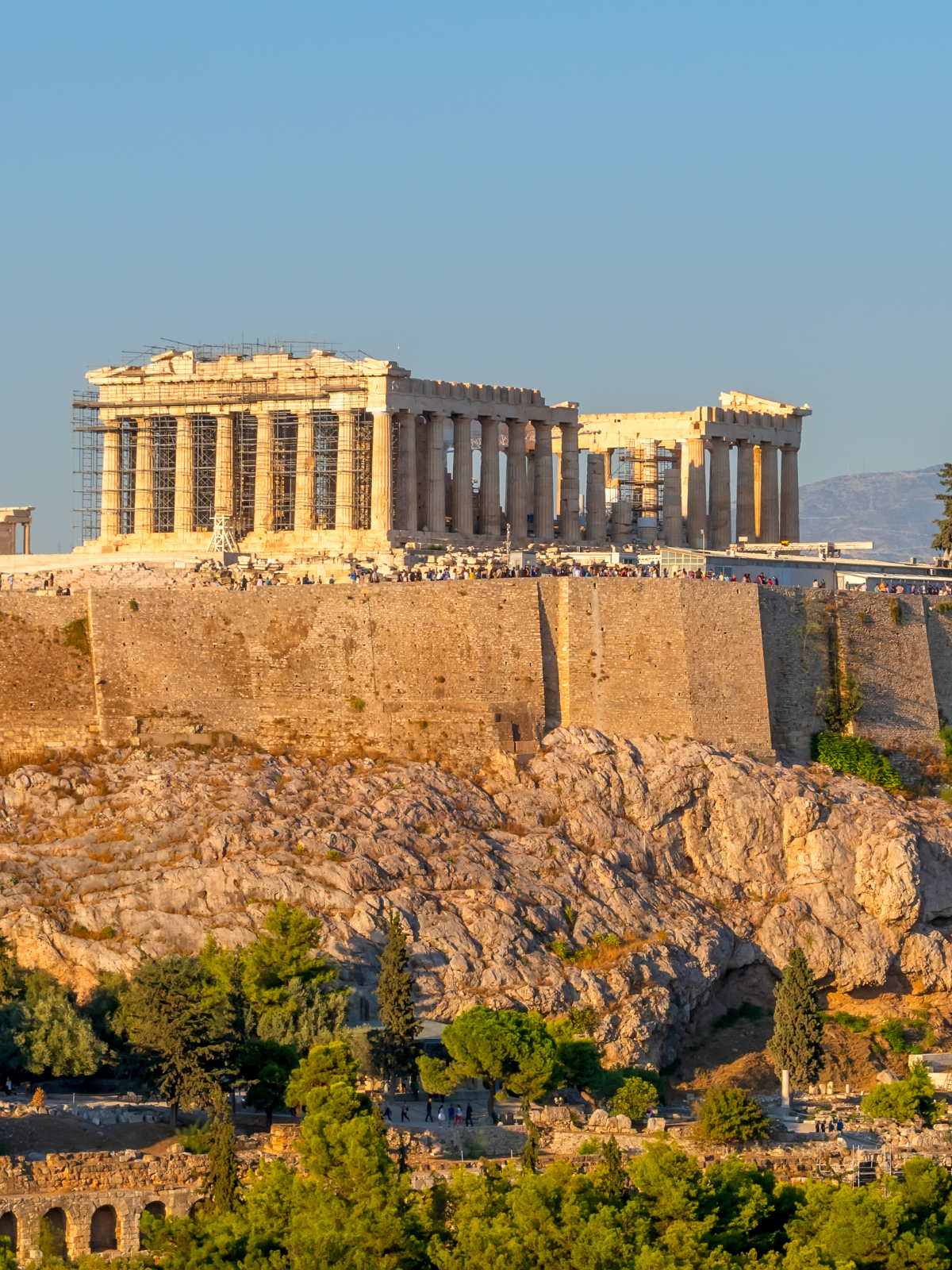
You have to start at the top. Not because it’s the most original choice, but because the Acropolis is the essential starting point for understanding everything else. And because seeing it early — at eight in the morning, when it opens, before the cruise ships arrive — is a radically different experience from seeing it at noon with three thousand people.
The ascent via the south slope, passing the Theatre of Dionysus — where Western theatre was born, literally — and the Odeon of Herodes Atticus, has something of a pilgrimage about it. And when you reach the Propylaea and the Parthenon appears all at once, there is a moment when your sense of human scale recalibrates. The Greeks of the 5th century BC built this without cranes, without concrete, without modern engineering. Every column drum of the Parthenon was individually carved and fitted with millimetre precision. The columns have a deliberate curvature — entasis — so they appear perfectly straight to the human eye. It’s a building designed to deceive perception, and it’s been doing so for twenty-five centuries.
The Erechtheion, with its caryatids (those that remain are copies; the originals are in the museum below), deserves as much time as the Parthenon. And the view from the southern lookout, with all of Athens stretching to the Piraeus and the sea, puts into perspective why the Athenians chose this rock: from here you can see everything. You control everything.
After the Acropolis, head straight down to the Acropolis Museum. It is one of the finest museums in Europe and it was designed for a single purpose: to explain what you’ve just seen above. The top floor reproduces the exact orientation of the Parthenon, and the friezes and metopes are displayed in the positions they occupied on the original building. The empty gaps, where the Elgin Marbles that Lord Elgin took to London in 1801 should be, are a silent, deliberate reproach to the British Museum. Greece has never stopped demanding them back, and this museum is its most eloquent argument.
The afternoon of the first day is for Plaka and Anafiotika. Plaka is the oldest neighbourhood in Athens, with cobblestone streets climbing toward the base of the Acropolis. It’s touristy, yes, but the side streets retain a genuine charm. Anafiotika, the micro-neighbourhood of whitewashed houses built by stonemasons from the island of Anafi in the 19th century, is a fragment of Cycladic island wedged into the slope of the sacred rock. It’s tiny — barely a few streets — but it gives a completely different perspective of the Acropolis: from below, intimate, among bougainvillea and cats.
For dinner, walk toward Adrianou Street or, better yet, look for a taverna on the perpendicular streets where prices drop and authenticity rises. The souvlaki in Plaka is decent, but it’s not the best in Athens. We’ll get to that tomorrow.
Day 2: The Agora, the street and the neighbourhood that won’t surrender
The second day is for the Athens that most people miss. Start at the Ancient Agora, the public square where democracy was invented. Not metaphorically: here, in this space of earth and stone between the Acropolis and the Kerameikos, the citizens of Athens voted, debated, judged and traded. Socrates was sentenced to death here. The Stoa of Attalos, rebuilt in the 1950s by the American School of Archaeology, houses a small but extraordinary museum: the ostraka (pottery shards with names scratched into them, used to vote for the exile of unpopular politicians — that’s where the word “ostracism” comes from) are among the most revealing objects in all of Greece.
The Temple of Hephaestus, on the hill above the Agora, is the best-preserved Doric temple in all of Greece. Better than any in the Peloponnese, better even than the Parthenon in terms of structural integrity. It has stood for twenty-four centuries without scaffolding, without dramatic restorations. It is a monument to Greek engineering as much as to religion.
From the Agora, walk toward Monastiraki. The square is the junction where every possible Athens converges: the flea market with genuine antiques and picturesque junk, the view of the Acropolis framed by the Tzistarakis Mosque (18th century, now a ceramics museum), the smell of souvlaki drifting from Mitropoleos Street. If there is one place where Athens can be summed up in a single point, it’s Monastiraki at mid-morning.
For lunch, cross over to Psyrri. This neighbourhood was for decades one of the most run-down in the centre. Today it’s one of the most vibrant: natural wine bars in converted warehouses, tavernas with a ten-euro set lunch, street art murals that change every few months. It’s not clean, packaged gentrification: Psyrri retains a roughness that is part of its appeal. Try the souvlaki at Kostas (on Agia Irini Square, one of the most pleasant squares in Athens for a mid-afternoon sit-down) or seek out a taverna on the side streets off Sarri.
And then, Exarchia. This is the neighbourhood that no conventional guide recommends with enthusiasm, and yet it is essential for understanding Athens. Exarchia is the city’s anarchist and alternative quarter. Since the 1970s, when it was a centre of resistance against the military junta, Exarchia has maintained a countercultural identity that manifests in everything: the political graffiti covering every available surface, the self-managed social centres, the independent bookshops, the vinyl bars where Greek punk sounds as if the revolution were yesterday.
Exarchia Square is its heart, and the Athens Polytechnic, where in November 1973 the junta’s tanks rolled in to crush a student uprising, is its founding scar. Every 17th of November, Athens commemorates that date with a march that ends at the American embassy. Exarchia is not a dangerous neighbourhood — that reputation is overblown — but it is a neighbourhood with opinions. And in a city that invented politics, that is profoundly coherent.
Dinner in Exarchia. The tavernas here are the cheapest in the centre and among the most honest: generous combination plates, retsina on tap, and a local clientele that hasn’t come to pose for anyone.
Day 3: The museum, the hill and the farewell
The third day begins at the National Archaeological Museum, on Patission Street. It is the most important museum in Greece and one of the five or six most important in the world for the history of Western civilisation. The Mask of Agamemnon (which probably isn’t Agamemnon’s, but the name stuck), the Antikythera Mechanism (a 2nd-century BC analogue computer that shouldn’t exist according to what we know of ancient technology), the bronze sculptures rescued from the seabed: every room is an argument against the idea that we know everything there is to know about the ancient world.
Allow at least two hours. Three if you can. And don’t try to see everything: choose the sculpture collection, the bronzes and the Antikythera room, and save the rest for another trip.
After the museum, walk south along Patission and turn toward the Kolonaki neighbourhood, the elegant quarter of Athens. It’s not the most interesting area to wander, but it’s the gateway to Mount Lycabettus. The walk up takes about twenty minutes along a steep path through pine trees, or you can take the funicular. From the top, Athens reveals itself in full: the Acropolis to the southwest, Mount Hymettus to the east, the Piraeus and the Saronic Gulf to the south, and on clear days, the islands appearing on the horizon. It’s the best view in the city, and at sunset, with the golden light of Attica falling over the infinite urban sprawl, you understand something that photographs cannot convey: Athens is enormous. Four million people in a basin ringed by mountains. A city that shouldn’t work and that, against all urban logic, does.
Come down from Lycabettus for the final Athenian dinner. Head back to Psyrri or try the tavernas on Protogenous Street, near Monastiraki. Order mezedes to share: taramasalata, melitzanosalata, kolokithokeftedes, a portion of baked feta with honey and sesame. Drink a tsipouro or a Nemea wine. And reflect on the fact that this city has been continuously inhabited for over three thousand four hundred years, and that every dinner served here, from the first tavernas of the Agora to the table where you’re sitting, is part of the same thread.
What’s left out
Three days leave a lot out. The Kerameikos and its ancient cemetery. The neighbourhood of Koukaki, at the foot of the Acropolis, which is where you’d want to live if you moved to Athens. The Varvakeios central market, brutal and fascinating at seven in the morning. The Athenian Riviera, heading south, with surprisingly good beaches a half-hour tram ride away. Cape Sounion, with the Temple of Poseidon silhouetted against the Aegean at sunset, an hour’s drive away.
Athens is not a city you exhaust. It’s a city you begin. And those three days are enough to understand that it deserves your return.
For the full picture of every island, route and hidden corner in Greece, the Far Guides complete guide has it all: interactive maps & itineraries, information that stays up to date.
More on Greece
Keep reading.
Other pieces from the same destination.


Next step
Ready for Greece?
The guide is for travelling.
Interactive maps & itineraries and everything that doesn't fit in an article. Always the latest published version.
Get the Greece guide