
Greece · 25 August 2026
Greece in two weeks: a route combining mainland and islands
Two weeks aren't enough for Greece, but they're enough to understand it. A route combining Athens, the Peloponnese, Nafplio, Santorini and Crete without wasting time.

Planning Greece in fourteen days is an exercise in renunciation. The country has twenty destinations that would each deserve a week: Athens, the Peloponnese, Crete, Santorini, the Ionian Islands, Meteora, Thessaloniki, Rhodes, the Sporades. Fourteen days are not enough for all of it, and any honest route begins by acknowledging this. What two weeks do allow is understanding the country’s structure: a mainland of dense history and islands of distinct personalities. That is already a great deal.
This route assumes a flight into Athens and out of Heraklion (Crete), which avoids the wasted time of returning to Athens and opens the second half of the journey southward. Ferries, a rental car and one or two domestic flights are the transport. The logic is north to south, mainland first, islands after.
Days 1-3: Athens
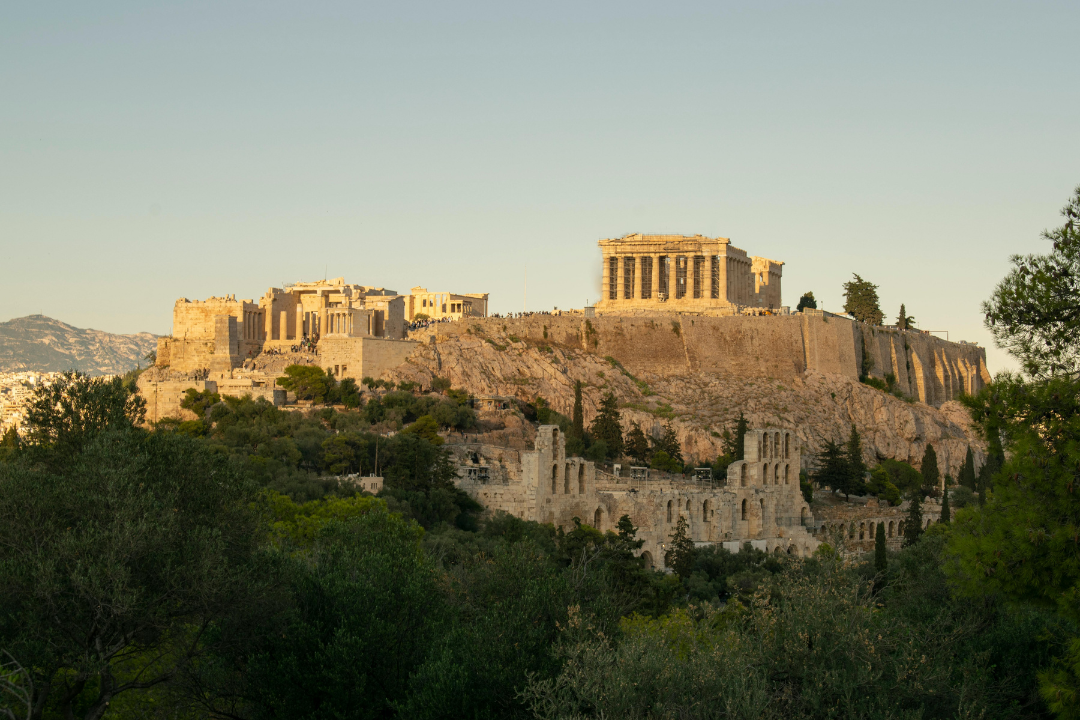
Three days in Athens is the minimum for the city to start making sense. The first day belongs to the Acropolis and the Acropolis Museum: arrive at the Acropolis at eight in the morning when it opens, before the tour groups arrive, and descend to the museum afterward. The afternoon is for Plaka and Anafiotika, the whitewashed neighbourhood wedged into the base of the rock.
The second day starts at the Ancient Agora, the square where Athenian democracy functioned in practice. The Hephaisteion on the western edge is the best-preserved Doric temple in Greece. The Stoa of Attalos, reconstructed, houses the small museum where the ostraka live — the pottery sherds with names scratched on them that Athenians used to vote for the exile of inconvenient citizens. The afternoon is for Monastiraki and Psyrri.
The third day should include the National Archaeological Museum: the Mask of Agamemnon, the Artemision bronzes, the Antikythera Mechanism. At least two hours. The afternoon free in Exarchia or climbing Lycabettus Hill for the city view at sunset.
Day 4-5: The car and Epidaurus
Day four is the car day. Pick one up in Athens, drive south toward the Peloponnese over the Corinth Canal (not large, but improbable: four kilometres long, 25 metres wide, 79 metres deep, and all excavated by hand between 1881 and 1893). Destination for the day: Epidaurus.
The theatre at Epidaurus is the best preserved in ancient Greece and has acoustics that remain a subject of study: from the uppermost rows, 55 tiers from the stage, a coin dropped on the stone floor can be heard without amplification. The secret is not the rural quiet: it is the specific geometry of the cavea and the limestone seating material, which reflects high frequencies and absorbs background noise. The acoustic engineers of the fourth century BC understood something that modern engineering took decades to formalise.
Days 5-6: Nafplio and Mycenae
Nafplio is Greece’s first independent capital (1828-1834) and the most beautiful town in the Peloponnese. Three fortresses in a town of twenty thousand people: the Bourtzi on an islet in the harbour, the Acronauplia on the headland, and Palamidi at the clifftop, 216 metres up, accessible by 999 steps cut in the rock or by a winding road. The cobbled streets of the centre, the neoclassical houses from the independence period, the cafés in the squares: Nafplio is not overrun because standard itineraries ignore it. That is its advantage.
Fifteen kilometres north, Mycenae is the citadel of the civilisation Homer knew as Agamemnon’s. The Lion Gate — the first example of monumental sculpture in Europe, dating to around 1250 BC — marks the entrance. The Treasury of Atreus, the beehive tomb the later Greeks named without quite knowing what it was, has a dome 14.5 metres in diameter built from unmortared stone blocks, and was the largest vaulted space in the world for over a thousand years.
Days 7-8: The Mani and the southern tip
The central finger of the Peloponnese — the Mani — is one of the most arid and singular landscapes in Greece. The stone towers dotting the villages of the interior were defensive family towers: Mani disputes between clans were conducted across generations from towers that could reach fifty metres in height. The landscape — sparse vegetation, gnarled olive trees and low scrub, sea always visible between the gorges — recalls an archaic Greece that tourism has elsewhere softened.
Cape Tainaron, at the peninsula’s southern tip, is the southernmost point of continental Europe. In Greek mythology it was the entrance to Hades: there is a sea cave and the remains of an ancient sanctuary. Today there is a forty-minute path from the lighthouse to the cape, empty of other visitors, with the Mediterranean in three directions.
Days 8-10: Santorini
Fly or ferry from Kalamata or Nafplio (connection in Athens if flying). Santorini deserves two nights: one for the island, one for Akrotiri, the Minoan city that the volcanic eruption of the seventeenth century BC buried and preserved under ash. The site is one of the most important in European prehistory and is now roofed for protection. The frescoes found there are in the museum in Fira.
Oia at sunset is exactly what it looks like in photographs: extraordinary. The price of that image is the most crowded experience in the entire journey. The quieter alternative is sunset from Imerovigli, the village halfway along the caldera rim, same view, far fewer people.
Days 11-14: Crete
Overnight ferry from Santorini to Heraklion (around nine hours). Time in Crete allows three focuses: Knossos and the Archaeological Museum (half a day each), Rethymno as a base for the central part of the island — the most elegant town in Crete, with a manageable Venetian centre — and the Samaria Gorge on the last day before the return flight from Chania. The gorge is sixteen kilometres of downhill walking from the Omalos plateau to the sea, the most famous hiking route in Greece. In July and August the density of people makes it less wild than its reputation suggests. In June or September, it is a different experience entirely.
The complete Far Guides Greece guide includes detailed routes across the mainland and islands, interactive maps and all the practical information you need to plan your independent trip.
More on Greece
Keep reading.
Other pieces from the same destination.


Next step
Ready for Greece?
The guide is for travelling.
Offline maps, itineraries and everything that doesn't fit in an article.
Get the Greece guide