

Greece · 8 September 2026
The Athenian Agora: what the Parthenon overshadows
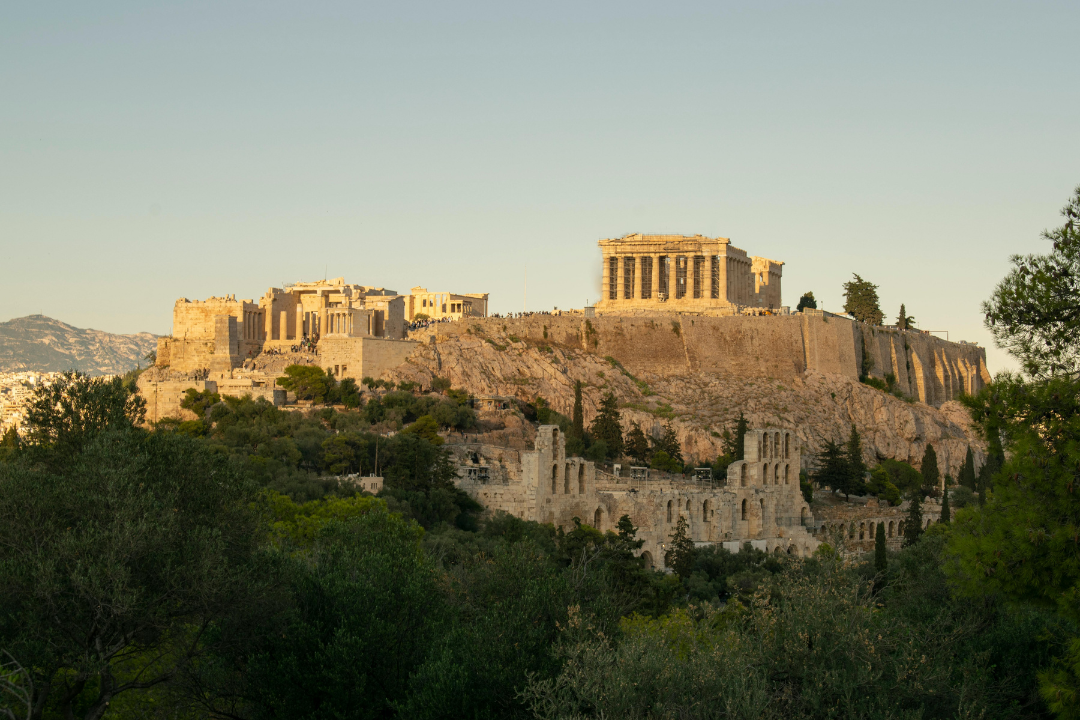
The Acropolis is visible for kilometres. The Agora at its foot is where everything actually happened: trials, the market, philosophical debates and the origins of Athenian democracy.

When Plato describes in the Apology the trial of Socrates, there is a detail that usually gets lost in the reading: Socrates explains to his jurors that he has spent his entire life in the Agora and in the gymnasia, talking to anyone willing to listen. The Agora is not the incidental setting of that description. It is the place where Athenian democracy physically functioned: where votes were cast, trials conducted, arguments made and purchases completed. The Acropolis was the sacred space, the space of divine and civic representation. The Agora was where the city actually lived.
Today the Athenian Agora is the most overlooked archaeological space in Athens’s mass tourism. The majority of groups visiting the Acropolis descend without crossing the street that leads to the Agora. The result is one of those paradoxical imbalances that tourism archaeology produces: the most important site for understanding the concrete workings of Athenian democracy is ten minutes’ walk from the most photographed site in Europe, and visited by a small fraction of those who go up to the top.
What the space was for
The Ancient Agora of Athens was not simply a market. It was the multifunctional public square that made direct government possible. Citizens gathered on the Pnyx, the hill to the west, for the major legislative assemblies. But the Agora was where most everyday civic acts occurred: payment of taxes, minor judicial proceedings, commercial transactions, and above all the informal political conversation that was the raw material of democracy.
The Athenian legal system is one of the most concrete and fascinating aspects of Greek democracy. Juries were enormous — Socrates’s trial had 501 jurors — to make bribery impractical. Each juror received at the start of proceedings a bronze disk stamped with their name, and voted using two types of disk: one solid (acquittal) and one hollow (condemnation). The Stoa of Attalos, reconstructed, displays dozens of these juror disks found during excavations. They are small objects, without spectacle, and they are the most direct evidence that exists for the material functioning of Athenian democracy in the fourth century BC.
The Hephaisteion: the most intact
On the western edge of the Agora, on a hill of schist rock, stands the Hephaisteion. It is the best-preserved Doric temple in the world. Better than the Parthenon — of which barely half the original columns survive — better than the Temple of Poseidon at Cape Sounion, better than any temple in Sicily or Magna Graecia. The building’s 34 metres of length and 13.7 of width are almost complete: including the roof, which in ancient Greek architecture is extraordinarily rare.
It was built between 449 and 415 BC, practically in parallel with the Parthenon. The frieze reliefs show the labours of Heracles and the deeds of Theseus — the legendary founder of Athens had a prominent presence in the decoration of the temple overlooking the Agora, the city’s foundational space. Through history, the temple was converted into a Christian Orthodox church in the seventh century AD, which explains both the apse added to the eastern end and paradoxically its preservation: churches were maintained while pagan temples were abandoned.
The ostraka and democracy as a tool
Among the most revealing objects in the Stoa of Attalos are the ostraka. The Greek word ostrakon means literally “shell” or “pottery shard,” and the procedure of ostracism — from which our modern word derives — consisted of citizens writing on a pottery shard the name of the politician they considered dangerous to democracy. If a name accumulated more than six thousand votes, that citizen was exiled for ten years without losing their rights or property.
The ostraka from the Agora include fragments with the names of Themistocles, Aristides, Cimon and Pericles: some of the greatest Athenian statesmen came close to or underwent this procedure. In excavations at the Kerameikos neighbourhood northwest of the Agora, 190 ostraka were found all bearing the same name in the same handwriting: clearly prepared in advance for an organised vote. Athenian democracy, like every democratic system that has existed since, was susceptible to manipulation.
The Church of the Holy Apostles
Inside the Agora, near the southern boundary of the site, there is a church that has something no other building in the space has: it is a genuine medieval structure, not a modern reconstruction. The Church of the Holy Apostles — Agii Apostoli — dates from the eleventh century and has seventeenth-century frescoes inside. It was built above the remains of a Roman nymphaeum and represents the continuity of use of the public space from antiquity through the Byzantine period.
The Agora has been excavated since 1931, when the American School of Classical Studies began systematic operations that required demolishing an inhabited neighbourhood of Ottoman and neoclassical houses. The excavation continues: each year there are summer campaigns going deeper into the oldest layers of the site. Entrance to the Agora includes access to the Stoa of Attalos, and the combination with the Acropolis is available on a single multi-site ticket. But the Agora deserves its own afternoon, without hurry, away from the noise of the groups that have passed above.
The complete Far Guides Greece guide includes detailed routes across the mainland and islands, interactive maps and all the practical information you need to plan your independent trip.
More on Greece
Keep reading.
Other pieces from the same destination.


Next step
Ready for Greece?
The guide is for travelling.
Offline maps, itineraries and everything that doesn't fit in an article.
Get the Greece guide