



Montenegro · 20 July 2026
What to eat in Montenegro: a guide to the country's food
Between the Balkan mountain cooking of the interior and the Adriatic fish of the coast: the dishes, the products and where to eat well in Montenegro.

There is a village on the slopes of Mount Lovćen — Njeguši, around eighteen kilometres from Kotor by road — that has given its name to the most celebrated product of Montenegrin gastronomy. Njeguši pršut is a ham cured in mountain air, smoked over beechwood, with a denser texture and more intense flavour than most Mediterranean hams. The altitude (around nine hundred metres), the air circulation between the Bay of Kotor and the upland plateau, and the climate that combines Adriatic humidity with mountain cold create curing conditions that are specific to that microclimate and cannot be replicated anywhere else.
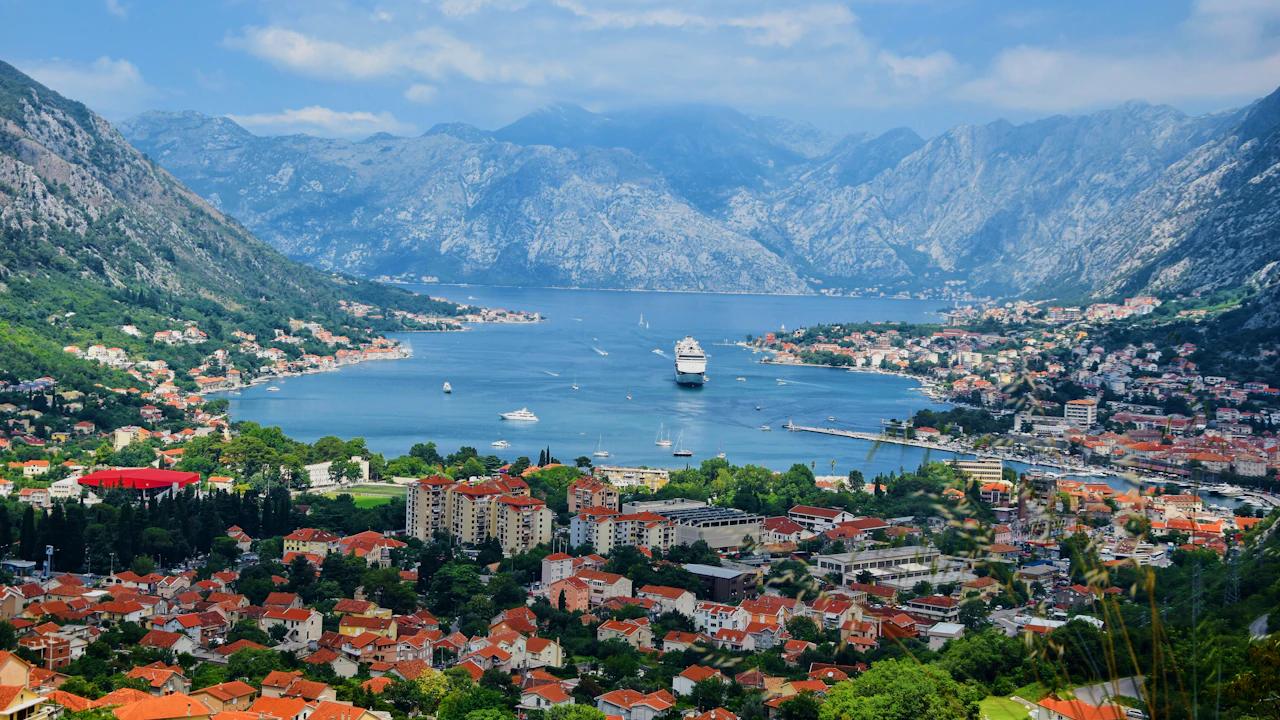
Njeguši pršut is not just a gastronomic product: it is also a statement about the duality of Montenegrin cooking, which has two clearly differentiated souls. The cuisine of the interior — mountains, livestock, smoked meats, sheep and cow milk dairy products — and the cuisine of the coast — Adriatic fish, seafood, Mediterranean vegetables, olive oil. They are two traditions that coexist in a small territory and sometimes merge, especially in the towns around the Bay of Kotor’s interior, where mountain ham and bay fish meet at the same table.
The products of the interior
Kajmak is perhaps the most ubiquitous dairy product in Montenegrin cooking. It is made by boiling whole milk and allowing the cream to accumulate on the surface, which is then skimmed off and lightly salted. The result is a fatty, smooth paste in texture, tasting somewhere between butter and sour cream, spread over cornbread or served alongside ćevapi and kačamak. Its flavour is difficult to describe without tasting it: it has a richness that industrially produced dairy cannot achieve.
Kačamak is the Montenegrin polenta: cornflour cooked slowly with water and salt until thick, then mixed with kajmak and white sheep’s cheese. It is a winter dish, substantial, that the interior’s shepherds ate to endure the cold. In mountain restaurants it appears as a side dish or main course in more elaborate versions, sometimes with added potato or pieces of melted cheese folded through.
Jagnjetina ispod sača is the special-occasion dish of Montenegrin celebrations: lamb cooked under an iron bell (the sač) with hot coals above and below, for several hours, until the meat falls from the bone of its own accord. The restaurant version is rarely as good as the home-cooked one, which requires hours of preparation and a fire that must be maintained. When eaten well — in a trusted interior restaurant, with good red Vranac — it is one of those dishes that makes you understand why wood-fired cooking still makes sense.
Ćevapi and the Balkan inheritance
Ćevapi — small sausages of minced beef and pork, grilled and served with onion, kajmak and flatbread — are the fast food of the Balkans. They appear in Montenegro, Bosnia, Serbia, Kosovo, in every country in the region with minor variations in meat ratios or bread style. In Podgorica and Budva there are restaurants serving them from early morning; a portion of ten pieces costs around six to eight euros.
They are not haute cuisine, but they are very good when made well: the key is the fat content of the meat (enough that they do not dry out on the grill) and fresh kajmak alongside. Ćevapi bought at a street stall in a market are often better than those served in restaurants with aspirations.
Vranac wine and rakija
Vranac is Montenegro’s indigenous red grape variety, grown mainly in the Podgorica and Crmnica regions around Lake Skadar. It produces a very dark wine (the name means “black horse”), with marked tannins, good body and an acidity that makes it more pleasant than its colour suggests. The Plantaže winery in Podgorica produces the best-known exported version; but the wines from small family producers in the Skadar region sometimes have a quality that surpasses the industrial output.
Plum rakija (šljivovica) is the spirit of the Balkans: made in almost every house in the interior, served as an aperitif before eating, as a digestif afterwards and as a universal remedy in between. The Montenegrin version is not conceptually different from the Serbo-Bosnian one, but quality varies enormously between producers.
Eating well in Montenegro requires very little searching: restaurants without decorative ambition, with a menu in one language, located outside the main tourist zones, are often the best. The reference price for a good meal — starter, main course and drink — is around fifteen to twenty euros per person in the interior; somewhat more on the coast in high season.
The complete Far Guides Montenegro guide includes detailed routes, interactive maps and all the practical information you need to plan your independent trip.
More on Montenegro
Keep reading.
Other pieces from the same destination.

Next step
Ready for Montenegro?
The guide is for travelling.
Offline maps, itineraries and everything that doesn't fit in an article.
Get the Montenegro guide