Montenegro · 7 September 2026
Lovćen and the Njegoš Mausoleum: the mountain that named a country
Lovćen — Black Mountain, Montenegro — is the peak that gave the country its name. At its summit, a mausoleum with extraordinary views over the Adriatic and the story of a poet-king.

The name Montenegro is not a Slavic name. It is Venetian. The navigators of the Serenissima, crossing the Adriatic in galleys loaded with spices and silk, saw from the sea a dark mountain — dark from its dense cover of black pine forest — and called it Monte Negro. The name attached itself to the country that had grown at the foot and on the slopes of that mountain for centuries. Lovćen, in Montenegrin. Monte Negro, in Venetian. Montenegro.
The mountain is not the highest in the country — the Zla Kolata, in the Prokletije massif, exceeds 2,500 metres — but it is the most significant. Visible from the sea, from the Bay of Kotor, from the Albanian coastal plains on clear days, Lovćen functioned for centuries as a dark lighthouse, a reference point that Adriatic sailors used to navigate and Montenegrins used to define themselves.
Petar II Petrović-Njegoš: the poet who governed a mountain
In 1830, at the age of seventeen, Petar Petrović-Njegoš became vladika of Montenegro following the death of his uncle Peter I. He governed for twenty-one years, until his death from tuberculosis in 1851 at the age of thirty-eight. In that brief time — in the historical circumstances he faced, which included permanent conflict with the Ottoman Empire, the forced modernisation of the state and the management of relations with Russia and Austria — he did two things that Montenegrins have not forgotten: he governed with relative effectiveness a state that barely deserved the name, and he wrote the Gorski vijenac.
The Gorski vijenac — The Mountain Wreath — is the epic poem that Montenegrins consider the equivalent of Shakespeare’s Hamlet or Cervantes’ Don Quixote: the literary work that defines the soul of a culture. Written and published in 1847, it narrates the story of the purging of Montenegrins who had converted to Islam during the Ottoman occupation in the eighteenth century. The poem is politically uncomfortable from a contemporary perspective — there are readings that identify in it elements of what we would today call ethnic cleansing — but it is literarily extraordinary and culturally fundamental for understanding how Montenegrins constructed their national identity.
The mausoleum: Meštrović’s work at the summit
When Njegoš died in 1851, he was buried in a small chapel he himself had ordered built at the summit of Lovćen, at the highest point accessible with the means of the time. The chapel survived for a century until the Yugoslav regime decided to replace it with something more monumental.
The current mausoleum was designed by Croatian sculptor Ivan Meštrović, the most celebrated artist of twentieth-century Yugoslavia, and was inaugurated in 1974. Meštrović died before seeing it completed. The work is a black granite building embedded in the summit rock at 1,657 metres altitude, with a circular interior chamber where Njegoš’s sarcophagus rests beneath a four-metre gilded statue of the poet. The effect is theatrical and deliberately monumental.
The mausoleum is accessed by climbing 461 steps from the car park at the summit of the national park. The steps are well built but steep; allow twenty to thirty minutes of ascent at a normal pace. Entry costs eight euros.
The views: what can be seen from the summit
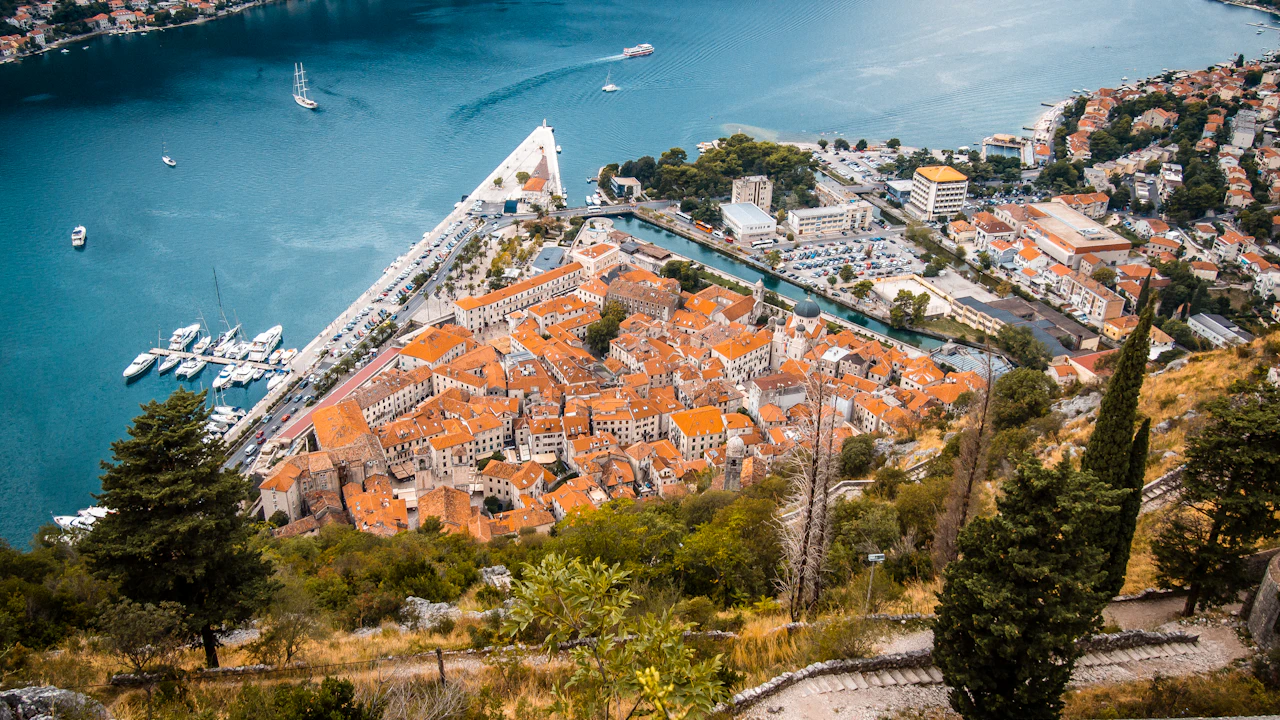
The views from the mausoleum’s exterior platform are the primary reason to make the journey. On a clear day — more common in spring and autumn than in summer, when haze can reduce visibility — you can see simultaneously: the complete Bay of Kotor with its four linked sections; Lake Skadar to the east with the Albanian plain behind; the Adriatic coast south to Ulcinj; and in exceptional visibility conditions, the Italian coastline of Puglia, more than a hundred kilometres away.
This multiple perspective — the Adriatic, the inland lake, the mountains, the entire country in a three-hundred-and-sixty-degree turn — is what makes the Lovćen summit a viewpoint without equal in the Balkans. There is no other geographical position in Montenegro that allows you to see so much from a single point.
How to get there
The best-known route is from Kotor along the twenty-five-hairpin road, which climbs from sea level to a thousand metres over about twenty kilometres. The road is narrow but paved and not technically difficult if driven calmly. Lovćen National Park charges an entry fee (with car): four euros.
You can also arrive from Cetinje, along the inland side, by a gentler and less photogenic road. This option is more practical for those coming from the interior and wanting to combine Cetinje with Lovćen on the same day.
The complete Far Guides Montenegro guide includes detailed routes, interactive maps and all the practical information you need to plan your independent trip.
More on Montenegro
Keep reading.
Other pieces from the same destination.
Next step
Ready for Montenegro?
The guide is for travelling.
Offline maps, itineraries and everything that doesn't fit in an article.
Get the Montenegro guide