Montenegro · 26 April 2026
Montenegro coast road trip: from Herceg Novi to Ulcinj
300 kilometres of Adriatic in one week. The stops, the pace and what truly deserves your time.
Montenegro’s coastline runs for three hundred kilometres. That is not much in absolute terms — the Spanish coast runs for thousands — but the Montenegrin Adriatic concentrates within that space a variety of landscapes, histories and characters that is hard to find along such a compact stretch of shore. From Herceg Novi, in the far north near the border with Bosnia-Herzegovina, to Ulcinj, a few kilometres from Albania, the coastal road crosses protected bays, walled cities, rocky peninsulas and sandy plains that have little in common except the sea.
This seven-day itinerary follows the shoreline from north to south. It works best by car, which is the option with the most freedom and the only one that allows you to stop where the landscape demands it. Buses cover the main stretches but with schedules that do not always coincide with the moment you want to move. The main road, the M2, is narrow in some stretches of the Bay of Kotor — you share it with lorries and cruise-ship buses — but in general it is accessible and well signposted. What this route demands is not driving skill but patience and a willingness to deviate.
Day 1: Herceg Novi — the threshold
Arriving via the Debeli Brijeg border crossing or the Kamenari ferry
Herceg Novi is the first city on the Montenegrin coast coming from Dubrovnik, and that geographical accident defines much of its character. It is a transit town that learned to be a destination. Its Croatian neighbours ignored it for decades in favour of Dubrovnik — Herceg Novi remained in Yugoslavia while Dubrovnik was the jewel of Tito’s crown — and that partial neglect allowed it to preserve historical layers that the more visited cities have been losing under the weight of tourism.
The city has three levels to tell. Below, the seafront promenade — the Šetnica — is a corniche above the sea with cafés and palm trees where daily life unfolds at a slow pace. In the middle level, the Ottoman city: the Kanli Kula fortress, built in the sixteenth century during the Turkish occupation, red as blood — its name means precisely “bloody tower” — dominates the old quarter. Higher up, the Austro-Hungarian influence: when the Empire took control of Dalmatia in the nineteenth century, it built and reformed with that Central European solidity still recognisable in the architecture of the hillsides.
The result is a city of layers where the mosque minaret and the Catholic bell tower stand two hundred metres apart, and where the morning market smells of Turkish coffee while the afternoon taverns serve local wine on terraces overlooking the Verige channel.
One night in Herceg Novi is enough. But do not leave without walking up to the Španjola fortress at sunset: the views over the Bay of Kotor from up there are the perfect prologue for the days ahead.
Day 2: The Verige channel and Perast — entering the bay
Distance: 40 km. Estimated time without stops: 1 hour
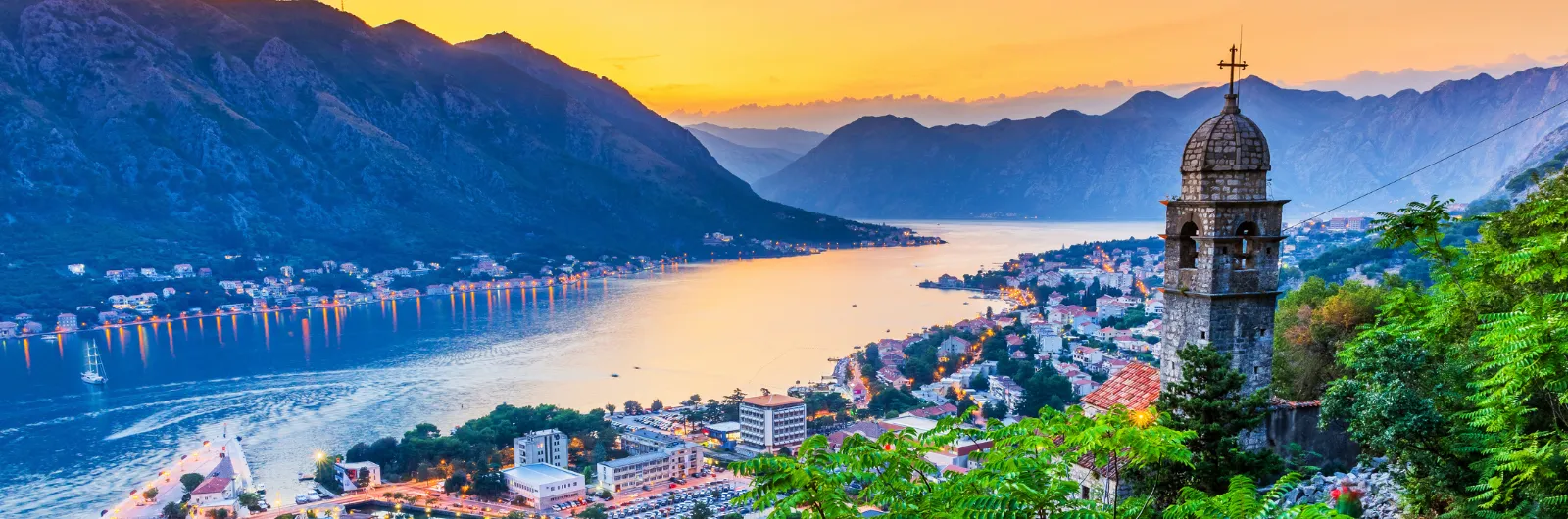
The Bay of Kotor is not technically a fjord — fjords are formed by glacial action, and this arm of the sea has tectonic origins — but it has that quality of a protected, deep space that it shares with Nordic geography. The water is calmer here inside, the mountains drop vertically to the sea, and the light in the first hour of the morning turns the landscape into something that is hard to believe is real.
The Kamenari-Lepetane ferry crosses the narrowest channel of the bay — the Verige channel, “chains” in Slavic, because the Venetians used to stretch chains here to stop enemy fleets entering — in five minutes. It is one of those brief crossings that change perspective: on the ferry, with the car on top of a barge and the mountains of Orjen on one side and the Lovćen on the other, the scale of the landscape becomes comprehensible in a new way.
Perast deserves its own time and has a separate article on this blog, but you cannot drive past it without stopping: arriving in Perast means suddenly finding a main street that opens directly onto the water, with baroque palaces from the seventeenth century, a cathedral, and in the middle of the bay two islets with their churches. The most famous is Gospa od Škrpjela, Our Lady of the Rock, built on a reef that the sailors of Perast were enlarging stone by stone over centuries. This is not legend: the tradition remains alive, and every year in August local boats throw stones into the sea to expand the island’s artificial base.
Day 3: Kotor — the city the Venetians loved
Base for the full day
Kotor is the most visited city in Montenegro, and there are strong reasons for that. The medieval walls that snake up the mountain of Saint John, the old town with its cobbled squares and its cats — Kotor has a historical and almost institutional relationship with cats, the symbol of the city — and the Romanesque churches from the twelfth century: all of that is real and deserves a visit.
But Kotor is also the city that best illustrates the paradox of successful tourism. In summer, when the cruise ships are in the bay and the buses are unloading passengers at the sea gate, the old town fills to a point that makes it difficult to enjoy. The solution is simple: get up early. At seven in the morning, when the restaurants have not yet opened and the cruise passengers are asleep in their cabins, Kotor is a different city. The cobblestones damp with dew, the pigeons in the Arms Square, the silence broken only by the sound of water in the fountains.
The climb up the walls — 1,350 steps to the Saint John fortress — is the exercise Kotor demands of those who want to understand it. Not because the view from the top is the only way to see it, but because the scale of the medieval defences can only be understood from within: the difficulty of building this, the reason why Kotor was never taken by the Ottomans despite centuries of pressure, the logic of a city that chose to become impregnable rather than surrender.
Venice governed Kotor for four centuries, from 1420 to 1797, and that influence is present in the architecture, in the surnames of the old families, in the organisation of urban life. But Kotor is not a copy of Venice: it is a city that took the Venetian architectural language and adapted it to a Balkan and mountainous context. The result has a personality of its own.
Day 4: Tivat and the luxury controversy — a brief stop
Distance from Kotor: 10 km
Tivat is the city that has changed the most in Montenegro over the past twenty years. The old Yugoslav naval arsenal — where submarines of the War Navy were built and repaired — was transformed into Porto Montenegro, a luxury marina that today houses some of the largest superyachts in the Mediterranean and a complex of hotels, restaurants and boutiques that cost more per night than a transatlantic flight.
The controversy is there for all to see. For some Montenegrins, Porto Montenegro is the symbol of a tourist development that benefits foreign investors — mainly Russian and Arab in its first phase — at the cost of local identity. For others, it is proof that Montenegro can compete in the luxury segment of European tourism and that investment generates employment and tax revenue. Both positions have their arguments.
For the independent traveller, Porto Montenegro is an interesting place to observe precisely because it exemplifies a tension found all along the coast: between the Montenegro that was and the one it is deciding to become. The marina itself — with its seventy-metre yachts and its fusion restaurants — is not the reason for the visit. Tivat airport, on the other hand, with its direct flights to several European cities, can be a convenient point of arrival or departure.
A half-morning stop in Tivat is enough. Continue south.
Day 5: Budva and Sveti Stefan — the tourist heartland
Distance from Tivat: 25 km
Budva is the centre of tourist life in Montenegro, and that has its advantages and its limitations. The old town, on a small peninsula that juts into the sea, is genuinely beautiful: medieval walls, stone alleyways, churches dating back to the ninth century. At night, in high season, it is also one of the most active nightlife zones on the eastern Adriatic, with beach clubs and terraces that close when daylight returns.
You need to know which Budva you are looking for. If the answer is parties and beaches, you are in the right place, especially in July and August. If what you are looking for is quiet and authenticity, June or September are entirely different months, and the old town at dawn, with the fishermen and traders preparing for the day, is a different place altogether.
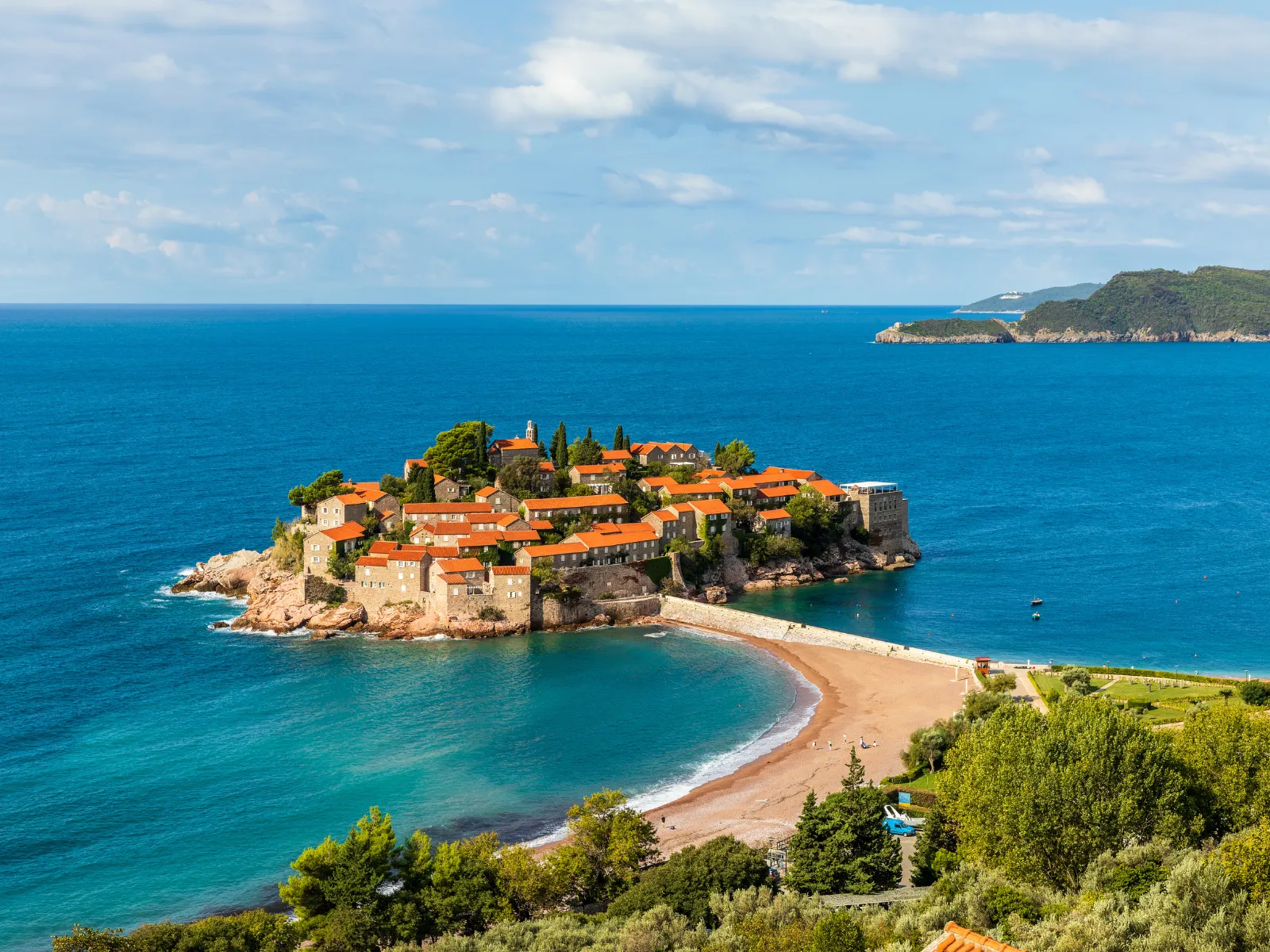
Three kilometres to the south is Sveti Stefan. This is the image of Montenegro that appears in every travel guide: an island connected to the mainland by a narrow spit of sand, covered in fifteenth-century stone houses that today form part of a luxury resort — the Aman Sveti Stefan — closed to the general public. The beach at its foot is public and magnetic. The resentment of Montenegrins at the privatisation of what was once a fishing village turned into millionaire exclusivity is understandable and lies beneath many conversations about tourism in the country.
The view of the islet from the road is free. It is, objectively, one of the most beautiful images in the Mediterranean. The right to walk its streets no longer belongs to everyone.
Day 6: Petrovac and Bar — between the ancient and the functional
Distance from Budva: 30 km to Petrovac, 25 km more to Bar
Petrovac is the best-kept secret on the Budva coast. A small bay with a dark sand beach, a human-scale town that has not grown vertically, a Venetian fortress at the end of the promenade. In July it shares high season with the rest of the coast, but it has less tourist mass than Budva and a more visible everyday life. It is the kind of place where you can have breakfast at the same terrace every day for a week and by the end of the week the owner will know how you like your coffee.
Bar is different. It is the southern port city, the place where the ferry from Bari arrives — Montenegro’s only regular maritime link with Italy — and where life is functional rather than tourist. The port is large and active. The modern city does not have much to offer the traveller, but the Old City — Stari Bar — is three kilometres up the road through thousand-year-old olive groves.
Stari Bar is a city in ruins. Not in the sense of an archaeological site, but in the literal sense: a city that was evacuated after an explosion in the Ottoman arsenal in 1878, never fully rebuilt, and which today is a mixture of inhabited ruins, half-restored churches and houses where everyday life peeps through between the ancient stones. The olive trees surrounding Stari Bar are more than two thousand years old: they are among the oldest living trees in the world, and their presence gives the place a temporal continuity that the ruins alone could not convey.
Day 7: Ulcinj — the final port, the other story
Distance from Bar: 25 km
Ulcinj is Montenegro’s southernmost city, and it is different from everything that comes before it. Not subtly different: different in culture, in the language spoken in the streets, in the smell of the markets. Ulcinj has an Albanian majority, a legacy of a history in which the border between Montenegro and Albania was not always where it is today. The minaret above the old town is not the same decorative minaret seen in other coastal cities: it is that of an active mosque, with the muezzin calling to prayer and the life of the neighbourhood organised around that rhythm.
The old town — another city in a small fortress above the sea — had a turbulent history. It was one of the last pirate ports in the Mediterranean: between the sixteenth and nineteenth centuries, Barbary pirates used Ulcinj as a base for raiding ships and selling slaves. It is said — though not verified — that Miguel de Cervantes was held captive here for a time before being ransomed in Algiers. The legend is more beautiful than verifiable, but it has the effect of placing this Balkan corner within a network of Mediterranean stories that stretches as far as Spain.
To the south of Ulcinj, the Velika Plaža — the Great Beach — extends for thirteen kilometres, the longest sand beach in Montenegro. It is a different landscape from the rocky bays of the north: here the sea is more open, the swell more present, the scale more horizontal. At the southern end, the mouth of the Bojana river forms a small delta where fishermen have had their huts on the water for generations.
Ulcinj is the logical end of this route and also its point of greatest strangeness. Arriving here from Herceg Novi in a week is having crossed not only kilometres of coastline but layers of history, languages, religions and characters that the Adriatic geography deposited over centuries.
Practical notes for driving
The main road, the M2, connects all the cities on this route. In the Bay of Kotor stretches — especially between Risan and Kotor — it is narrow and winding, with lorry traffic and cruise-ship buses that slow it considerably in high season. Plan your distances with more margin than the maps suggest.
The Troica pass, between Petrovac and Bar, is one of the most spectacular stretches of the coastal road: a series of bends descending a vertical hillside above the sea. It is well surfaced but requires attention.
Parking in Kotor, Budva and Sveti Stefan is complicated and expensive in summer. The towns have outer car parks from which it is better to enter on foot.
Petrol is not expensive in Montenegro compared to Western Europe. There are petrol stations in all the cities mentioned. In the mountain stretches between Petrovac and Bar there are fewer options; do not leave Petrovac with a low tank.
The best time for this route is June and September. July and August are months of mass tourism — especially in Kotor and Budva — with high prices and congestion on the roads and beaches. In June the sea is already warm, wildflowers cover the hillsides and the towns operate without the pressure of summer. In September the afternoon light is different — more golden, more horizontal — and prices drop considerably.
If you want to go deeper into every route, city and corner of Montenegro, the Far Guides complete guide has it all: interactive maps & itineraries, information that stays up to date.
More on Montenegro
Keep reading.
Other pieces from the same destination.

Next step
Ready for Montenegro?
The guide is for travelling.
Interactive maps & itineraries and everything that doesn't fit in an article. Always the latest published version.
Get the Montenegro guide