Iceland · 30 August 2026
Iceland's waterfalls: Skógafoss, Seljalandsfoss and the ones that matter
Iceland has thousands of waterfalls. Two are famous. A handful more are worth the detour. The rest are part of the landscape that accompanies you along the Ring Road, unnamed in any tourist brochure.

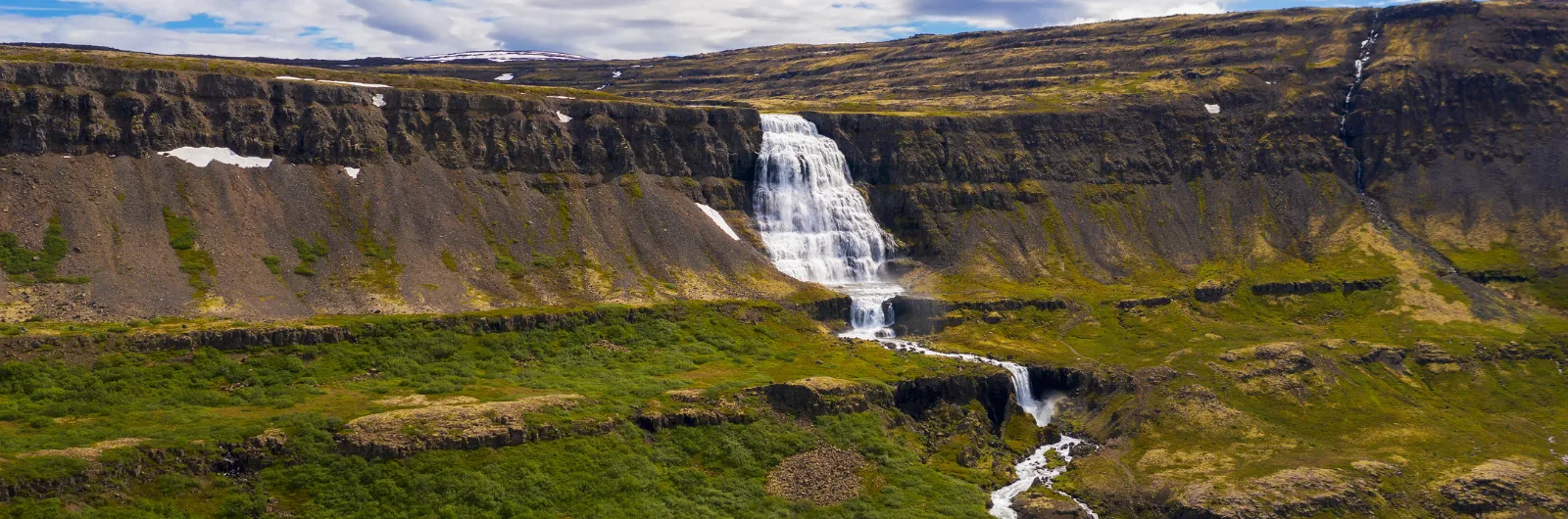
About a hundred kilometres east of Reykjavík along the Ring Road, the south coast landscape begins to behave in a particular way. The mountains that have been sitting on the southern horizon draw close enough to almost touch the road, and from their cliffs waterfalls drop with a regularity that first impresses and then becomes, incredibly, almost ordinary. There are days when you pass twenty nameless waterfalls in an hour of driving the south coast. The reason is not mysterious: glaciers at the top of the cliffs melt continuously in summer, and the water takes the fastest route to the sea.
Seljalandsfoss: the one you can walk behind
Seljalandsfoss drops sixty metres over a rock shelf that allows something very few waterfalls in the world permit: walking behind the water. There is a path that circles the base and enters the space between the rock wall and the water curtain, from where the view outward — with the liquid veil in the foreground and the south coast landscape behind — has something simultaneously intimate and spectacular about it. Waterproof clothing is not optional: the spray the waterfall generates will soak through any layer that is not fully water-resistant.
What most visitors do not know is that five hundred metres south along the cliff path there is a secondary waterfall called Gljúfrabúi, unmarked by any sign, that requires wading a small river — less than thirty centimetres deep in normal conditions — to enter a slot in the rock. The waterfall drops inside a cave. From the outside you see only steam. From inside, with the sound of water bouncing off the walls and light filtering from above, it is one of the most memorable experiences on the entire south coast. The entry fee is wet feet.
Skógafoss: the scale
Skógafoss has a sixty-two-metre drop and a twenty-five-metre width, and it is that breadth that distinguishes it. While Seljalandsfoss is a waterfall you can embrace, Skógafoss is one that overwhelms. The water volume is among the highest in Iceland. On sunny days, the double rainbows in the spray cloud produce the most repeated image in Iceland’s social media presence, which does not diminish their inherent merit.
On the right side of the waterfall, a staircase of 527 steps climbs to the plateau from which the Skógar river descends from the Eyjafjallajökull glacier — the same glacier whose 2010 eruption shut down European airspace for six days. From the top, the view towards the ocean over the lip of the waterfall justifies the climb without qualification. The Skógar river continues inland between volcanoes and glaciers: the Fimmvörðuháls trail that follows it reaches Þórsmörk in two days and passes between the craters opened by the 2010 eruption.
Dettifoss: the power
In northern Iceland, within Vatnajökull National Park, Dettifoss is defined by one statistic: an average of 193 cubic metres of water per second, making it the highest-volume waterfall in Europe. The water is not blue or green — it is grey-brown from the glacial sediment it carries down from Vatnajökull. Photographed, it is not the most beautiful. Visited, it is the one that leaves the strongest impression, because the scale of the sound and the vibration in the ground have no equivalent among European waterfalls. Ridley Scott opened Prometheus with a sequence filmed at Dettifoss.
Goðafoss: the history
A few kilometres west of Akureyri, Goðafoss is the “waterfall of the gods”: according to Njáls saga, this is where Þorgeirr Þorkelsson, the lawspeaker of the Alþing, threw the statues of the Norse gods into the water in the year 1000, after the assembly voted to convert to Christianity. The waterfall does not need the history to have value — it has a twelve-metre drop and thirty-metre width with a curved form that makes it photographically composed — but the history makes it the only point in Iceland where mythology, politics and geography occupy the same space simultaneously.
The rest of Iceland’s waterfalls — the thousands without names — do not deserve detours or planning. They deserve only that you stop the car, get out, look for two minutes, and drive on. On the south coast, this happens with a frequency no other European country can match.
The complete Far Guides Iceland guide includes detailed routes across the whole island, interactive maps and all the practical information you need to plan your Ring Road and beyond.
More on Iceland
Keep reading.
Other pieces from the same destination.


Next step
Ready for Iceland?
The guide is for travelling.
Offline maps, itineraries and everything that doesn't fit in an article.
Get the Iceland guide