Montenegro · 18 April 2026
Budva and Sveti Stefan: glamour and concrete on the Montenegrin Riviera
Two faces of the Montenegrin coast ten kilometres apart: Budva's mass tourism and Sveti Stefan's exclusivity.
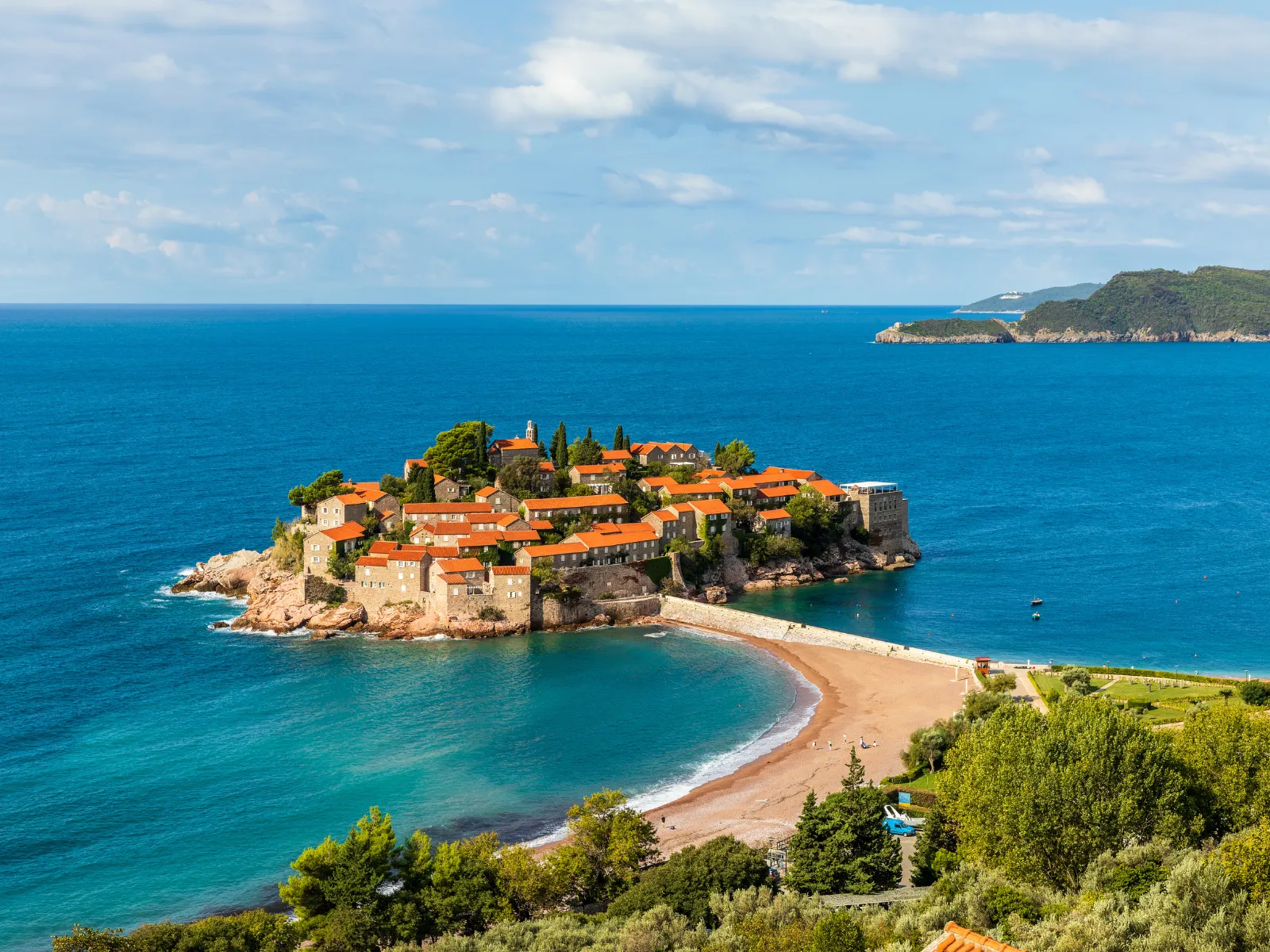
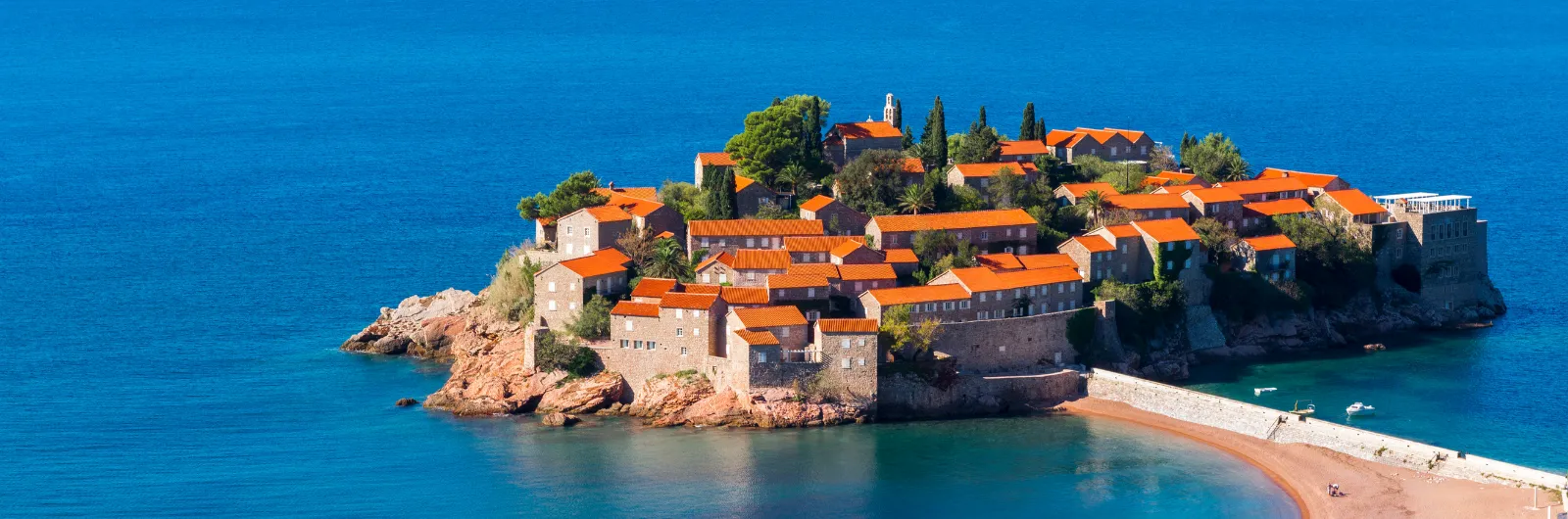
There is a ten-kilometre stretch of the Montenegrin coast that summarises, with almost implausible concentration, all the contradictions of the country. It begins in Budva and ends — or has its most visible point — in Sveti Stefan. The first is the emblem of mass tourism on the Adriatic, a city that has built its economy around summer so completely that by October it resembles an abandoned film set. The second is an island converted into a luxury resort whose image — rose-stone houses on a rock connected to the mainland by an isthmus — appears in every Montenegro brochure even though ninety-nine percent of those who photograph it can never go inside.
Understanding these two places is understanding something about what Montenegro wants to be, what it was, and the permanent tension between accelerated tourist development and the identity of a country that thirty years ago did not yet exist as an independent state.
Budva before Budva: the layers of a coastal city
Budva has twenty-five centuries of documented history, making it one of the oldest cities on the Adriatic coast. The Greeks colonised it in the fifth century before Christ — legend connects it to Butes, the navigator of the Argonauts who founded the city after escaping the wrath of the gods — and the traces of that antiquity persist in the logic of the settlement: the stari grad, the old town, is built on a small rocky peninsula that juts into the sea, exactly as the Greeks did when they sought defensive coastal positions.
What you see today in Budva’s old town is, however, not Greek but medieval and Venetian, with Byzantine, Ragusan and Austro-Hungarian layers superimposed. The walls encircling the stari grad are largely from the fourteenth and fifteenth centuries. The Citadel at the tip of the peninsula dates from the Venetian period. The churches — Santa Maria, Saint John, the Holy Trinity — have that accumulation of interventions and renovations that characterises the religious buildings of the Adriatic coast, where each century left something of its own on top of what preceded it.
But the earthquake changed almost everything.
The 1979 earthquake and the city that had to be rebuilt
On 15th April 1979, a 7.0 magnitude earthquake struck Montenegro and the neighbouring areas of Yugoslavia with a violence that left more than a hundred dead and destroyed or severely damaged tens of thousands of buildings. In Budva, the impact was devastating: the stari grad was practically destroyed. The walls survived, the thicker stone structures held partially, but the interior of the old town collapsed.
What you see today in Budva’s old town is a reconstruction. Conscientious, respectful in many respects, but a reconstruction nonetheless. The streets have the correct paving, the buildings have the right proportions, the churches have been restored with care. And yet something is missing: the texture of time, the organic wear of centuries on stone, the irregularity that only continuous use gives. Budva’s old town is beautiful, but it is beautiful in the way that a well-made replica is beautiful: it convinces at a distance and in photographs, and up close reveals its nature.
This is not a criticism of the reconstruction — which was necessary and in many respects admirable — but an invitation to calibrate expectations. The visitor who arrives in Budva seeking the stratified authenticity of Kotor or the scale of Dubrovnik will leave with a feeling of something that does not quite complete itself. The visitor who arrives in Budva for other reasons — the atmosphere, the beach, the nightlife, the proximity to Sveti Stefan — may find exactly what they are looking for.
What Budva sells and what it delivers
Budva is the epicentre of what is called the Montenegrin Riviera, a term that at the start of the 2000s evoked an emerging and sophisticated destination and which today describes above all a strip of dense development between the old town and the hotel complexes that have been built southwards.
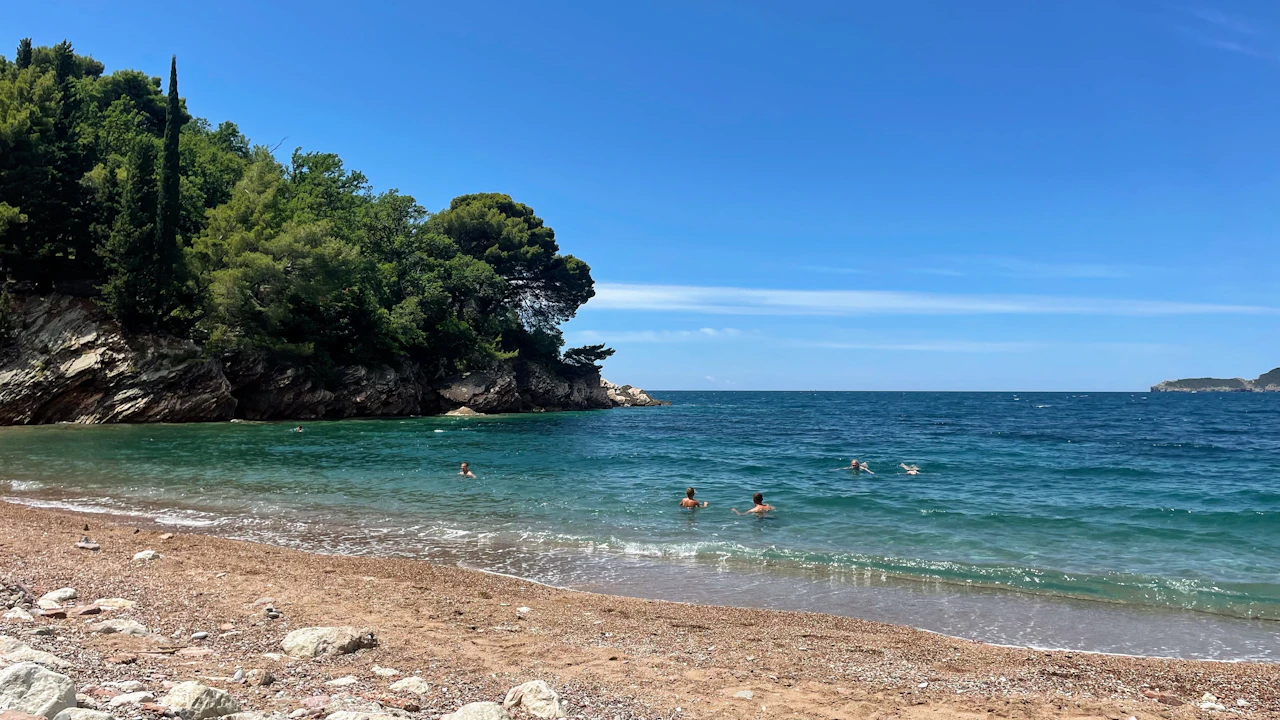
In summer, Budva works. It has to be admitted. Mogren Beach, ten minutes on foot from the old town along a path that follows the cliffside, is genuinely beautiful: a double cove set between rocks, with clear water and an atmosphere that blends international tourists with Balkan holidaymakers in a more organic way than one might expect. Jaz Beach, three kilometres to the north, is longer, more open and cheaper on sun loungers and parasols.
Budva’s nightlife has a reputation throughout the Balkans that is no accident. The clubs in the northern waterfront area, the beach bars that in some cases are semi-permanent installations with programmed DJs and deliberate décor, attract a mix of Russian and Eastern European tourists, young people from the region and travellers looking for exactly that atmosphere. It is not Ibiza, and it does not pretend to be: it is a smaller, more accessible version, with prices that even in August remain below those of any equivalent European destination.
The problem with Budva is not what it has but what it has given up to have it. The coast to the south of the old town — the area that should be the natural transition towards Sveti Stefan — is dotted with hotel complexes from the eighties and nineties carrying the specific aesthetic of that period in late and post-Yugoslav Montenegro: concrete blocks with small windows and colours that the sun has faded to indefinite shades of beige and grey. Not all of them are like this: there are more recent developments of higher architectural quality. But the overall picture is not harmonious, and anyone who arrives with the image of the stari grad in mind and stays in one of those seventies complexes has to make the conscious effort of separating one image from the other.
In August, the tourist pressure on Budva is so intense that the stari grad during the middle hours of the day becomes a continuous flow of people moving in the same direction, with the bars on the walls full and the seafront promenade converted into a succession of parasols and kiosks. It is not necessarily a bad experience if that is what you are looking for. But anyone arriving expecting peace or any intimacy with the city’s history needs to adjust their schedule: Budva before nine in the morning, when hotel guests have not yet had breakfast, is a completely different place.
The ten kilometres between Budva and Sveti Stefan
The road connecting Budva to Sveti Stefan is one of the most photogenic on the entire Adriatic. It leaves Budva heading south, climbs rapidly up the hillside, and from the viewpoint at the bend — a point where the road doubles back on itself at around two hundred metres above sea level — offers a view that takes in the Bay of Budva, the stari grad, and in the distance, just coming into view, the silhouette of Sveti Stefan.
The road descends and rises again, passing through Pržno — a small and relatively quiet cove with a couple of fish restaurants where the seafood is fresh and the prices are honest — and through Miločer, which was the summer residence of the Yugoslav royal family and now forms part of the Sveti Stefan complex as an annexe hotel.
This stretch of coast between Budva and Sveti Stefan has some of the most interesting beaches on the Riviera: Pržno with its village scale, the Queen’s Beach next to Miločer, Sveti Stefan Beach with direct views of the island. They are not free — access to some requires a minimum spend or hiring a sun lounger — but they offer a calmer and more beautiful Montenegrin coastal experience than the beaches at the centre of Budva.
Sveti Stefan: the island that became a symbol
Sveti Stefan is one of those images that you recognise instantly even without knowing what you are looking at: a small island of reddish rock, covered in stone houses clustered around a fifteenth-century church, connected to the mainland by a narrow sandy isthmus that at low tide appears as a natural path over the water. It is Montenegro’s image in every airport in the world. It is the screensaver, the travel supplement cover, the photo that comes up in every search.
The origin of Sveti Stefan is that of a fifteenth-century fishing village that used the island as a defensive refuge against pirates and Ottoman attacks. The families who lived there, known as the Paštrovići, were a warrior clan that had successfully resisted for centuries the pressures of the surrounding empires and maintained a notable degree of autonomy. The island was their fortress, their harbour and their cemetery.
The transformation came in the 1960s. Tito’s Yugoslavia needed foreign currency, and tourism was a way to obtain it without overly compromising the ideology. The inhabitants of Sveti Stefan were relocated to the mainland — with compensation, though the degree to which it was voluntary is debatable — and the entire island was converted into a luxury resort that combined the historic structure with modern hotel services. International celebrities, political leaders and European aristocrats spent their summers there during the 1970s and 1980s. The name Sveti Stefan was synonymous with Adriatic exclusivity.
The fall of Yugoslavia, the wars of the nineties and the economic uncertainty of the transition period degraded the complex. By the 2000s the island was in a considerable state of deterioration. In 2007, the Aman chain — specialising in ultra-luxury resorts in historic locations — took over the concession and renovated the complex completely. Aman Sveti Stefan opened in 2010 with prices starting at six hundred euros a night and rising to over five thousand for a private villa.
Today, Sveti Stefan is de facto inaccessible to anyone who is not a hotel guest. The path across the isthmus has a barrier. Security guards are there to enforce it. You can photograph the island from the beach, from the road viewpoint, from a hired kayak or boat. You can eat at the hotel’s restaurant on the mainland, Miločer, at prices that are expensive but not outlandish. But walking onto the island and through its stone streets, seeing the church, sitting in one of its corners: that requires booking a room.
The question everyone asks
Is it worth seeing Sveti Stefan without being able to go inside? The honest answer is yes, within its limits. The image from the beach or from the road viewpoint is real and extraordinary: the combination of the island with the colour of the water, the silhouette of the medieval houses and the quality of the light at dusk creates one of those landscapes that the Mediterranean produces with apparent ease but which are actually rare. The problem is not that the image disappoints, but that knowing you cannot enter gives it a shop-window quality that unsettles some travellers.
Spending an afternoon on Sveti Stefan Beach — the public beach at the foot of the island, which charges an entry fee of around twenty euros for a sun lounger and parasol — and watching the island change in the light during the final hours of the day is an experience that gives you plenty. The sunset from this beach, with the island in silhouette and the Adriatic in all its shades of blue and green, is memorable without needing to access the interior.
What does not work is planning your trip around Sveti Stefan as the central destination if you are not going to stay there. The island as a visual object, yes; the island as an immersive experience, no.
When Budva makes sense and when it does not
Budva makes sense in May or June, when the beaches have space, the stari grad can be explored at a calm pace, prices are reasonable and the nightlife is already working without August’s suffocation. It also makes sense in September, for similar reasons.
It makes less sense in August if you are looking for peace, quality of life or genuine contact with the city’s history. It also makes less sense if Kotor is thirty kilometres away: Kotor is historically more interesting, has better value for money in accommodation during mid-season, and the morning walk through Kotor’s stari grad has a texture that Budva can no longer offer.
But there are travellers for whom Budva is exactly right: those looking for beach, atmosphere, logistical ease and a base from which to explore the Riviera by car. For that profile, Budva remains the most practical logistical centre on the Montenegrin coast. It has the widest accommodation offer in terms of variety and relative price, the best bus connections, and the supermarkets, pharmacies and infrastructure that the smaller coastal towns do not always provide.
The Montenegrin Riviera is, in the end, not a single destination but a sum of fragments with different personalities: the medieval scale of Budva’s old town, the locked-away exclusivity of Sveti Stefan, the calm of Pržno, the long strand of Jaz Beach. Understanding that mosaic before arriving allows you to put together an itinerary that does not disappoint. The mistake would be to arrive with the postcard image — the rose-stone island over turquoise water — and expect that image to be the whole truth of the coast.
The image is real. But around it there is much more, and also considerably less, than the catalogue promises.
Far Guides’ complete Montenegro guide includes routes along the Riviera, lesser-known beaches and all the practical information to explore the coast independently.
More on Montenegro
Keep reading.
Other pieces from the same destination.

Next step
Ready for Montenegro?
The guide is for travelling.
Interactive maps & itineraries and everything that doesn't fit in an article. Always the latest published version.
Get the Montenegro guide