Uzbekistan · 24 April 2026
What to see in Tashkent: the capital nobody expects
Tashkent is more than a stopover. The Soviet metro, Chorsu bazaar, brutalist architecture and a city reinventing itself without losing its identity.
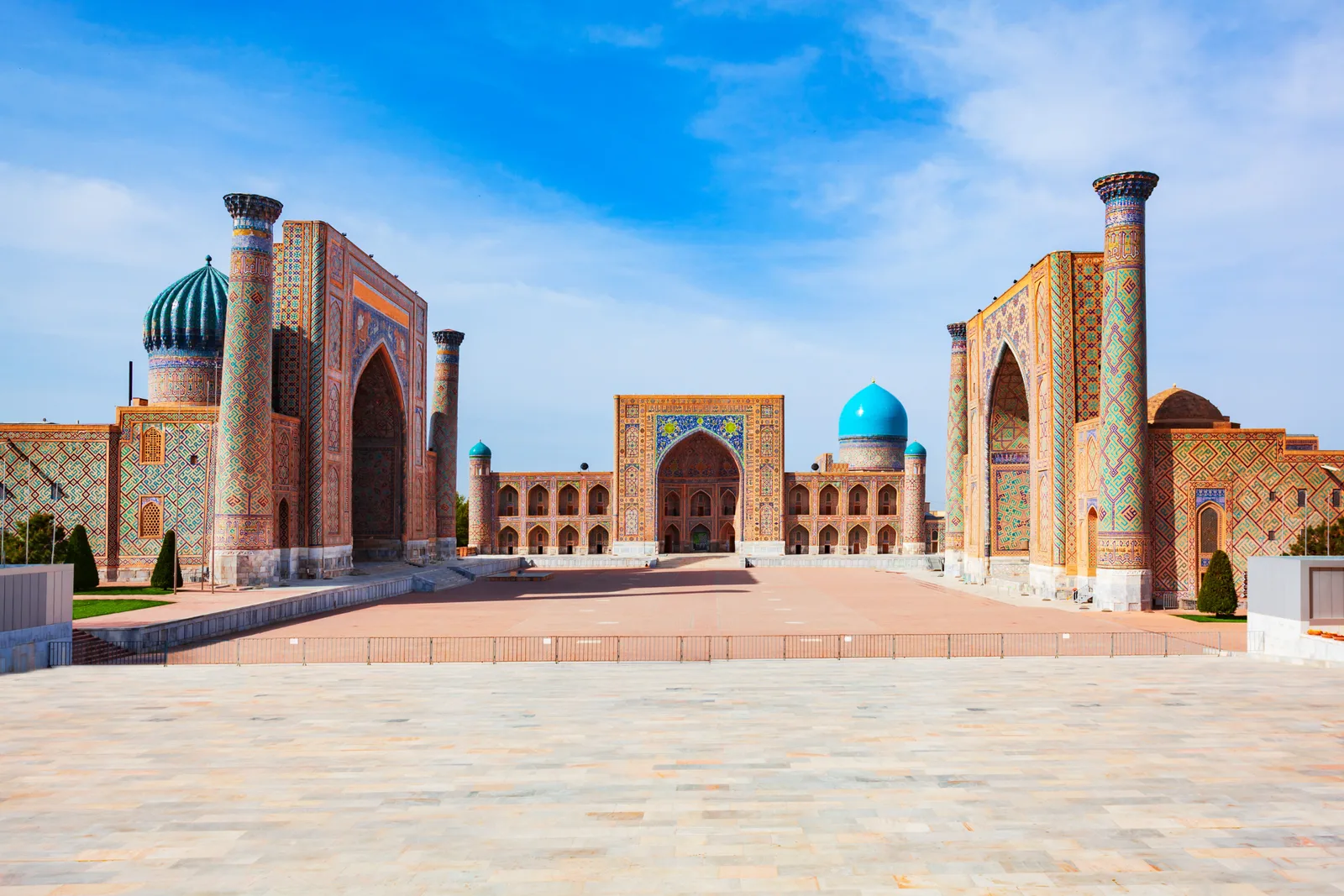
Most travellers who land in Tashkent already have their minds on Samarkand. Understandably so: the madrasas of the Registan, the mosaics of Shah-i-Zinda, the long shadow of Tamerlane. Tashkent, by comparison, looks like a city without a story. An administrative capital of wide avenues and concrete blocks. A place to pass through, not to stay in.
That is the first mistake almost everyone makes when visiting Uzbekistan. Because Tashkent does have a story — it just isn’t the one you were expecting. This is not a Silk Road city preserved in amber. It is something far more interesting: a city that was destroyed and rebuilt from scratch, one that has spent sixty years negotiating its identity between the weight of the Soviet Union and the ambitions of a young nation. And that tension, if you know how to look for it, is on every corner.
The earthquake that erased the city
On 26 April 1966, at 5:23 in the morning, an earthquake of magnitude 5.1 shook Tashkent for barely eight seconds. It was not an especially powerful quake, but its epicentre lay directly beneath the historic centre, just eight kilometres underground. The old city — adobe, unreinforced brick, narrow alleyways — collapsed almost entirely. Over 300,000 people were left homeless in a single morning.
What happened next defines Tashkent to this day. Moscow saw the catastrophe as an opportunity. Every Soviet republic was ordered to send construction brigades. Ukrainians, Russians, Georgians, Belarusians: tens of thousands of workers arrived to build a new city. Not to reconstruct the old one — to build a new one. A model Soviet city, planned from zero, with six-lane avenues, geometric parks and identical residential blocks.
The old Islamic Tashkent, the city of madrasas and caravanserais, vanished almost completely. What survived was reduced to a handful of blocks around the Hazrati Imam complex. The rest is the city Moscow designed: functional, symmetrical, monumental in its own way.
When you walk today near Amir Timur Square — the symbolic epicentre of the capital — what you see is that direct legacy. The Hotel Uzbekistan, with its facade of prefabricated concrete panels and a silhouette that resembles an open book, is pure late Soviet architecture. Inaugurated in 1974, it was for decades the tallest building in the city. It still stands today, slightly worn but imposing, like an involuntary monument to an era Uzbekistan has not quite decided whether to claim or to leave behind.
The metro: palaces underground
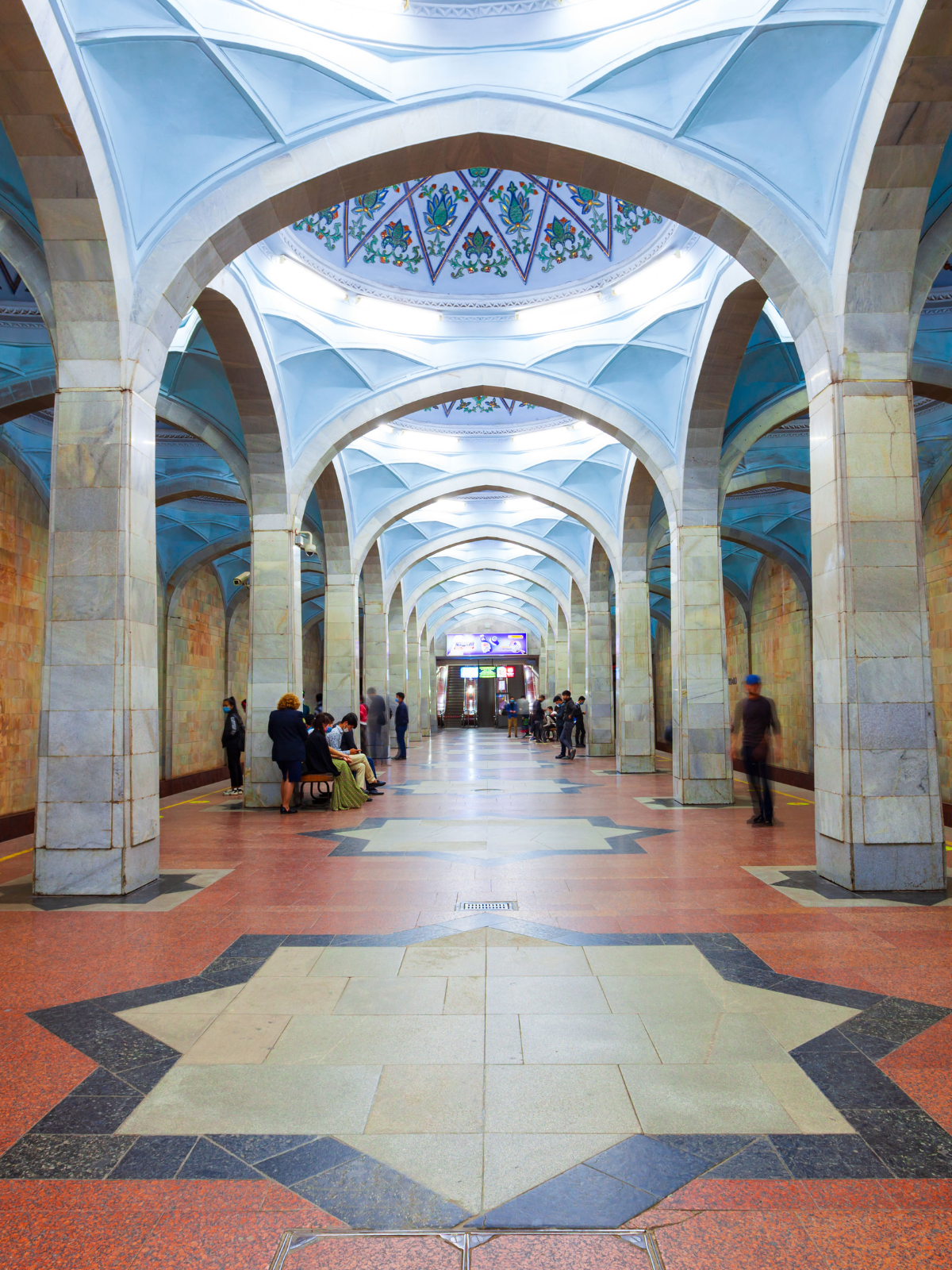
If there is one place in Tashkent where the Soviet legacy approaches something like beauty, it is the metro. Opened in 1977, it was the first in Central Asia, and for decades photographing it was forbidden — the authorities considered it strategic military infrastructure. That ban was lifted in 2018, and since then the Tashkent metro has become one of the most unexpected attractions in the country.
Every station has a unique design. These are not metro stations: they are underground galleries with an aesthetic ambition that today feels almost moving. Kosmonavtlar (Cosmonauts) is dedicated to the space race, with cobalt-blue ceramic columns and medallions depicting Gagarin and Valentina Tereshkova. Alisher Navoi pays homage to the Uzbek national poet with decorative panels that blend Islamic motifs with socialist realism. Pakhtakor celebrates cotton — the white gold that defined the Uzbek economy during the Soviet period — with golden and white mosaics.
A ticket costs less than fifteen euro cents. You can ride all three lines in a single morning, stepping off at each station to see the lobbies. It is probably the cheapest and most surprising monument in all of Uzbekistan. And also the most revealing: those stations were designed to demonstrate that socialism could offer public beauty, accessible and everyday. That art did not have to live in museums but could inhabit the places people pass through each day on their way to work.
That idea, stripped of its ideological baggage, remains powerful.
Chorsu: the real city
If the metro is Soviet Tashkent, Chorsu bazaar is the Tashkent that existed before — and that, against all odds, still exists. It is the oldest market in the capital, located in the heart of the old city, beneath a vast turquoise dome visible from a distance.
Stepping into Chorsu means crossing an invisible border. Outside: wide avenues, heavy traffic, modern Tashkent. Inside: a different logic. The stalls are organised by trade, as in medieval bazaars: spices here, meats there, dried fruits further on. An entire section is devoted to bread — the smoking tandoor ovens where lepyoshka, the round, dense loaves that are the foundation of Uzbek food, are baked. The women who sell them have been there for hours, since before dawn.
This is not a market for tourists. It is where Tashkent’s residents buy what they eat every day. You can tell from the prices, the rhythm, the near-total absence of souvenirs. If you want to have breakfast in Tashkent the way locals do, sit down in one of the bazaar’s eateries and order a plate of lagman — hand-pulled noodles in a lamb and vegetable broth — or a samsa fresh from the clay oven. It costs less than a euro and is, quite possibly, the best breakfast you will have on your entire trip.
Chorsu is open every day, but Sunday morning is when it reaches peak intensity. The market spills beyond the dome and stretches into the surrounding streets. It is chaotic, noisy, fascinating. It is the Tashkent that the 1966 earthquake could not quite erase.
Hazrati Imam: what survived
About fifteen minutes on foot from the bazaar, heading north, lies the Hazrati Imam complex. It is the religious heart of Tashkent and one of the few fragments of the pre-Soviet city that have survived to the present, though heavily restored.
The complex includes the Barak-Khan madrasa (16th century), the Tillya Sheikh mosque and the mausoleum of Kaffal Shashi, a 10th-century Sufi saint venerated across Central Asia. But what draws most visitors is what the library of the Islamic Institute holds: the Quran of Uthman.
It is one of the oldest Quranic manuscripts in the world, dated to the 7th or 8th century. According to tradition, it is one of the original copies commissioned by Caliph Uthman ibn Affan, the third of the Rightly Guided Caliphs, and it bears stains that legend attributes to his blood — he was assassinated while reading it. The real history is more complex: the manuscript has travelled half the world, from Samarkand to Saint Petersburg and back, and scholars debate its exact dating. But seeing it there, in a climate-controlled display case, in a silent library in Tashkent, is one of those moments when history stops being abstract.
The Hazrati Imam complex has been extensively renovated in recent years. It is cleaner and more orderly than it probably ever was. But it serves its purpose: reminding you that Tashkent did not begin with Soviet concrete. That before the six-lane avenues there was an Islamic city with madrasas, mausoleums and narrow streets. That city was erased, but not entirely.
The brutal beauty of concrete
There is a type of traveller who goes to Tashkent specifically for its Soviet architecture. Not out of nostalgia, but out of genuine interest in a heritage that is disappearing at great speed. And Tashkent, alongside Minsk and Almaty, is one of the best cities in the world for it.
The Navoi Opera and Ballet Theatre is the best-known example. Built between 1942 and 1947 — in the middle of the Second World War, using labour that included Japanese prisoners of war — it is a Stalinist neoclassical building whose interiors blend Soviet ornamentation with Uzbek decorative motifs. Each of its six halls is dedicated to a region of Uzbekistan, with murals and plasterwork that combine the two aesthetic traditions in a way found nowhere else.
The Palace of People’s Friendship, with its concrete-and-glass facade and circular plan, is Soviet brutalism in its purest form. The Senate building, the television tower, the residential blocks of the Chilanzar district: all form part of a coherent urban landscape, designed to impress at a scale that Western urbanism of the same era rarely attempted.
It is an uncomfortable heritage. For many Uzbeks, those buildings represent decades of cultural imposition, an identity dictated from Moscow. But they are also, objectively, architecture of enormous ambition and, at their best, of an austere beauty that deserves attention.
The new Tashkent: between ambition and amnesia
In recent years, Tashkent has entered a phase of accelerated transformation. President Mirziyoyev, who came to power in 2016 following Karimov’s death, has driven an economic opening that translates, among other things, into a construction boom.
Tashkent City is the most visible symbol. A complex of glass-and-steel skyscrapers in the city centre, where a Soviet residential neighbourhood once stood. Office towers, shopping malls, international hotels. Tashkent’s skyline has changed more in five years than in the three preceding decades.
The transformation has its lights and shadows. On one hand, the city is more open, more dynamic, more connected to the world. Speciality coffee shops have appeared, Korean restaurants — a legacy of the Korean diaspora deported by Stalin to Central Asia in the 1930s — and a food scene that would have been unthinkable ten years ago. The Korean influence in Tashkent is, in fact, one of its most distinctive features: there are entire neighbourhoods where the signs are in Korean, where people eat kuksi (cold Korean-Uzbek noodles) and where the bakeries sell pastries with an aesthetic that could be from Seoul.
On the other hand, modernisation often advances with little regard for what came before. Entire neighbourhoods are demolished to make way for new developments. Soviet buildings of architectural interest disappear without documentation or debate. The urban amnesia — already practised on the Islamic city in 1966 — is now being repeated with the Soviet city.
A city of layers
The charm of Tashkent is that it never gives you what you expect. It is not beautiful in the conventional sense. It lacks Samarkand’s perfect postcard and Bukhara’s immediate appeal. What it has is something rarer: layers of history stacked on top of one another, visible if you pay attention. The Islamic fragment that survived the earthquake. The Soviet gesture that survived independence. The modernising impulse that is erasing the Soviet.
Walking through Tashkent means traversing those layers. Emerging from the metro at Kosmonavtlar station, with its ceramic cosmonauts, and walking to Chorsu, where a woman sells you samsa for thirty cents. Crossing from Amir Timur Square, with its equestrian statue and geometric garden, to the Korean quarter of Mirzo Ulugbek, where an unmarked restaurant serves the best bibimbap in Central Asia. Visiting Hazrati Imam in the morning, when the light falls at an angle across the courtyard and there is almost nobody around, then taking the tram to Tashkent City to see the skyscrapers reshaping the skyline.
None of those experiences, on its own, justifies a trip. But together they compose something few cities offer: the sensation of watching, in real time, how a place negotiates with its past to build its future. Tashkent is not a museum city. It is a living, contradictory city in permanent transformation. And that, if you are willing to look at it with attention, is far more interesting than any monument.
Give it at least two full days. One is not enough to understand what you have in front of you.
For the full picture of every city, route and hidden corner in Uzbekistan, the Far Guides complete guide has it all: interactive maps & itineraries, information that stays up to date.
More on Uzbekistan
Keep reading.
Other pieces from the same destination.


Next step
Ready for Uzbekistan?
The guide is for travelling.
Interactive maps & itineraries and everything that doesn't fit in an article. Always the latest published version.
Get the Uzbekistan guide