
Uzbekistan · 28 March 2026
What to see in Uzbekistan: the places that actually matter
A practical guide to Uzbekistan's unmissable sights: from the Registan of Samarkand to Khiva's walled city, with the Bukhara bazaars in between.
Uzbekistan is one of those destinations where the reality consistently exceeds the expectation. The Silk Road cities, the thousand-year-old bazaars, the tilework that makes no architectural sense until suddenly it makes perfect sense — it adds up to one of the most singular journeys available to a traveller from Europe. The question is never whether to go, but where to start.
This guide covers the places that genuinely warrant the detour, in roughly the order that a well-structured itinerary would encounter them.
The Registan, Samarkand
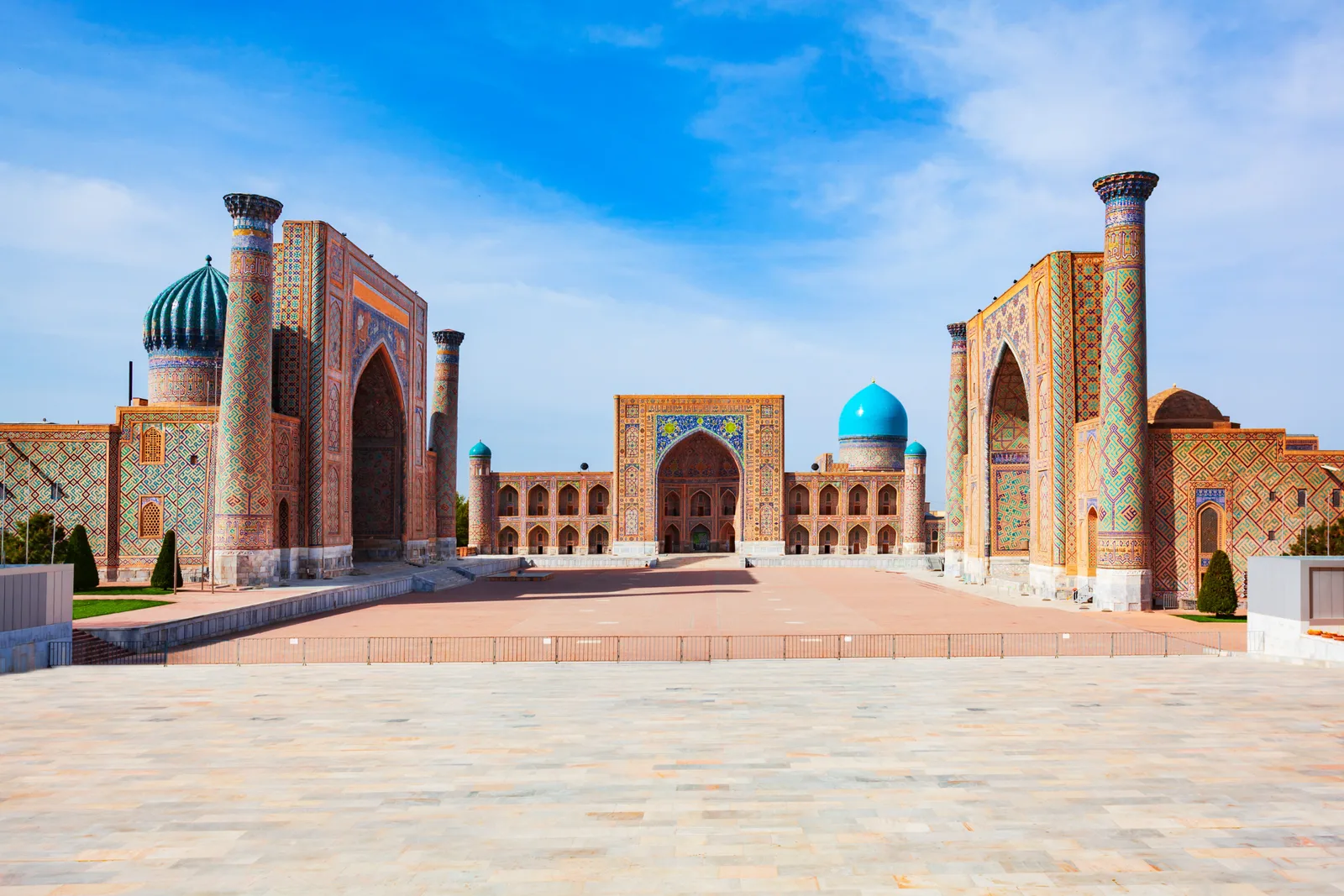
If there is a single image of Uzbekistan, it is this: three madrasas facing each other across a monumental square, their façades covered in turquoise and cobalt tilework under a sky that is almost always a specific shade of Central Asian blue. The Registan is what Tamerlane’s successors built when they wanted to demonstrate what power looked like. It worked then and it works now.
The three madrasas span three centuries: the Ulugbek (1420), the Sher-Dor (1636) and the Tilya-Kori (1660). Each has a slightly different character. The Ulugbek is the most scholarly — Ulugbek was an astronomer-king who built it as a genuine place of learning. The Sher-Dor is the most iconographically surprising: its portal has tigers chasing deer under stylised suns, which is unusual in Islamic architecture’s general avoidance of animal imagery. The Tilya-Kori is the most gilded.
Arrive at opening time (9:00) to have the square nearly to yourself. The entry fee is around 8$.
Shah-i-Zinda, Samarkand
The “Avenue of the Living King” is the most spiritually charged place in Samarkand and, paradoxically, the least visited by the tour groups that flood the Registan. A narrow lane climbs through a succession of mausoleums from the 14th and 15th centuries, each with tilework that makes the technical achievement of the Registan look almost routine. The blue here is different — more intimate, more varied, more human in scale.
It is also an active pilgrimage site. The legend holds that Kusam ibn Abbas, a cousin of the Prophet Mohammed, is buried here and did not die but went underground, still living. On any given morning there are Uzbek women in headscarves pressing their hands to the tile, praying. This does not feel performative. It feels like the place is still working.
Bukhara’s historic centre
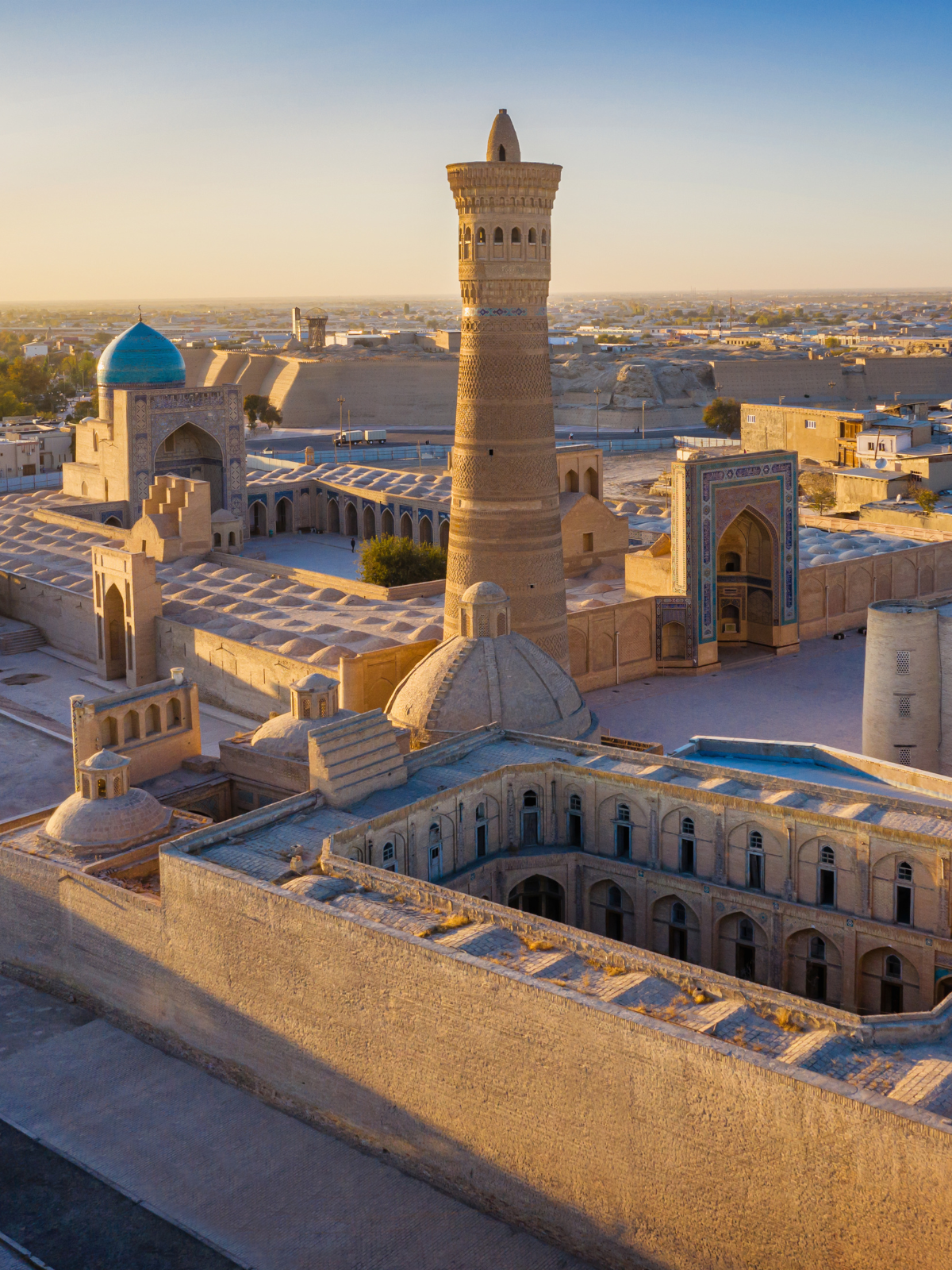
If Samarkand is the showpiece, Bukhara is the city. Its historic core is largely original — the Kalon Minaret (1127) survived Genghis Khan’s destruction of the city because, according to a probably apocryphal story, the Khan was so impressed he ordered it spared. The medieval bazaar domes (Toqi Zargaron, Toqi Telpak Furushon) are intact 16th-century market infrastructure. The Lyabi-Hauz pool, surrounded by mulberry trees, has been the social centre of the neighbourhood for four centuries.
Walk the old city without an itinerary for at least one afternoon. The streets between the monuments are where Bukhara reveals itself.
Khiva’s Ichan Kala
Khiva’s inner walled city is the most completely preserved of the three Silk Road cities — and the one that feels most like a museum, for better and worse. More than 60 monuments inside 30 hectares, almost all restored, with barely any of the city’s actual population living within the walls. The Kalta Minor, the stubby unfinished minaret covered in turquoise tiles that was meant to be the tallest in Central Asia before its commissioning khan died; the Islam Khoja minaret (1910), the tallest in Khiva; the Tash-Hauli palace — all within walking distance of each other.
The trick is to arrive early in the morning, before the tour groups, when the alleys are quiet and the light on the tilework has a quality that midday eliminates entirely.
Tashkent’s metro stations
A metro system on a list of unmissable sights requires justification. Tashkent’s metro, opened in 1977, is that justification. Each station was designed as an individual architectural statement: Kosmonavtlar has space-age metalwork, Alisher Navoi has carved plasterwork celebrating Uzbek poets, Pakhtakor has glass mosaics in Soviet agricultural-heroic style. A ticket costs around 0.12$ and the train will take you from one to the next in minutes.
The Eski Shahar (old city) district around the Chorsu bazaar is worth at least a morning: the blue-domed market building, the streets where the samsa vendors set up before 9:00, the Hazrat Imam complex with what may be the world’s oldest Quran (7th century, reportedly stained with the blood of the caliph Uthman).
The Chorsu Bazaar, Tashkent
The oldest market in the capital. The exterior dome of blue metal dominates the street. Inside: spices sold by weight, dried fruits from the Fergana Valley, cuts of lamb and mutton, bread from tandoor ovens. Arrive before 10:00 for breakfast — a bowl of shurpa (lamb broth), a samsa (baked meat pastry) and a glass of green tea eaten standing at a table shared with strangers is as good an introduction to Uzbekistan as any monument.
Ulugbek’s Observatory, Samarkand
On the outskirts of Samarkand, in what is now a quiet residential area, the astronomer-king Ulugbek built in 1420 the most precise observatory of the medieval world. His star catalogue, completed in 1437, was not surpassed in accuracy until the 17th century. What survives is the underground arc of the enormous sextant that he used to measure the positions of celestial bodies. The museum above it is small, the visit takes 45 minutes, and most tour groups skip it entirely.
The Kyzylkum Desert routes
A few kilometres outside Bukhara, the Kyzylkum desert begins. Day excursions allow access to sand dunes, saxaul forests and the particular silence of Central Asian steppe. For those with more time, the network of yurt camps between Nurata and Bukhara offers a night in the desert — dinner by firelight, camels at dawn, a sky with no light pollution whatsoever.
The Fergana Valley
The economic and cultural heart of Uzbekistan: a fertile valley surrounded by mountains, producing the country’s finest silk, ceramics and fruit. The town of Margilan has workshops where silk is still woven on hand looms. Rishtan produces the blue-glazed ceramics that end up in markets across the country; the best pieces are made by individual master craftsmen, not factories. Few tourists make the detour. That is their loss.
The Aral Sea (for the determined)
The Aral Sea was once the fourth-largest lake in the world. Soviet irrigation policy in the 1950s-60s diverted its two feeder rivers to grow cotton in the desert. By the 1980s it was collapsing; today it has lost more than 90% of its volume. What remains near Moynaq — the rusting hulls of fishing boats stranded on what was once the harbour floor, now kilometres from any water — is one of the most haunting landscapes on earth.
Getting there requires two days from Nukus, a willingness to handle basic logistics independently, and a tolerance for the emotional weight of witnessing an ecological catastrophe at human scale. It is, in that sense, unlike any other destination in this list.
How many days do you need in Uzbekistan?
- 7 days: Tashkent, Samarkand, Bukhara. The minimum circuit that makes sense.
- 10 days: Add Khiva and a day in the Fergana Valley.
- 15 days: The full country, with desert nights and the Aral Sea.
The complete Far Guides Uzbekistan guide includes detailed Silk Road routes, interactive maps and all the practical information you need to plan your independent trip.
More on Uzbekistan
Keep reading.
Other pieces from the same destination.


Next step
Ready for Uzbekistan?
The guide is for travelling.
Interactive maps & itineraries and everything that doesn't fit in an article. Always the latest published version.
Get the Uzbekistan guide