

Uzbekistan · 17 July 2026
The Silk Road: history of the route that connected civilisations
The Silk Road was not a single route and it didn't only carry silk. It was the nervous system of pre-modern Eurasia: ideas, religions, plagues and technology all travelled along it.

The name “Silk Road” was invented by a German geographer in 1877. Ferdinand von Richthofen used it in a book on China to describe the trade routes connecting the Roman Empire with the Han dynasty. The irony is that those routes had existed for more than a thousand years before anyone gave them that name, and throughout that time they carried not only silk: they carried paper, gunpowder, compasses, spices, horses, diseases, Buddhism, Islam, Manichaeism and the idea that the world was larger and more connected than any single civilisation could imagine on its own.
Calling it a “road” is also an error of precision. It was a network: dozens of overland and maritime routes that branched, converged, were interrupted by war and reopened by peace, with northern variants (across the Kazakh steppe), central ones (through the Central Asian cities) and southern ones (through India and the Indian Ocean). To speak of the Silk Road as if it were a single path with a beginning and end is like speaking of “the internet” as if it were a cable.
What travelled along the routes
Silk was the most coveted Chinese product in Rome because it was impossible to manufacture anywhere else: the secret of the silkworm was guarded for centuries under penalty of death. In the first century CE, a pound of silk in Rome was worth the same as a pound of gold. The silk trade generated a Roman trade deficit so large that several emperors attempted to ban its import without success. The Romans, in exchange, exported glass — a technology that China took centuries to master — and gold.
Paper reached Europe along these routes: developed in China in the second century CE, it spread westward along the trade routes, reached the Islamic world in the eighth century after the Battle of Talas (751 CE, where the Arab army defeated the Tang and captured artisans who knew the process), and arrived in Europe in the twelfth century. A thousand years of travel for a sheet of paper.
The Ferghana horses — the “heavenly horses” of Chinese texts — were a Han dynasty obsession. Central Asian horses were larger and stronger than Chinese ones, and Emperor Wu sent two armies westward during the second century BCE to obtain them, in the process opening the trade route that would connect the two extremes of Eurasia. The search for horses, before silk, was the engine that set the network in motion.
The intermediaries
The Sogdians were the great forgotten protagonists of the Silk Road. An Iranian people established in the heart of Central Asia — with Samarkand and Bukhara as their main cities — Sogdian merchants dominated Asian commerce for more than a thousand years, from the third to the tenth century CE. They were not conquerors or rulers: they were extraordinarily organised traders, with colonies in Chang’an, in Mongolia, in Siberia, in India, in Byzantium.
What they carried was not only goods: it was culture. Sogdian merchants brought Buddhism to China, translated Sanskrit texts into Chinese and Persian, spread Manichaeism across Asia, introduced board games, musical instruments and artistic techniques. The seventh-century frescoes of the Afrasiab palace in Samarkand show exactly this world: ambassadors from China, India, the Iranian world and the Mediterranean gathered at the court of a Sogdian king.
The ideas that travelled
Buddhism was born in India in the fifth century BCE and reached China along the Silk Road: the earliest Buddhist texts in Chinese were translated in the first century CE from Sogdian and Parthian versions. Islam, emerging in Arabia in the seventh century, spread eastward along the same routes in under a century: Samarkand fell under Arab control in 712 CE. Nestorian Christianity — declared heretical in Byzantium — survived and flourished in Central Asia and reached China before the seventh century. The Silk Road did not only carry commerce: it was the circulatory system of ideas in pre-modern Eurasia.
Plagues also travelled. The Plague of Justinian (541-549 CE) — possibly the same bacterium that would cause the Black Death — reached the Roman Empire along trade routes from Central Asia. The Black Death (1347) reached Europe from the Eurasian steppe, possibly carried by caravans following the Mongol routes opened by Genghis Khan a century earlier. Commerce and disease share the same paths: wherever people circulate, everything they carry circulates with them.
The decline and the legacy
The overland Silk Road routes entered definitive decline in the fifteenth century for several converging reasons: Tamerlane’s conquests disrupted trade networks that had taken centuries to stabilise, the Ottoman Empire blocked routes westward, and Portuguese navigators opened maritime routes that made trade with Asia faster and cheaper than any overland path.
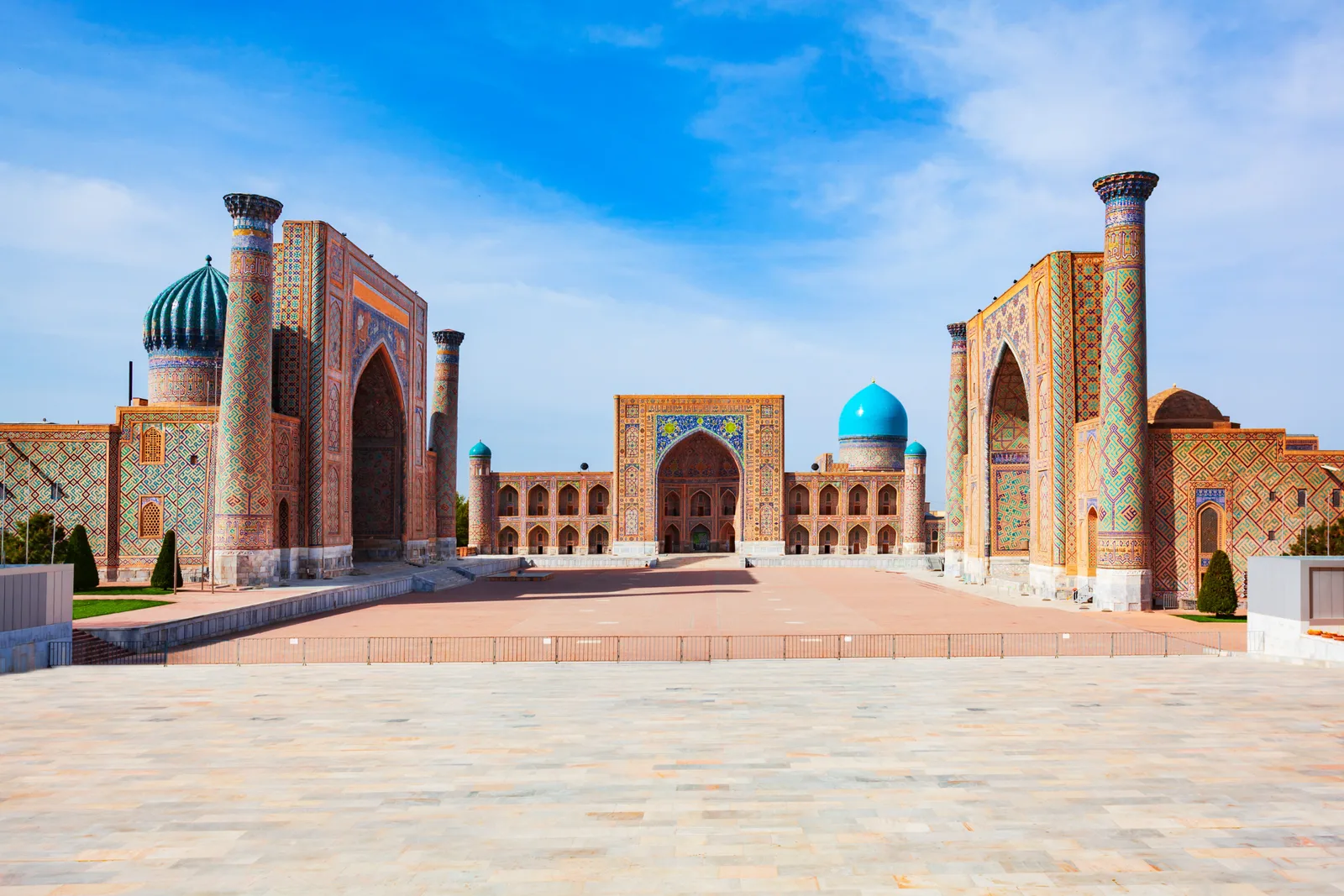
What remained were the cities: Samarkand, Bukhara, Khiva, Merv. Cities that existed because they were on the routes, and which, when the routes lost their importance, were left in a kind of historical suspension. It is that suspension — the fact that the wealth of commerce became crystallised in their monuments rather than being swept away by industrialisation — that makes a journey to Uzbekistan more than a tourist visit: it is an encounter with the actual physics of how the world connected itself before steamships existed.
The complete Far Guides Uzbekistan guide includes detailed Silk Road routes, interactive maps and all the practical information you need to plan your independent trip.
More on Uzbekistan
Keep reading.
Other pieces from the same destination.


Next step
Ready for Uzbekistan?
The guide is for travelling.
Offline maps, itineraries and everything that doesn't fit in an article.
Get the Uzbekistan guide