
Uzbekistan · 18 September 2026
Timurid architecture: why the blue matters
The turquoise and cobalt tile mosaics of Samarkand and Bukhara's madrasas and mausoleums represent the peak of medieval Islamic architecture. Why they are so extraordinary.

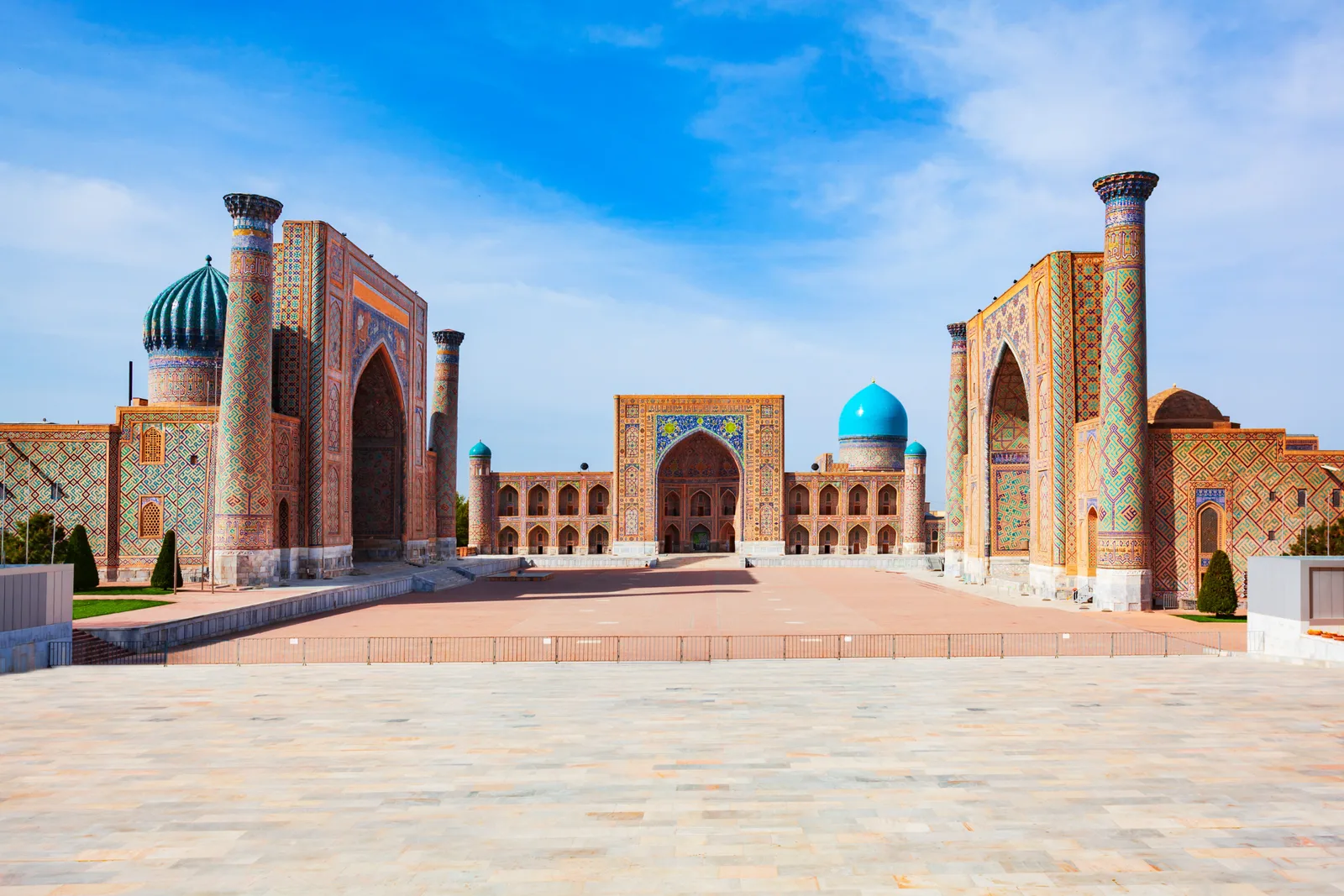
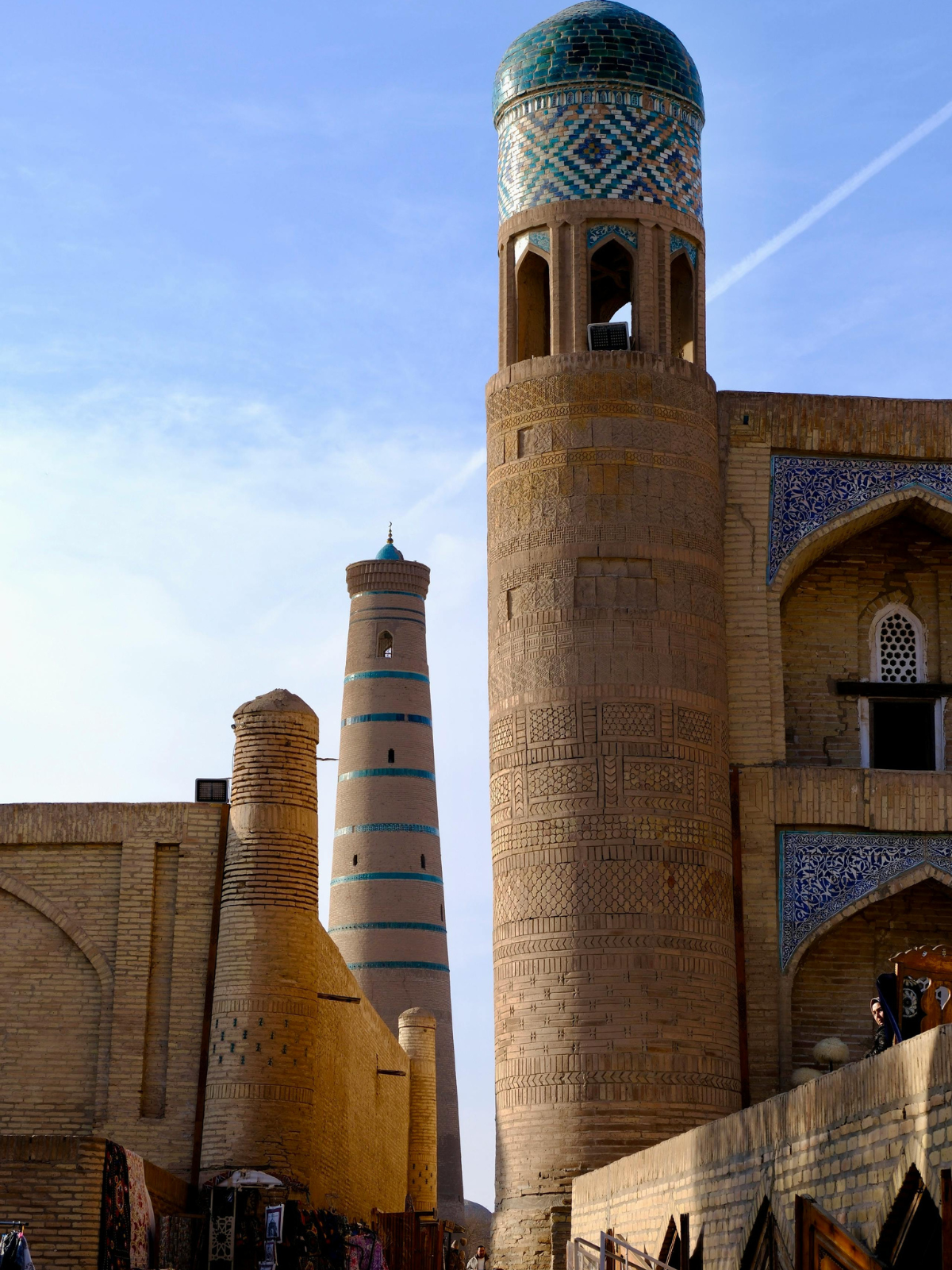
There is a technical decision in the Timurid mosaic that most visitors to the Registan do not notice because they are not looking for it: each tile piece is cut individually by hand and placed so that the mortar joint becomes invisible. In the finest mosaics of the fourteenth and fifteenth centuries, the result is a surface that appears continuous, as if the colour were not an addition applied to stone but the material’s own nature. That illusion — that the building is blue from within, not just on its surface — is the most sophisticated technical and aesthetic achievement of Central Asian Islamic architecture.
Understanding how that illusion works and why it exists entirely changes the experience of standing before Timurid architecture.
The portal and its logic
The most characteristic architectural element of the Timurid period is the pishtak: the monumental pointed-arch portal that frames the entrance to madrasas, mausoleums and mosques. The Timurid pishtak is not simply a large door: it is a machine for creating perspective.
The pointed arch — which medieval Islamic architects knew could be built much taller than a semicircular arch for the same load — is framed by a rectangular wall surface that always sits behind the arch, creating a vertical plane that receives the decoration. That rectangular surface, combined with the pointed inner arch, generates a perspective that makes the portal appear taller than it is when viewed from the central axis. Timurid architects knew this and calculated it: the rectangle’s proportions, the arch’s depth, the angle of the tiles — everything is calibrated to maximise that effect from the viewpoint of the pedestrian approaching.
The bands of Arabic script — Kufic or Naskhi, white on blue or blue on white — that frame the portals are not merely decorative. They are the building’s title, its function, its date and the names of its builders: a permanent inscription that in a culture with high illiteracy rates reserved reading for scholars while making the monumentality visible to everyone.
The colour and its origins
The cobalt blue dominating Timurid architecture comes from lapis lazuli mined in Badakhshan, in present-day Afghanistan: ground lapis lazuli produces the most stable and most intense pigment medieval craftspeople knew. Turquoise — the other dominant colour — comes from copper oxide combined with tin. White is kaolin. Black, manganese oxide. All of these materials were expensive, some brought from great distances, and the decision to cover the facades of the most important buildings with mosaics of this quality was an economic act as much as an aesthetic one: it was the demonstration that the power could afford the finest raw materials in the known world.
Tamerlane, when commissioning his buildings in Samarkand, brought artists and craftspeople from across his conquests. After the Persian campaign (1386-1388), Persia’s finest ceramicists worked in Samarkand. After the conquest of India (1398), Indian technicians arrived with engineering knowledge that Central Asian builders did not possess. Timurid architecture is the result of an imperial synthesis: Persian in its decoration, Central Asian in its scale, with influences from the Arab, Indian and Chinese worlds in details that specialists can read and ordinary travellers perceive without needing theory.
The ribbed dome and its influence
The ribbed dome — with its vertical ribs that create a sense of movement and divide the surface into segments — is the most recognisable and most influential Timurid element. The dome of the Gur-e-Amir, Tamerlane’s mausoleum in Samarkand, built in 1405, is the prototype: its sixty-four channels, clad in blue-turquoise tiles, created a model that the architects of Mughal India — Tamerlane’s direct descendants — adopted and transformed into the domes of the Taj Mahal, built in Agra two hundred and fifty years later.
The connection between Samarkand and the Taj Mahal is not metaphorical: it is genealogical. India’s Mughal emperors were descendants of Babur, Tamerlane’s great-grandson, who conquered India from Kabul in 1526. The architecture they carried in memory — or in the drawings they commissioned — was the Timurid architecture of Samarkand. The Taj Mahal is, in a real sense, Samarkand rebuilt in white marble in a different climate.
Shah-i-Zinda as a manual of techniques
If the Registan shows Timurid architecture at its maturity, Shah-i-Zinda shows its process. The “avenue of mausoleums” — built over nearly a hundred years, from the mid-fourteenth to the mid-fifteenth century — allows comparison of different decorative techniques across a space of a few hundred metres: cut tile mosaics in the earliest structures, painted majolica in the later ones, combinations of gilded relief and tilework in the most elaborate.
What makes Shah-i-Zinda unique as an experience is not the quality of any individual mausoleum — though some are extraordinary — but the possibility of walking between them and seeing the evolution of a decorative language over time. It is, for the traveller interested in architecture, one of the most instructive walks available anywhere in Asia.
The complete Far Guides Uzbekistan guide includes detailed Silk Road routes, interactive maps and all the practical information you need to plan your independent trip.
More on Uzbekistan
Keep reading.
Other pieces from the same destination.


Next step
Ready for Uzbekistan?
The guide is for travelling.
Offline maps, itineraries and everything that doesn't fit in an article.
Get the Uzbekistan guide