Montenegro · 18 May 2026
Ostrog Monastery: built into the living rock
The most visited Orthodox monastery in the Balkans, carved into a cliff at 900 metres. The story of St Basil and why thousands of pilgrims sleep at its gates.

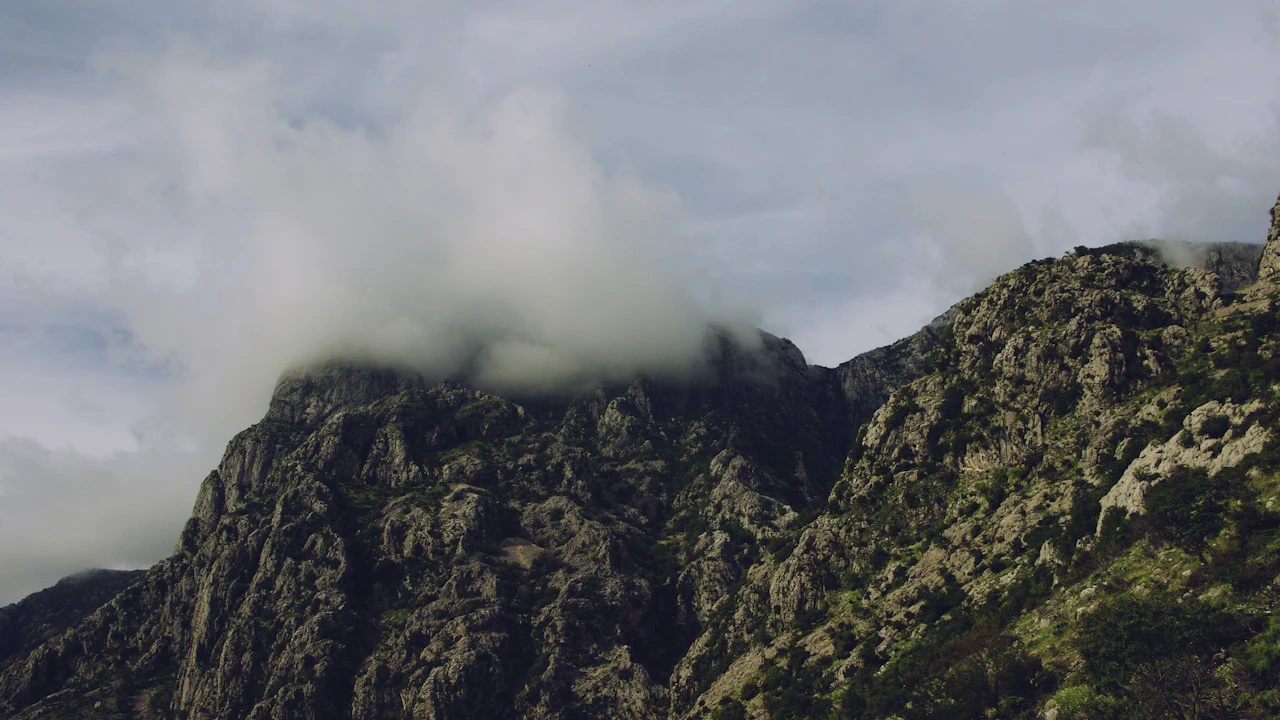
There is a moment on the road up to Ostrog Monastery — one of the most winding roads in Europe, with hairpin turns that force inexperienced drivers to pull into passing places — when the vertical rock face appears directly through the windscreen. And there, wedged into a natural crack in that cliff face as though placed by someone with a good eye for impossible geometry, is the monastery. White, small, suspended over the void, visible from kilometres away but incomprehensible until you are standing directly beneath it.
Ostrog is Montenegro’s most visited site, not because of international tourists but because of Balkan pilgrims from the region itself. On summer weekends, the lower car parks fill from dawn. Families walk the four kilometres up from the lower monastery. Pilgrims make the journey barefoot. It is one of those places that operates on several levels simultaneously — religious, historical, scenic — and that resists reduction to any single category.
St Basil and the crack in the mountain
The monastery was built in the seventeenth century by Vasilije Jovanović Ostroški, better known as St Basil of Ostrog, a monk and bishop who came from Herzegovina and found in the vertical rock face of Ostroška Greda mountain the place he had been looking for. The choice of location was not arbitrary: medieval monks — and their predecessors in Christian asceticism, the anchorites of the Syrian and Egyptian deserts — deliberately sought out inaccessible places that served both as physical protection against the armies patrolling the Balkans and as metaphors for separation from the world.
What Basil did not calculate — or calculated with more precision than it appears — was that the difficulty of access would turn the monastery into a pilgrimage destination. He died in 1671 and was canonised by the Serbian Orthodox Church in 1692. His relics — an incorrupt body, which the faithful consider proof of sainthood — remain in the upper monastery and are the primary object of pilgrimage.
The two monasteries
Ostrog is actually two distinct complexes at different altitudes, connected by the road of impossible bends and by the pilgrim footpath.
The lower monastery, the Church of the Holy Trinity, is a nineteenth-century building in the more conventional style of Orthodox ecclesiastical architecture: dome, arcades, frescoes inside. It sits in a wooded valley and serves as the starting point for those who walk up. Its atmosphere is quieter, less frenetic than the upper complex.
The upper monastery is another matter. The two churches — Krstovača (the Church of the Holy Cross) and Introduktsia (the Church of the Presentation) — are literally carved into the rock or wedged into its natural fissures. The one housing St Basil’s relics is a dark, narrow chamber where the faithful queue for hours, in silence, to approach the reliquary. The seventeenth-century frescoes decorating some interior surfaces are extraordinary given the context: painted in a cave at nine hundred metres, preserved under conditions that are hostile to any form of art.
Pilgrimage as a social phenomenon
What makes Ostrog different from other Orthodox monasteries in the Balkans is the demographic of its visitors. It is not primarily a destination for foreign tourists — though their numbers are growing — but an active pilgrimage site for Montenegrins, Serbs, Bosnians and Albanians, both Christian and, to a lesser extent, Muslim. This religious porousness is remarkable: St Basil’s name crosses confessional boundaries in a region where those boundaries have cost wars.
The pilgrims who sleep outdoors in the monastery grounds — a regular occurrence on the nights before major religious feast days, especially St Basil’s Day on 12 May — do so for reasons ranging from conventional devotion to something harder to categorise: the search for protection, gratitude for a healing attributed to the saint, the fulfilment of a vow. The Montenegro Orthodox Church has for decades been documenting testimonies from people who attribute miraculous healings to St Basil’s intercession. Whatever one’s position on miracles, those testimonies are first-hand documents of how faith operates in this corner of Europe.
The road and the logistics
Reaching Ostrog via the monastery road itself — which spirals up from the main E65 highway — is an experience in its own right. It is approximately four kilometres of narrow tarmac with very tight bends, some sections without guardrails, and a drop immediately to one side. It is not technically difficult if driven carefully and oncoming traffic is respected, but anyone unused to mountain roads may find it stressful. In high season — primarily July and August — traffic can create significant queues.
There is an alternative: park at the base of the mountain and take the pilgrimage minibuses that operate during summer. Or walk up, which is roughly four kilometres from the lower monastery and takes between one hour and ninety minutes depending on pace.
Entry to the monastery is free. The dress code is standard Orthodox: shoulders and knees covered. In the car park and along the path there are vendors selling candles, icons and holy water. Opening hours vary by season; in summer the complex is generally accessible from dawn until late at night.
The best time to visit is early morning, before the organised tour coaches arrive from the coast. At that hour — with the rock face lit by oblique dawn light and the white monastery set against the grey stone — Ostrog has a visual quality that justifies an early start.
The complete Far Guides Montenegro guide includes detailed routes, interactive maps and all the practical information you need to plan your independent trip.
More on Montenegro
Keep reading.
Other pieces from the same destination.
Next step
Ready for Montenegro?
The guide is for travelling.
Interactive maps & itineraries and everything that doesn't fit in an article. Always the latest published version.
Get the Montenegro guide