


Montenegro · 8 April 2026
Kotor: the bay that Europe forgot
A medieval Venetian town enclosed between mountains and sea. Why Kotor is the Adriatic's best-kept secret.
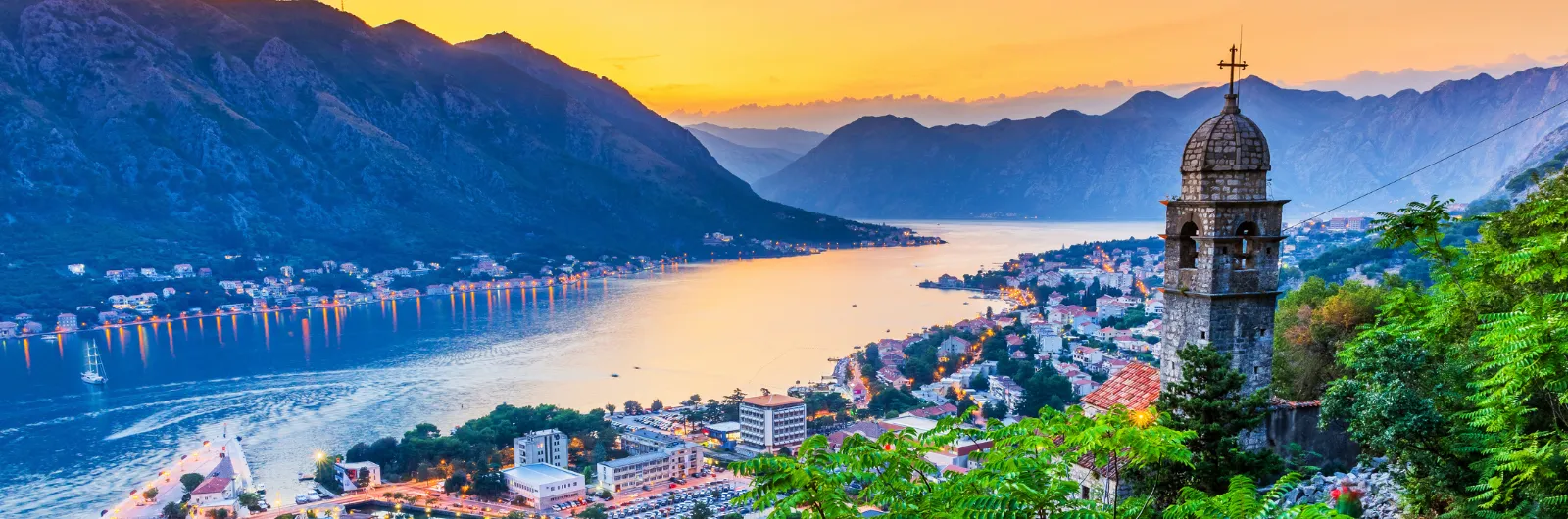
There is a Norwegian word, fjord, that describes something very specific: a long, narrow arm of sea formed by glacial erosion, surrounded by steep mountains, with deep water and quiet currents. In Scandinavia this is everyday landscape. But there is another fjord, the only one of its kind in southern Europe, and it lies on the coast of Montenegro. The Boka Kotorska — the Bay of Kotor — is not technically a fjord in the strict geological sense, but it is the closest thing the Mediterranean can offer: a seaway that penetrates twenty-five kilometres inland, folding back on itself, enclosed by the vertical walls of the Lovćen and Orjen mountains, with medieval villages leaning over the water as if time had lost track of them.
At the far end of that bay stands Kotor. And Kotor is, quite possibly, the most surprising city in the Balkans.
The problem with comparing it to Dubrovnik
The first thing most people do when they hear about Kotor is compare it to Dubrovnik. It’s about ninety kilometres to the north, it also has medieval walls, it’s also a UNESCO World Heritage Site, and it also looks out over the Adriatic. The comparison is inevitable, but it is also misleading, because the two cities are profoundly different in character, scale, and in what they offer the traveller who knows how to look.
Dubrovnik is large, self-aware, managed as a cultural product. The wall encircling the old town — the famous and genuinely beautiful wall — receives close to two million visitors a year. The interior is an open-air museum where every street has been optimised for tourism. There is nothing wrong with that: it is what Dubrovnik is, and it is extraordinary. But it is a spectacle, not a city.
Kotor is something else. It has twelve thousand inhabitants, walls that climb the mountain behind it all the way up to the fortress of San Giovanni at four hundred and eighty metres above sea level, cats wandering through squares that have not changed in five centuries, and restaurants where you eat next to local families celebrating a birthday. Tourism has arrived, and it is growing, but Kotor still has the texture of a place where people actually live.
The difference is not one of quality but of scale and human presence. Dubrovnik takes your breath away. Kotor makes you want to stay.
The Boka before Kotor: landscape as argument
To understand Kotor you have to understand the bay that precedes it, because without the bay the city loses half its meaning. Travellers arriving from the north by road, from the Croatian border, first cross the Bay of Herceg Novi, and then the road follows the water for forty kilometres with continuous views of the inner arm. On windless days the water is so still it reflects the mountains with mirror precision. The mountains drop directly into the sea without any transition of beach or plain. The effect is one of enclosure and majesty at the same time.
At the point where the bay narrows to almost closing — the Verige channel, barely three hundred metres wide — a ferry crosses every few minutes. The crossing takes less than five minutes, but that moment, with the dark green water below and the mountains above, is one of those instants in a journey that stays with you years later.
Before entering Kotor it is worth stopping at Perast. Perast is a village that seems to have refused to enter modernity: a single long street bordering the water, Venetian baroque palaces that are now family homes with flaking paint on the windows but perfect proportions, a church with a bell tower that dominates the waterfront silhouette. Between the seventeenth and eighteenth centuries, Perast was one of the most prosperous maritime cities on the entire Adriatic. Its captains sailed for Venice, its families built the palaces still visible today, and its naval schools trained the officers who would later serve in Tsar Peter the Great’s fleet. There was a moment, brief but real, when Perast mattered.
Facing Perast, about three hundred metres from shore, two islands float in the water. One is natural — the Island of Saint George, with its twelfth-century Benedictine monastery that is closed to the public — and the other is man-made. Our Lady of the Rocks was built over centuries by the sailors of the bay, who had a custom of throwing stones and shipwrecked boats into the water every time they passed that spot, until the pile of stones rose above the surface and became an island. The tradition continues: every 22nd of July, the people of the bay celebrate the fašinada, a procession of boats throwing stones into the sea to keep alive the island their ancestors built. The church atop it holds a hundred and fifty paintings by Tripo Kokolja, the seventeenth-century Montenegrin painter, and the walls are covered in votive offerings left by sailors who sought protection before setting sail.
This is the landscape that precedes Kotor. And that alone should say something about the place you are heading to.
The layers of Kotor: what the walls conceal
The walls of Kotor have a characteristic that sets them apart from those of most European medieval cities: rather than forming a simple ring around the urban core, they climb the mountain behind the city all the way up to the fortress of San Giovanni at the top. Those walls stretch four and a half kilometres in total length, and the section ascending the hillside follows an irregular line, tracing the contour of the rock, so steep in some sections that the steps become mere cuts in the stone.
Climbing those walls — accessible from the city for eight euros — takes between forty-five minutes and an hour depending on your pace. It is not a stroll: it is a real physical effort on hot days, and the summer sun beats the stone without mercy. But what awaits at the top is one of those views that justify every bit of the effort: the entire bay, with its arms and channels, with Perast and its two islands in the distance, with Kotor’s red rooftops directly below and dark green water encircling everything. And the mountains. Always the mountains.
Inside the walls there are historical layers that overlap without much apparent logic but which, read carefully, tell the complete story of the Adriatic coast.
The oldest layer is Romano-Illyrian. Kotor already existed under the name of Acruvium in Roman times, though almost no visible remains from that period survive beneath the medieval town. The Byzantine layer is more perceptible: the city was under Constantinople’s rule for centuries, and the urban fabric — the narrow streets, the relationship between churches and civic spaces — carries something of the city-planning of the eastern empire.
But the dominant layer is Venetian. Venice controlled Kotor for four centuries, between 1420 and 1797, and in that time the city became a key node in the Adriatic commercial network. The merchants of Kotor — known as Cattarini in the Venetian dialect — were recognised in every port of the eastern Mediterranean. They exported timber, salt, grain and slaves. They imported luxury cloths, spices and metals. The heritage they left behind is what you see today: the Cathedral of Saint Tryphon, built in 1166 but with Venetian baroque interventions in subsequent centuries; the Rector’s Palace; the chapels of the mariners’ guilds, which still hold their relics and their membership registers of deceased brothers from the fifteenth century.
The last significant layer is Austro-Hungarian. When Napoleon dissolved the Republic of Venice in 1797 and distributed its Adriatic possessions, Kotor passed briefly through French hands before falling definitively into the Habsburg orbit. The Austrian period, which lasted until 1918, left its mark on the architecture of the districts outside the walls, in the central-European administrative buildings that contrast with the Venetian baroque of the interior, and in a certain mentality of order and efficiency that still surfaces in some aspects of how the city functions.
The cats, the venial sins and daily life
There is something that travel guides tend to ignore because it seems anecdotal and yet defines the experience of Kotor as clearly as the walls: the cats. Kotor has hundreds of stray cats living inside the walled town as though they are its rightful owners. They lie stretched out on church steps, wander through the squares, sleep inside pastry shops, gaze down from window ledges. There is even a small museum dedicated to the cats of Kotor, a modest place with photographs and feline handicrafts which in any other kind of destination would be ridiculous and which here, on the contrary, has a perfect logic.
The cats arrived on the Venetian ships, says the story — or the legend, which amounts to much the same thing — as pest control in the harbour warehouses. They stayed and multiplied over four centuries. They are part of the city’s landscape with the same naturalness as the walls or the cathedral, and walking through Kotor paying attention to the cats as well as the monuments is a way of understanding that the city is still alive, that it is not merely a historical artefact to be contemplated but a place where small and everyday things happen.
The squares help too. The Arms Square, in front of the Sea Gate — the main entrance from the water — is the gravitational centre of the city. There is a seventeenth-century clock tower with a pillar of shame attached to its base — where the condemned were publicly exposed — and a series of café terraces that operate from early morning until two in the morning. In the morning, while the cruise ships are still in port and the first tourists begin to filter in, the square belongs to the Kotorans drinking coffee before work. At night, when the cruise ships have sailed and the heat of the day gives way, the same square transforms into something calmer and more genuine.
This matters because Kotor has a growing problem with cruise ships. The vessels discharge up to four thousand passengers a day during high season, and since the old town has the dimensions it has — you can cross it from one end to the other in ten minutes — the saturation during certain morning hours can be overwhelming. The solution is not to avoid Kotor but to choose your hours well: the city before nine in the morning and after four in the afternoon, once the cruise ships have reloaded their passengers, is a completely different experience.
The bay as total landscape
What distinguishes Kotor from other medieval cities on the Adriatic is not only the quality of its architecture or the impression made by its walls: it is the landscape in which it is set. The bay is not a backdrop but the main argument. The mountains that surround it — Lovćen at nearly seventeen hundred metres, Orjen at nearly two thousand — are not decoration but an active presence, changing colour according to the time of day and the season, turning white with snow in winter while the bay’s water goes on reflecting the blue of the sky.
The afternoon light in the Bay of Kotor has a particular quality that painters have tried to capture without much success: it is a light that bounces between water and stone, filters between the mountains and arrives inside the bay already filtered, softened, almost intimate. It is not the open, horizontal light of the western Mediterranean. It is something more contained, more dramatic, more northern.
There is a way of seeing the bay that few guides mention: the water taxi that makes the run from Kotor through the shoreline villages — Dobrota, Prčanj, Stoliv — all the way to Perast and the two islands. The journey lasts a generous hour and offers the reverse perspective: the city seen from the water, with the walls climbing the mountain and the bay opening behind you. It is the view the Venetian sailors had when they arrived at Kotor from the open Adriatic, and it remains the most eloquent one.
When and how
Kotor works best in May, June, September and October. Summer, especially July and August, combines intense heat — the mountains create a funnel effect that warms the bay to temperatures regularly exceeding forty degrees — with peak tourist pressure. It is not unbearable, but it is not what the city offers at its best.
The wall climb is more manageable in the early morning hours or at sunset. The drive around the bay from Kotor to Herceg Novi — the city at the mouth of the bay, with its own citadel and bougainvillea gardens — takes less than an hour and is worth a half-day excursion.
Staying inside the walls gives a different experience from the modern hotels outside. There is a handful of old houses converted into small hotels or apartments, and while they are not cheap — in high season prices can exceed a hundred euros a night for a double room — sleeping inside the walls, in the silence that descends after the cruise ships depart, is a part of the journey that cannot be replicated any other way.
Kotor is not a secret. It has been on the radar of attentive European travellers for years, and the cruise ships do nothing to keep a low profile. But it remains, for most people coming from northern or western Europe, something unexpected: a medieval city that functions, that has a life of its own, surrounded by a landscape that does not seem to belong to the Mediterranean even though it does. That combination of human scale, accumulated history and extraordinary geographical setting is what makes Kotor a place to which one returns.
Far Guides’ complete Montenegro guide includes routes through the bay, interactive maps of Kotor and all the practical information for exploring the country independently.
More on Montenegro
Keep reading.
Other pieces from the same destination.

Next step
Ready for Montenegro?
The guide is for travelling.
Interactive maps & itineraries and everything that doesn't fit in an article. Always the latest published version.
Get the Montenegro guide