The river that made it all possible
Before talking about pharaohs, we need to talk about the Nile. Without it, Egypt does not exist. Not in a poetic sense — in a literal one.
Ninety-five per cent of Egyptian territory is uninhabitable desert. The entire civilisation, from the pyramids to modern Cairo, is concentrated along a strip of fertile land that the Nile creates as it crosses the Sahara from south to north over 1,500 kilometres.- Old Kingdom 2686-2181 BC · Age of the pyramids
- New Kingdom 1550-1069 BC · Valley of the Kings, Karnak
- Unification 3100 BC · Narmer unites Upper and Lower Egypt
- Tutankhamun 1922 · 5,000 objects in 4 intact chambers
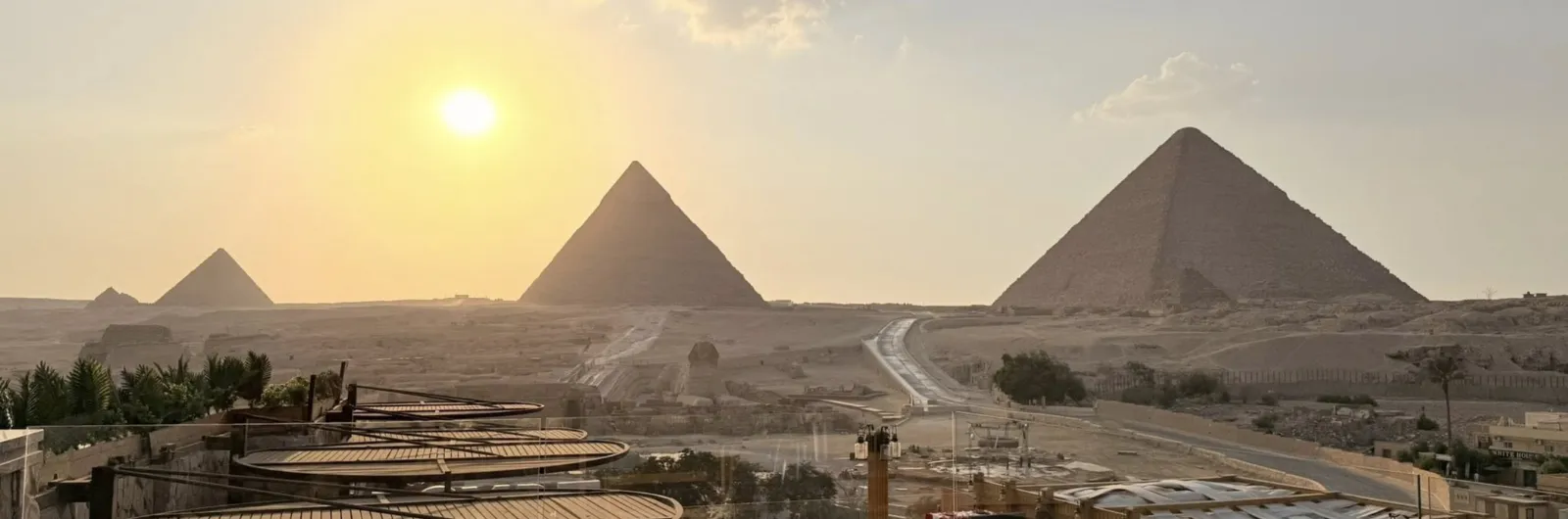 Three thousand years of pharaohs, from Narmer’s unification to Alexander’s arrival, produced the oldest monumental architecture on the planet: pyramids, temples and tombs that still define how the world pictures Egypt.
Every year, between June and September, the river rose. The waters carried black silt down from the Ethiopian highlands and deposited it along the banks. That predictable flood — neither capricious like the Tigris nor devastating like the Yangtze — was the foundation of everything. It enabled a surplus agriculture that fed a population large enough to build pyramids, sustain armies, and develop a bureaucracy that outlasted the Roman Empire, the Abbasid caliphate, and the British Empire combined.
The Egyptians understood this perfectly. They organised their calendar around the flood. They built their theology around cyclical renewal. And they divided their geography in radical fashion: the eastern bank of the Nile, where the sun rises, was the bank of the living — cities, temples, palaces. The western bank, where the sun sets, was the bank of the dead — tombs, necropolises, the Valley of the Kings. When you visit Luxor, that division is still visible and still operational.
The predynastic period and unification (before 3100 BC)
Egypt was not born unified. For millennia, the Nile valley was inhabited by independent farming communities that gradually coalesced into two entities: Upper Egypt (the south, upriver) and Lower Egypt (the northern delta). Their unification, traditionally attributed to King Narmer around 3100 BC, marks the beginning of dynastic history.
The Narmer Palette, held in the Egyptian Museum in Cairo, is one of the oldest objects of political history: it shows a king wearing both crowns — the white crown of the south and the red crown of the north — subduing his enemies. It is state propaganda carved in stone, and it is five thousand years old.
Traveller’s tip: The Narmer Palette is currently displayed on the ground floor of the Egyptian Museum on Tahrir Square. When the Grand Egyptian Museum (GEM) is fully operational, most of the collection will move there. Check before your visit which pieces are in which museum.
The Old Kingdom: the age of the pyramids (2686–2181 BC)
Why the pyramids were built
The question is not how — though that is fascinating too — but why. Egyptian theology held that the pharaoh, upon death, was transformed into Osiris and needed a preserved body (hence mummification) and a place from which to ascend to the sky (hence the pyramid, whose form imitates the rays of the sun breaking through clouds).
The pyramid was also a demonstration of organisational power. Building one required mobilising tens of thousands of workers — not slaves, as the myth persists, but farmers who laboured during the months of flooding, when the fields were underwater and there was nothing to cultivate. The state fed them, organised them, and in the process consolidated its authority.
From Djoser to Khufu: the evolution you can see
The first pyramid is the Step Pyramid of Djoser at Saqqara, built around 2670 BC by the architect Imhotep. It is, literally, a mastaba (rectangular tomb) stacked six times. Imhotep was improvising — and what he invented changed architecture forever.
A century later, Pharaoh Sneferu built three pyramids, each one correcting the errors of the last. The Bent Pyramid at Dahshur shows the exact moment the engineers realised the angle was too steep and reduced it halfway through construction. It is a miscalculation frozen in stone for 4,600 years.
His son Khufu applied everything that had been learned and built the Great Pyramid of Giza: 146 metres tall, 2.3 million stone blocks, an orientation to true north that deviates by less than one-twelfth of a degree. It was the tallest structure in the world for 3,800 years, until Lincoln Cathedral was built in 1311.
The Sphinx, facing the pyramids, was carved probably during the reign of Khafre (Khufu’s son). It faces east — toward the rising sun — and its lion body with a human head represents the pharaoh as guardian of the necropolis.
Traveller’s tip: Visit Saqqara and Dahshur as well as Giza. Most visitors only see the three great pyramids, but the architectural evolution from Djoser to Khufu is far more eloquent when seen in sequence. A private taxi for all three sites costs 600–900 EGP per day (negotiable). Saqqara opens 8:00–17:00, entry 200 EGP for foreigners.
The Middle Kingdom: Thebes enters the scene (2055–1650 BC)
The Old Kingdom collapsed. Not through invasion — through internal disintegration. Droughts reduced the Nile floods, provincial governors accumulated power, and the centralised state that had built the pyramids fragmented into a dozen rival principalities. Egyptologists call this the First Intermediate Period, and it lasted nearly 150 years.
Reunification came from the south. The rulers of Thebes (modern-day Luxor) managed to subdue the north and restore unity under the Eleventh Dynasty. This is where Thebes begins its rise as the religious capital of Egypt — a role it would hold for more than a thousand years.
The Middle Kingdom was an era of consolidation rather than monumental grandeur. Trade with Nubia (present-day Sudan) expanded, the southern frontier was fortified, and a literature was produced that the Egyptians themselves would consider classical for millennia. The pyramids of this period are more modest — many built with mudbrick and poorly preserved — but the artistic refinement of the jewellery, sculpture, and sarcophagi is extraordinary.
The New Kingdom: the golden age (1550–1069 BC)
The end of the pyramids, the beginning of the temples
The New Kingdom began with an expulsion: that of the Hyksos, an Asiatic people who had invaded the delta during the Second Intermediate Period. The Theban pharaohs who drove them out inaugurated the most expansive and monumental era in Egyptian history — and the most relevant for the modern traveller, since most of the temples and tombs visited in Luxor and Aswan date from this period.
One fundamental shift: pharaohs stopped building pyramids. The reason was practical — every known pyramid had been robbed — and the solution was brilliant: excavate tombs into the rock, hidden in a remote valley west of Thebes. Thus was born the Valley of the Kings.
Hatshepsut: the pharaoh who built at Deir el-Bahari
Hatshepsut was not the first woman to rule Egypt, but she was the first to assume every attribute of the pharaoh, including the ceremonial false beard. Her mortuary temple at Deir el-Bahari, carved into the cliff on the west bank of Luxor, is one of the most audacious architectural works of antiquity: three stepped terraces that merge into the rock with an elegance that feels modern.
She ruled for twenty-two years of peace and prosperity. She organised a trading expedition to the mysterious land of Punt (probably in modern Eritrea or Somalia), whose reliefs at Deir el-Bahari depict the imported goods in detail: incense, ebony, ivory, monkeys. After her death, her successor Thutmose III attempted to erase her name from the monuments — without complete success, as any visitor can verify.
Akhenaten and Amarna: the seventeen years when Egypt invented monotheism and was erased by the next pharaoh
Between Hatshepsut and Ramesses II — but outside the official narrative that Egypt accepted for three thousand years — there was a theological experiment so radical that his own dynastic successors scrubbed the protagonist from the king lists and referred to him, without naming him, as "the criminal of Akhetaten". Amenhotep IV ascended the throne around 1353 BC as a pharaoh of the Eighteenth Dynasty at the height of the empire. Within a few years he changed his name to Akhenaten ("beneficial to Aten"), closed the Amun temples in Thebes, expelled the country's most powerful priesthood and proclaimed that only one god existed — the solar disc Aten — whom no one could depict in human or animal form, only as a disc with rays ending in hands. In the fifth year of his reign he abandoned Thebes and built from scratch a new capital, Akhetaten ("the horizon of Aten"), 300 km further north, at what is now Tell el-Amarna: a regularly planned city with palaces, residential quarters, sculptors' workshops and a Great Temple open to the sky, because Aten could not be worshipped in darkness. Akhenaten reigned for seventeen years. The art of the period — the Amarna style — breaks with three thousand years of convention: elongated bodies, pronounced bellies, intimate family scenes of the pharaoh and his wife Nefertiti kissing their daughters on their laps, something unimaginable in any other Egyptian period.
When he died around 1336 BC, the system collapsed within months. His successor — a nine-year-old boy born Tutankhaten, "living image of Aten" — changed his name to Tutankhamun ("living image of Amun"), returned the capital to Thebes, restored the old cults and refilled the temples. The later pharaohs — Horemheb and Ramesses I — completed the damnatio memoriae: Akhetaten was abandoned within a generation, its stones reused as fill inside the pylons of the Karnak temple (where archaeologists have recovered thousands of talatat blocks since the 1970s), Akhenaten's name was systematically chiselled from every monument, and the official king lists jumped directly from Amenhotep III to Horemheb with no mention of the interval. For three thousand years the episode disappeared entirely from history. Only when Flinders Petrie excavated Tell el-Amarna in 1891-92, uncovered Akhenaten's diplomatic archive (the famous Amarna Letters, 382 cuneiform tablets of correspondence between the pharaoh and the kings of Babylonia, Mitanni and Hatti, today split between the Berlin Museum, the British Museum and the Louvre), and Ludwig Borchardt found the bust of Nefertiti in the workshop of the sculptor Thutmose in 1912 (today in Berlin's Neues Museum), did the world recover the memory of the earliest documented monotheism in history — seven centuries before the emergence of the exclusive cult of Yahweh in the kingdom of Judah. Freud, in Moses and Monotheism (1939), even argued that Moses was an Aten priest who carried Akhenaten's theology to the Hebrews. The thesis is speculative, but the chronological coincidence is too sharp to ignore.
Ramesses II: the compulsive builder
If one pharaoh defines the concept of monumental megalomania, it is Ramesses II. He reigned for 66 years (1279–1213 BC) and built more temples, more colossi, and more statues of himself than any other ruler in Egyptian history. His mark is visible at almost every site you will visit:
- Abu Simbel: four colossi of 20 metres carved into the rock, oriented so that sunlight illuminates the inner sanctuary twice a year (22 February and 22 October). The entire temple was relocated block by block in the 1960s to save it from the Aswan Dam — an engineering feat that deserves its own section.
- The Ramesseum: his mortuary temple on the west bank of Luxor, now in ruins but still imposing.
- Karnak: he expanded the great temple of Amun with the largest hypostyle hall ever built — 134 columns up to 23 metres tall that create a forest of stone.
Tutankhamun: the minor pharaoh who changed everything
Tutankhamun was an insignificant pharaoh. He ascended the throne at nine, reigned for ten years, and died without having done anything memorable. His importance is posthumous, and he owes it entirely to an obsessive British archaeologist.
Howard Carter had spent six seasons excavating in the Valley of the Kings with nothing to show for it. His patron, Lord Carnarvon, was about to withdraw funding when, on 4 November 1922, a water boy on the team stumbled upon a step carved into the rock. Carter uncovered a staircase of sixteen steps descending to a sealed doorway. He sent a telegram to Carnarvon — who was in England — and waited three weeks without opening anything. On 26 November, with Carnarvon present, Carter made a hole in the inner door and held up a candle. Carnarvon asked: “Can you see anything?” Carter replied: “Yes, wonderful things.”
What lay inside exceeded every expectation: more than 5,000 objects across four chambers — dismantled chariots, gilded beds, painted chests, ka statues, a golden throne and, in the burial chamber, a sarcophagus with three nested coffins, the innermost of solid gold weighing 110 kilograms. Over the mummy lay the most famous gold mask in the world. Carter spent ten years cataloguing the entire contents.
The tomb itself (KV62) is small and relatively modest compared with those of the great pharaohs. What was extraordinary was that it had not been looted, making it the only complete window into what an Egyptian royal tomb contained. Everything else we know — Khufu, Ramesses, Hatshepsut — we know through tombs emptied millennia ago.
Traveller’s tip: Tutankhamun’s tomb in the Valley of the Kings requires a separate ticket (400 EGP) in addition to the general valley entry (300 EGP). The gold mask will be on display at the Grand Egyptian Museum when fully operational. The valley opens at 6:00–17:00 in summer — go early, because by midday the temperature exceeds 40°C and the experience becomes gruelling.
The Third Intermediate Period and the pharaonic twilight (1069–332 BC)
After the death of Ramesses XI in 1069 BC, Egypt entered a slow decline that lasted seven centuries. The country fragmented, was invaded successively by Libyans, Nubians, Assyrians, and Persians, and never recovered the unity or power of the New Kingdom.
But even in decline, Egyptian culture remained a reference point. When the Nubian kings of Kush conquered Egypt in the eighth century BC, they did not destroy the pharaonic tradition — they adopted it. They built their own pyramids (smaller, more pointed) in what is now Sudan. And when the Persians conquered Egypt in 525 BC, they maintained the pharaonic forms and titles.
This capacity for cultural absorption — for making every conqueror end up playing by Egyptian rules — is one of the most remarkable traits of this civilisation, and explains much of what you will encounter when you reach the Ptolemaic period.
The Saites: the last renaissance (664–525 BC)
The Twenty-sixth Dynasty, the Saites, deserves mention. Ruling from Sais in the delta, they staged a deliberate cultural renaissance. They looked backward — to the Old Kingdom, nearly two thousand years earlier — and produced an archaising art of extraordinary technical quality. Some of the most refined sculptures in Egyptian art come from this period. It is a lesson in how a civilisation in decline can produce sublime art precisely because it knows what it is losing.
The Persians put an end to the Saites in 525 BC. Cambyses conquered Egypt and incorporated it into the Achaemenid Empire as a satrapy. The two centuries of Persian domination — interrupted by brief rebellions and native restorations — set the stage for the arrival of Alexander the Great in 332 BC.
The writing: hieroglyphs, hieratic, and demotic
No aspect of Egyptian civilisation fascinates more than its writing, and understanding its basic forms enormously enriches a visit to any temple or tomb.
Hieroglyphs — from the Greek for “sacred writing” — were the monumental form, the one you see carved on temple walls. Each sign can be a phonogram (representing a sound), an ideogram (representing an idea), or a determinative (indicating the category of a concept). About 700 signs were in use throughout most of Egyptian history.
Hieratic was the cursive version, used by scribes on papyrus for administrative, literary, and religious texts. And demotic, developed in the seventh century BC, was a further simplification for everyday use. The Rosetta Stone contains the same text in hieroglyphic, demotic, and Greek — and it was that triplication that allowed Champollion to crack the system in 1822.
Traveller’s tip: In the temples of Luxor and Karnak, look for the cartouches — the ovals enclosing the royal names of the pharaohs. They are the easiest signs to spot and recognise. If you learn to read the names of Ramesses II and Thutmose III (the most frequent), you will start to “see” the temple walls in an entirely different way.
What remains: how to read the monuments
When you stand before an Egyptian temple, remember three things:
Orientation matters. Temples were built in relation to the Nile and the path of the sun. The entrance always faces the river. The interior becomes progressively darker, narrower, and more sacred — from the public courtyard to the inner sanctuary where only the pharaoh or the high priest could enter.
Every surface tells a story. Temple walls are not decorative: they are religious texts, historical records, and political propaganda. The battle reliefs at Karnak or Abu Simbel are the ancient equivalent of a press release: official versions of real events, embellished for the greater glory of the pharaoh.
Scale is intentional. Egyptian monumentality is neither accidental nor whimsical. Every column, every colossus, every hypostyle hall was designed to produce a specific experience: to make the visitor feel small before the power of the god and the pharaoh. Thirty centuries later, it still works.