Egypt: beyond the pyramids
Why Egypt is unlike any other destination and how this guide helps you understand it
The country that invented eternity
Egypt needs no introduction, and that is precisely the problem. Everyone arrives with a mental image — pyramids, pharaohs, mummies — that is simultaneously correct and insufficient.
It is like saying Rome is gladiators or Japan is samurai: there is truth in the postcard, but the postcard conceals everything that made it possible.- Population ~107 million · 95% of the country is desert
- History 5,000 years · 30 dynasties · 4 visible layers
- Nile 20 km of fertile land between Sahara and Red Sea
- Best time Oct-Apr · Nov and Feb ideal
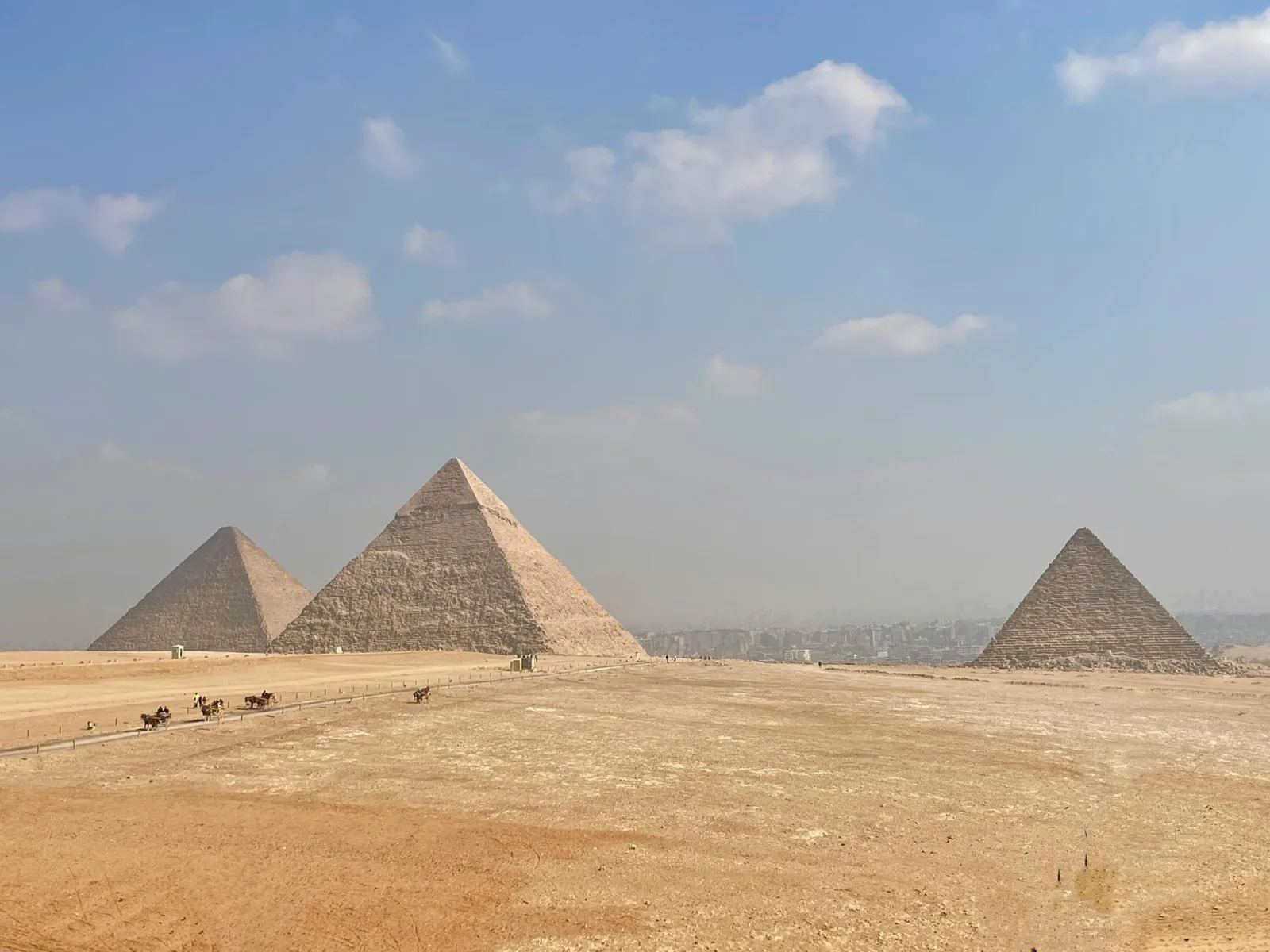 The green strip of the Nile cutting through the desert is the image that explains Egypt. Everything — pyramids, temples, cities — was built along this thread of life between the Sahara and the Red Sea.
What makes Egypt a destination without equivalent is not the age of its monuments but the continuity of its civilisation. This is not a dead culture studied behind glass. It is a country of a hundred million people living on top of five thousand years of accumulated history, where every layer — pharaonic, Greek, Roman, Coptic, Islamic, Ottoman, colonial, modern — has left something visible in the stone, in the language, in the way the world is understood.
The Nile explains almost everything. A fertile strip barely twenty kilometres wide, surrounded by absolute desert, that for millennia was the only source of life between the Sahara and the Red Sea. Every Egyptian civilisation — every temple, every tomb, every city — was built in relation to that river. Understanding this is understanding why the pyramids stand where they stand, why the temples face the direction they face, and why Cairo exists where it exists.
What makes this guide different
There are hundreds of resources about Egypt. Most tell you what to see. This guide tries to explain why you are seeing it.
When you walk into the temple of Karnak at Luxor, you will not only know that Amenhotep III built it and Ramesses II expanded it. You will understand why every pharaoh needed to add something to the previous temple, what that had to do with political legitimacy, and how that logic of accumulation produced the largest religious complex of the ancient world.
When you sail the Nile between Aswan and Luxor, you will understand why the Ptolemaic temples of Edfu and Kom Ombo were built where they were — and why Greek rulers chose to present themselves as Egyptian pharaohs.
And when you walk through Islamic Cairo, you will grasp how a city founded by the Fatimids in the tenth century became the intellectual capital of the Arab world, and why every mosque, every madrasa, every public fountain tells a story of power, faith, and patronage.
The practical information is there — prices, opening hours, how to get around, where to eat — but always woven into the narrative. This is not a data sheet: it is a story you can read before the trip and consult during it.
The layering of civilisations
What makes Egypt unique as a destination is that you can see every layer of its history in a single trip:
Pharaonic Egypt (3100–332 BC)
The pyramids of Giza, the Sphinx, the temples of Luxor and Karnak, the Valley of the Kings, Abu Simbel. Nearly three thousand years of pharaohs who produced the oldest monumental architecture on the planet. This is not one period: it is thirty dynasties, three empires, and a dozen collapses and rebirths.
Greco-Roman Egypt (332 BC–641 AD)
Alexander the Great, the Ptolemies, Cleopatra, the Lighthouse of Alexandria, the Library. Then Rome: the empire’s granary. The temples of Philae, Edfu, and Kom Ombo date from this era, though they look pharaonic — and that deliberate ambiguity has a fascinating explanation.
Islamic Egypt (641–1798)
The Arab conquest, the Fatimid founding of Cairo, the golden age of the Mamluks. Islamic Cairo is one of the densest concentrations of medieval architecture in the world: mosques, madrasas, caravanserais, palaces. A living city that still functions much as it did in the fourteenth century.
Modern Egypt (1798–today)
Napoleon, Muhammad Ali, the Suez Canal, the British occupation, Nasser, the Aswan Dam, Camp David, Tahrir. A country that has spent two centuries negotiating between tradition and modernity, and whose latest gesture — the Grand Egyptian Museum beside the pyramids — attempts to reconcile both.
Travelling independently in Egypt
Egypt is not a difficult destination, but it is an intense one. It requires a certain mental and logistical preparation that this guide aims to provide.
What works well
Transport between cities is affordable and frequent: overnight trains between Cairo and Luxor, cheap domestic flights with EgyptAir, Nile cruises that are an experience in their own right. The food is extraordinary and inexpensive. The people are genuinely hospitable, with a sociability that can feel overwhelming but is rarely hostile.
What requires patience
Bargaining is the norm in markets and taxis. Prices for tourists are systematically higher than for locals — and this includes monument tickets, which have official differentiated tariffs. Traffic in Cairo defies all European logic. Commercial harassment in tourist zones (Giza, Luxor, Aswan) is persistent and exhausting if you are not prepared.
What this guide gives you
Context to understand what you see. Proven strategies for getting around independently. Updated prices so you are not overcharged. And above all, a coherent narrative that connects the pyramids of Giza to the mosque of Al-Azhar, the temple of Karnak to the Aswan Dam, and the tomb of Tutankhamun to Tahrir Square.
Traveller’s tip: Egypt is more rewarding when it is understood. Read the history sections before visiting each site — not because it is obligatory, but because it completely transforms the experience. A temple without context is a pretty ruin; a temple with context is a conversation with people who lived three thousand years ago.
Essential facts
| Capital | Cairo |
| Official language | Egyptian Arabic; English in tourist areas |
| Currency | Egyptian pound (EGP) — €1 ≈ 55–65 EGP (2026, subject to fluctuation) |
| Time zone | UTC+2 (no daylight saving since 2014) |
| Visa | EU/UK: visa on arrival (25 USD) or e-visa |
| Population | ~107 million |
| Area | 1,001,449 km² (95% desert) |
| Predominant religion | Sunni Islam (~90%), Coptic minority (~10%) |
When to go
The ideal season is October to April, when temperatures are bearable (20–28°C in the south, 15–22°C in Cairo). Summer (May–September) turns Upper Egypt into a furnace: 40–45°C in Luxor and Aswan, making temple and tomb visits physically gruelling. November and February offer the best balance of weather, tourist numbers, and prices.
Indicative budget
Egypt is an inexpensive destination for European travellers, particularly after recent devaluations of the pound. An independent traveller with mid-range accommodation, efficient transport, and local food can get by comfortably on €40–70 per day. Monument admission is the most significant expense — a full day of sightseeing in Luxor can mean €30–40 in tickets alone.
Guide structure
This guide is organised so you can read it from start to finish as a narrative, or jump straight to the section you need:
- Introduction — You are here
- Ancient history — From the Old Kingdom to the New: three thousand years of pharaohs
- The Greco-Roman era — From Alexander to Cleopatra
- Islamic Cairo — Fatimids, Mamluks, and Ottomans
- Modern Egypt — From the Suez Canal to Tahrir
- Cairo — The largest city in Africa
- Luxor — Ancient Thebes and the Valley of the Kings
- Aswan — The southern frontier and the temples of Nubia
- Alexandria — Egypt’s Mediterranean face
- Practical information — Everything you need to plan the trip
Each section combines historical narrative with practical information. Prices, opening hours, and logistical tips are woven into the text, not isolated in decontextualised tables. The idea is that you can read each section as an essay and, at the same time, quickly find what you need when you are on the ground.
Welcome to Egypt. Not the Egypt of the postcards — the real one.
Before you read on
This guide assumes you are travelling independently or semi-independently — that is, you plan your own itinerary, book your own accommodation, and get around on your own, even if you hire local guides or join occasional excursions where it makes sense.
If you are on an agency-organised trip, the historical and cultural content will be equally useful, but the practical information (transport, prices, negotiation) may be less relevant — your operator handles that.
In either case, what this guide aims to give you is something that no tour guide, however good, can deliver in a two-hour visit: the full picture. The long history, the connections between periods, the reasons behind the forms. That is what turns a trip to Egypt into something you remember for decades.