Greece · 21 April 2026
Santorini or Milos: which is more worth it
Two volcanic islands, two opposite personalities. We compare Santorini and Milos to help you choose — or visit both.
There are two islands in the Cyclades that share a volcanic origin and yet have taken such different paths that comparing them is almost an exercise in the philosophy of tourism. Santorini turned its volcano into a global brand. Milos let its remain landscape. Both are extraordinary. But they are extraordinary in ways that attract very different travellers.
This is not a comparison where one island wins and the other loses. It is an attempt to explain what each one offers, who each makes sense for, and why the answer to “Santorini or Milos” depends entirely on what you are looking for.
The common origin: fire beneath the Aegean
To understand both islands you need to start with what created them. Santorini is what remains of a catastrophic volcanic eruption around 1600 BC, one of the most violent in human history. The eruption destroyed the island’s Minoan civilisation (the Akrotiri that is excavated today was an advanced city, with frescoes, sewerage and three-storey buildings), collapsed the volcano’s centre and created the caldera: that semicircular bay ringed by cliffs which is today the most recognisable image of the Aegean.
Milos has a different kind of volcanism: slower, more varied, more drawn out over time. There was no single great explosion but a prolonged activity that created layers of rock with different compositions. The result is a coastline that reads like a geology catalogue: white rock at Sarakiniko, red at Paliochori, black at Rivari, yellow at Tsigrado. Seventy beaches, and no two look alike.
Both islands are daughters of the same fire. But Santorini is the drama of the cataclysm, and Milos is the patience of erosion.
Santorini: the sunset industry
Something needs to be said about Santorini that may sound cynical but is simply true: Santorini is one of the most powerful visual experiences in the Mediterranean, and at the same time one of the most calculated tourism operations in the world. The two things coexist, and understanding that coexistence is key to deciding whether you want to go.
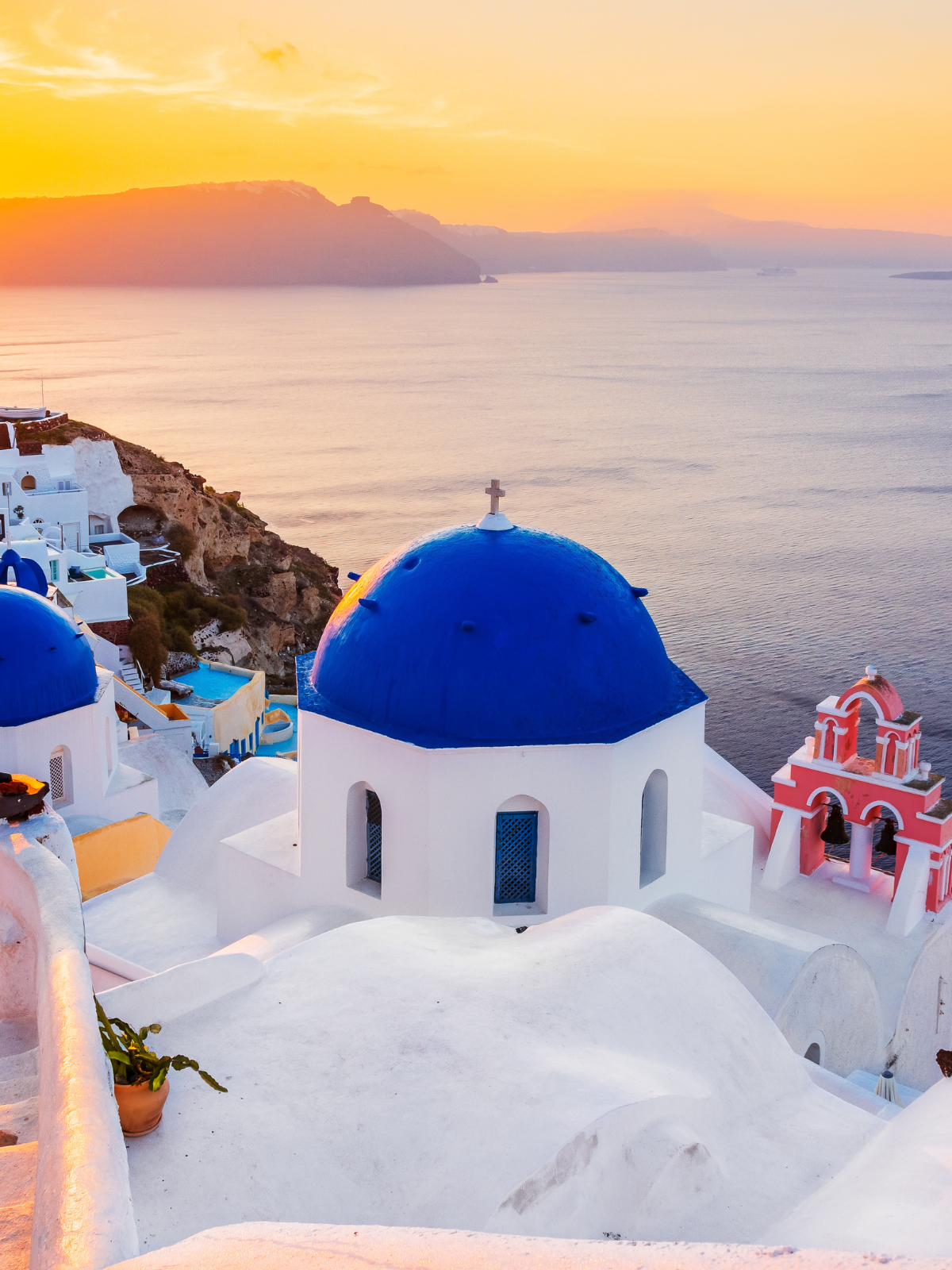
The caldera is real. That is not in question. The view from Fira, from Imerovigli, from Oia, is genuinely breathtaking: a three-hundred-metre precipice falling into the cobalt blue of the Aegean, with the island of Nea Kameni — the still-active volcano — gently smoking in the centre. The white villages with blue domes perched on the edge are real. The sunset light falling over the caldera in shades of gold, orange and purple is real.
What is also real: Oia receives every evening an avalanche of visitors that turns its one-metre-wide streets into something resembling a rush-hour underground. Hotels with infinity pools overlooking the caldera cost three hundred, five hundred, a thousand euros a night. Restaurants with a view charge prices that bear no relation to the quality of what they serve. In high season (July-August), cruise ships deposit thousands of visitors a day who ride up by bus, take photos, and ride back down. The island has fifteen thousand permanent residents and receives more than two million tourists a year. The maths are brutal.
And yet. Santorini out of season — May, early June, October — is a different proposition. Hotels drop to a third of the price. The streets empty. You can have breakfast in Fira gazing at the caldera without anyone jostling you. And there are parts of the island that mass tourism ignores: the wine-growing area on the central plateau, where wineries such as Santo Wines or Venetsanos produce a volcanic Assyrtiko that is one of the most interesting whites in the Mediterranean; the ruins of Akrotiri, the Minoan Pompeii, covered by a modern roof that protects frescoes and streets from three thousand six hundred years ago; the village of Pyrgos, the highest on the island, with a medieval labyrinth that almost nobody visits.
The best of Santorini: the caldera at sunset, Akrotiri, the wine, Fira in the empty mornings, the cliff-edge walk from Fira to Oia.
The worst of Santorini: the prices, the July-August crowds, the tourist-trap restaurants, the feeling that the island exists to be photographed rather than lived in.
Milos: the island that hasn’t sold its soul
Milos occupies a curious place in the Greek imagination. It is the island of the Venus de Milo, the most famous sculpture in the world — or at least the most recognisable — and yet Milos itself was for decades ignored by international tourism. The reason is historical: while Santorini was becoming a honeymoon destination in the 1980s, Milos remained a mining island. The kaolin, bentonite and perlite mines that had been exploited since antiquity were still active. There was no tourist infrastructure because there was no need: the island lived off the land, not off visitors.
That has changed in recent years. Milos has appeared on the lists, in the feeds, in the recommendations. But the change has been gradual, not explosive, and the island retains a scale that Santorini lost long ago.
The first thing that surprises about Milos is the coast. Sarakiniko is the place that draws most people in: a formation of white volcanic rock eroded by wind and sea until it resembles the surface of another planet. There is no sand: you lie on the smooth rock, warmed by the sun, and jump into the turquoise water from wherever you like. It is a landscape that resembles nothing else in Greece or anywhere in the Mediterranean.
But Sarakiniko is only the beginning. Kleftiko, on the southern coast, is a complex of sea caves and rock formations reachable only by boat. The name means “of the thieves” — it was a pirate hideout — and the boat trip from Adamas, the main port, is arguably the finest activity in the Cyclades. Tsigrado is a beach reached by climbing down a wooden ladder wedged into a crack in the cliff, which at the bottom turns out to be a cove of golden sand with absurdly transparent water. Firiplaka, Paliochori, Provatas: every beach on Milos has its own colour and personality.
Beyond the beaches, Milos has substance. The village of Plaka, high on the hill, has an old quarter of cobbled streets and whitewashed houses that recalls the Cyclades of thirty years ago. The sunset from Plaka’s castle is, for many, superior to Oia’s: the same golden light falling over the Aegean, but without the crowd. You may be the only person up there.
The syrmata of Klima and Mandrakia — fishermen’s boat garages carved into the rock at water level, painted in blue, red, green, yellow — are among the most photogenic landscapes in Greece. And the catacombs of Milos, dating from the first century AD, are the most important in the Greek world: an underground labyrinth where the early Christians of the Aegean buried their dead, predating even the catacombs of Rome.
The best of Milos: Sarakiniko, Kleftiko by boat, the impossible beaches, Plaka at sunset, the colourful syrmata, the human scale.
The worst of Milos: you need a car or scooter for everything, the access roads to some beaches are dirt tracks full of potholes, in August the tourist pressure is already noticeable, the dining options are limited compared to more established islands.
The honest comparison
Landscape: Santorini has the caldera, a vertical and dramatic landscape that exists nowhere else. Milos has geological diversity, a coastline where every beach is an experiment of nature. They are incomparable, but if you had to choose a single visual moment, the caldera of Santorini at sunset remains hard to beat. If you want to accumulate moments over the course of a week, Milos offers more variety.
Beaches: There is no comparison. Santorini has beaches of black or red volcanic sand that are interesting but not beaches for spending the day. Milos has seventy beaches among the best in Europe. Milos wins in a landslide.
Villages: Oia and Fira are spectacular but saturated. Plaka and Adamas are pretty and liveable. If you want to stroll without dodging selfie sticks, Milos.
Food: Santorini has more sophisticated restaurants and a serious wine culture. Milos has more honest tavernas and fresher seafood. It depends on what you are after.
Prices: Milos is significantly cheaper than Santorini across the board: accommodation, food, transport. The difference can be fifty per cent or more, especially for accommodation.
Crowds: Santorini in high season is overwhelming. Milos in high season is busy but manageable. Out of season, both are pleasant.
History and culture: Santorini has Akrotiri, which is exceptional. Milos has the catacombs and the Roman theatre, which are interesting but minor. Point to Santorini.
Logistics: Santorini has an airport with direct flights from half of Europe. Milos has an airport with flights from Athens. Both have good ferries from Piraeus and other islands.
Who each island is for
Choose Santorini if: it is your first trip to Greece and you want the iconic image; if wine interests you; if you can go in May, June or October; if you have a generous budget; if you are travelling as a couple and want cinematic romance; if Akrotiri interests you as much as the caldera.
Choose Milos if: you prioritise beaches above all else; if you want an island that does not feel like a theme park; if you are on a tighter budget; if you enjoy exploring on your own by car or scooter; if you have already seen Santorini and want something different; if September is your month.
Choose both if: you have at least ten days in Greece. The direct ferry between Santorini and Milos takes about two hours, and the combination works extraordinarily well: Santorini for the drama and the history, Milos for the beaches and the calm. Two or three nights in Santorini, four or five in Milos, is a balance that rarely disappoints.
What nobody tells you
There is a truth about Santorini that is seldom mentioned: the island is small and can be seen in two days. Three at most. After the caldera, Akrotiri, a couple of wineries and the cliff-edge walk, there is not much else to do except repeat sunsets. Milos, with its diversity of beaches, holds up for an entire week without any two days feeling alike.
And there is another truth about Milos: it is changing fast. Prices rise every year, boutique hotels appear where there were once fishing warehouses, and Sarakiniko in August is no longer the secret it was five years ago. If Milos interests you, do not wait too long. The Greek islands have a cycle that repeats itself: discovery, growth, saturation. Milos is in the growth phase. Santorini has been in the saturation phase for decades. The window is closing, but it is still open.
For the full picture of every island, route and hidden corner in Greece, the Far Guides complete guide has it all: interactive maps & itineraries, information that stays up to date.
More on Greece
Keep reading.
Other pieces from the same destination.


Next step
Ready for Greece?
The guide is for travelling.
Interactive maps & itineraries and everything that doesn't fit in an article. Always the latest published version.
Get the Greece guide