

Greece · 22 September 2026
When to visit Greece: a month-by-month guide
Greece has a high season that turns Santorini into a theme park and a low season that closes half the islands. An honest month-by-month guide.

The season system in Greece has a logic that is not always well explained. High season is not simply when it is hottest: it is when ferries run at maximum frequency, hotels are open, restaurants operate at full capacity, and the islands have sufficient infrastructure to handle tens of thousands of tourists. Outside that window, on small and medium islands, things close. Not arbitrarily, but because the economic model of many Greek islands operates exclusively around three or four months of the year. The taverna owner in Paros who closes in October is not being idle: there are not enough customers to keep the business open.
Understanding this prevents disappointment. Someone going to Mykonos in December finds a ghost island, with 80% of establishments closed, ferries running weekly instead of daily, and an atmosphere that can be interesting precisely for its strangeness, but which has nothing to do with what people expect from Mykonos. Someone going to Athens in December finds a fully functioning city with open museums, restaurants full of locals, and temperatures of 12-15 degrees that are perfectly pleasant for visiting ruins.
January and February: Athens and the mainland only
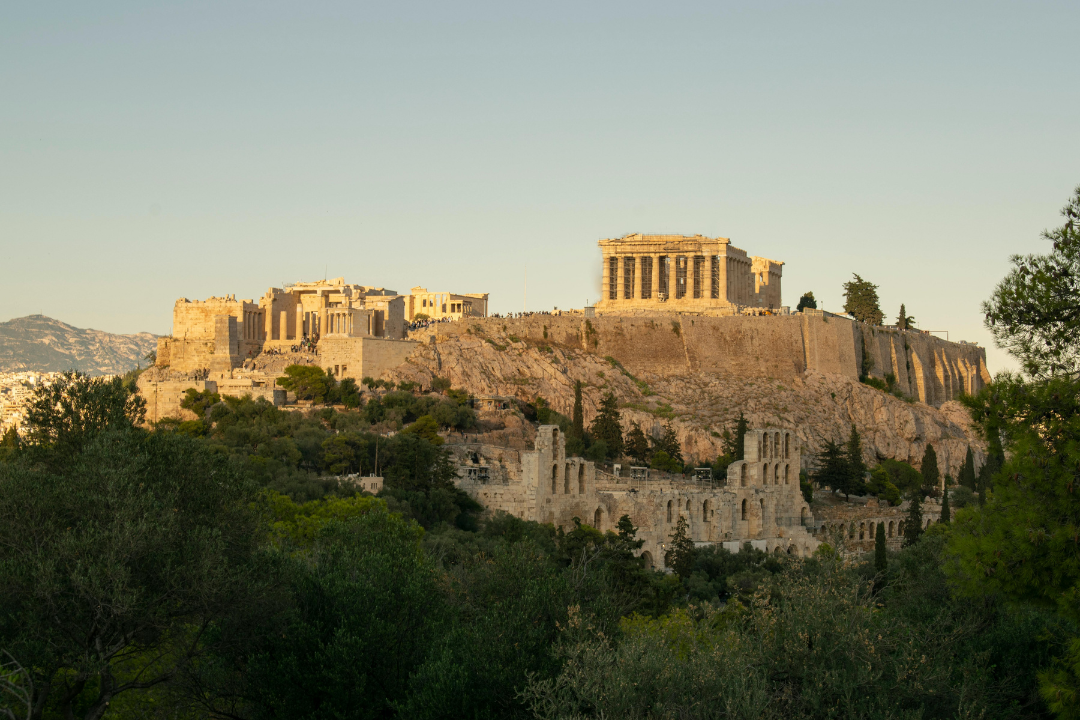
Temperatures in Athens in January range from 7 to 15 degrees. It rains — the Mediterranean winter is the wet season — but not continuously. Museums are open and nearly empty. The Acropolis on a clear January morning, with frost on the Propylaia floor and no other visitors visible, is an experience that has no equivalent in August. Flights and hotels are at their lowest prices.
The islands in January are another matter. The Cyclades — Mykonos, Santorini, Paros, Naxos — have minimal services: a weekly or bi-weekly ferry, a few establishments open for permanent residents, low prices for the few hotels not shuttered. For someone specifically seeking a Greek island in winter — the landscape without tourists, the bar where the fishermen are the only customers — it can be a singular experience. But arrive with information and without any expectation of tourist comfort.
March and April: the awakening
March is the first month Greece begins to come back to life. Hotels on some islands open for Easter — Greek Orthodox Easter, which in the Greek tradition is the most important festival of the year — and the mainland is fully accessible. Athens temperatures in March-April reach 15-22 degrees: ideal for walking the Agora and the Acropolis without the crushing summer heat.
Greek Orthodox Easter does not coincide with Western Easter every year — the Orthodox calendar uses the Julian calendar — and the date varies between March and April. Greek Holy Week celebrations have an intensity and beauty that in many mainland villages and more traditional islands surpasses any other festival of the year. The Holy Saturday liturgy at midnight, with the candles and the announcement of the Resurrection, is one of the most emotionally charged cultural rituals you can witness in Europe.
May: the best month for the mainland
May is the consensus among travellers who know Greece well: the best month for the mainland, the Peloponnese, and for beginning the islands at a gentle pace. Temperatures sit at 20-26 degrees in Athens, 22-28 on the islands. The sea begins to be swimmable on southern islands (Crete, Dodecanese), though the Cyclades are still cool. The wildflowers of the Peloponnese and the Parnassus slopes are at their peak. Archaeological sites have very few visitors. Prices are below mid-season.
The problem with May is ferries: some routes still run at reduced frequency, and inter-island connections may require more planning than in summer. But for anyone combining the mainland with one or two major islands, May is hard to beat.
June: the balance point
June is the transition month. Santorini and Mykonos begin filling, but still at a manageable level compared to July and August. Temperatures climb: 28-32 degrees on southern islands, 25-30 in Athens. The sea starts to feel warm for most people. Prices have risen since May but have not yet hit the July-August peak.
For quieter islands — Naxos, Paros, the Ionians, the Sporades — June is excellent. For Santorini and Mykonos, it is the last month before crowding becomes the dominant theme of the experience.
July and August: high season with open eyes
High season has real advantages: all ferries run at maximum frequency, every hotel and restaurant is open, there is nightlife, energy, the Mediterranean summer in full expression. It also has real disadvantages: maximum prices, bookings needed months in advance, the crushing crowding of Santorini (which in August can receive twelve thousand cruise passengers per day on top of hotel guests), extreme heat for visiting ruins in the interior.
The trick in high season is choosing the right island. The smaller Cyclades — Milos, Sifnos, Amorgos, Folegandros — have the same sun and water as Mykonos with a tenth of the traffic. The Ionian Islands — Lefkada, Ithaca, Paxos — are equally beautiful and far less saturated than the Cyclades. Crete is large enough to dilute tourists across a territory 260 kilometres long.
October: the forgotten extension
October, alongside May, is one of the most underrated months for Greece. Temperatures are still 22-26 degrees in Athens and southern islands. Mediterranean water has not yet cooled significantly. Archaeological sites are quiet. Prices have fallen. The only limitation is that some smaller islands begin closing services mid-month, and autumn rains start appearing — intermittently rather than continuously.
For the Peloponnese and the mainland, October can be even better than May: the landscape has autumn colours, the light is more golden, and the archaeological sites have a solitude that no summer month can provide. Olympia with no other visitors, Delphi in morning mist, Epidaurus empty at the start of an afternoon: these are the rewards of going when most people have already gone home.
The complete Far Guides Greece guide includes detailed routes across the mainland and islands, interactive maps and all the practical information you need to plan your independent trip.
More on Greece
Keep reading.
Other pieces from the same destination.


Next step
Ready for Greece?
The guide is for travelling.
Offline maps, itineraries and everything that doesn't fit in an article.
Get the Greece guide