Greece · 17 April 2026
Peloponnese road trip: 7 days by car
A one-week drive through the Peloponnese: Corinth, Mycenae, Nafplio, Monemvasia, Olympia and Mystras. The Greece that doesn't make the postcards.
The Peloponnese is the Greece most travellers skip. The usual logic of Greek tourism is simple: Athens, islands, home. And it is understandable, because the islands are magnetic and the blue Aegean has a pull that is hard to resist. But there is a problem with that logic: it skips the place where nearly everything that makes Greece Greece actually happened.
The Olympic Games were born in the Peloponnese. Agamemnon ruled here. Here stand Sparta, Corinth, Mycenae, Epidaurus. Here the Byzantines built Mystras, a ghost city that for two centuries was the intellectual centre of the empire. And here, at Monemvasia, the Greeks carved an entire town into a rock that seems impossible. All of it connected by roads that cross mountains, gorges, orange groves and centuries-old olive trees, with a fraction of the traffic of any popular island.
This seven-day route covers the Peloponnese from east to west, north to south. A car is essential. There is no reasonable alternative: public transport exists but is slow, infrequent, and leaves out the best places. Renting in Athens is straightforward and cheap outside August. The roads are generally decent, with a few exceptions we will mention.
Day 1: The Corinth Canal and Ancient Corinth
Distance from Athens: 85 km (1 hour)
Leave Athens early on the motorway heading west. The first stop is the Corinth Canal, that brutal six-kilometre incision through rock that separates the Peloponnese from the mainland. It is narrower than you expect — barely twenty-five metres — and deeper: the vertical walls drop eighty metres to the water. The ancient Greeks dreamed of this canal. Nero began digging it in 67 AD with six thousand Jewish slaves. It was not completed until 1893. There is something in the persistence of that idea across two thousand years that says a great deal about Greek geography.
Ancient Corinth is fifteen minutes away. It is not the most spectacular archaeological site in Greece, but it is one of the most revealing. Corinth was for centuries the wealthiest city in Greece, richer than Athens, thanks to its position between two seas. The Temple of Apollo, with its seven Doric columns from the sixth century BC, is one of the oldest surviving temples. And the Pirene fountain, where according to myth Pegasus was tamed by Bellerophon, is still there — dry but recognisable.
Above the ancient city rises Acrocorinth, the fortress that commands the isthmus. The drive up (or the walk, if you have the energy) leads to one of the finest views in the Peloponnese: the Gulf of Corinth to the north, the Saronic Gulf to the east, and the mountains of Arcadia to the south. Three levels of walls — Greek, Byzantine, Venetian, Ottoman — tell two thousand five hundred years of military history in stone.
Night in Ancient Corinth or continue to Mycenae.
Day 2: Mycenae and Nafplio
Distance: 50 km from Corinth to Mycenae, 25 km from Mycenae to Nafplio
Mycenae is one of those places where archaeology and myth merge until they become indistinguishable. When Heinrich Schliemann excavated here in 1876 and found the royal tombs with their gold masks, he telegraphed the King of Greece: “I have gazed upon the face of Agamemnon.” It was probably not Agamemnon — the tombs predate the Trojan War — but the phrase captures something real: at Mycenae, the Homeric epic stops being literature and becomes stone.
The Lion Gate, the monumental entrance to the citadel, is the oldest monumental sculpture in Europe. It is three thousand three hundred years old. The Cyclopean walls — blocks so enormous that later Greeks believed they had been built by the Cyclopes — still stand. The Treasury of Atreus, the tholos tomb outside the walls, has a corbelled dome that was the largest in the world until the Romans built the Pantheon, thirteen hundred years later.
After Mycenae, head down to Nafplio. It is the most beautiful town in the Peloponnese and one of the most beautiful on the Greek mainland. It was the first capital of the modern Greek state (1829-1834, before Athens was chosen), and that history shows in its architecture: neoclassical streets, Venetian balconies, mosques converted into cinemas or concert halls.
The Palamidi fortress, with its 999 steps (or 857, depending on who counts them and with what breath), dominates the town from above. The view is worth every step. And the islet of Bourtzi, the small Venetian fortress in the middle of the bay, is the most photogenic postcard in the Peloponnese.
Nafplio is a place to stay two nights. It has good food, a pleasant waterfront, and works well as a base for the following day.
Night in Nafplio.
Day 3: Epidaurus and the coast
Distance: 30 km from Nafplio to Epidaurus, return trip
Epidaurus is famous for one thing: its theatre. And that one thing justifies the trip. The theatre of Epidaurus, built in the fourth century BC, has acoustics that modern engineering has not fully managed to explain. A coin dropped on the circular stage floor can be heard clearly from the last row of fourteen thousand seats. This is not a legend: try it yourself. The most accepted theory is that the rows of limestone seats act as an acoustic filter, suppressing the low frequencies of background noise and amplifying the frequencies of the human voice. The Greeks had no formal acoustic theory, but they had something better: two centuries of theatre construction and an obsessive attention to what worked.
The Sanctuary of Asklepios, god of medicine, that surrounds the theatre is less visited but equally fascinating. The sick came here from across the Mediterranean to undergo incubation: they slept in the abaton and Asklepios cured them in their dreams. It is the most direct precursor of Western medicine, and the relationship between cure, sleep and theatre — all three coexisting in the same precinct — says something profound about how the Greeks understood health.
The afternoon is for the coast. From Nafplio, the road heading south hugs little-known beaches: Tolo is the most popular (and the most dispensable), but Kastraki and Paralia Tyrou, further south, are rocky beaches with crystalline water and no excessive tourist infrastructure.
Night in Nafplio.
Day 4: Monemvasia
Distance: 160 km from Nafplio (2.5 hours)
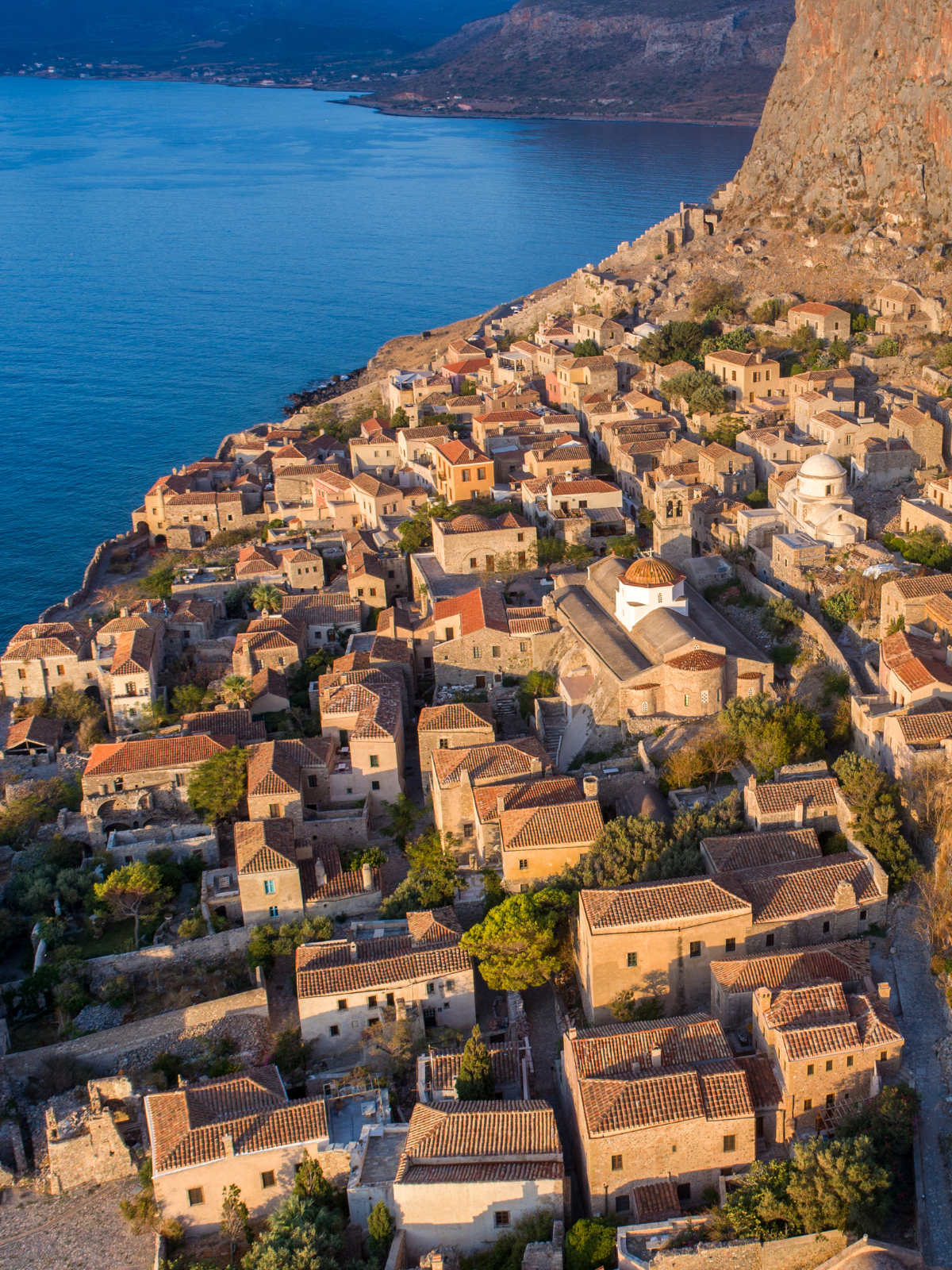
Today is the day of the rock. The road south descends through eastern Laconia, passing olive groves and arid mountains that recall Crete more than mainland Greece. And suddenly, at the end of a causeway that crosses the sea, Monemvasia appears: a three-hundred-metre-high rock joined to the mainland by a narrow bridge, with an entire medieval town hidden on its southern face.
Monemvasia means “single entry.” And that is literal: the only way to access the lower town is through a tunnel in the rock which, once inside, reveals an improbable world. Cobblestone streets, twelfth-century Byzantine churches, restored stone houses that are now hotels and tavernas, and a total absence of cars. The lower town takes an hour to explore. But the upper town, the fortress atop the rock, needs more time and stronger legs. The climb is steep and shadeless, but at the top there are ruined churches, cisterns, and a view that spans the entire southern Aegean.
Monemvasia was impregnable for centuries. The Venetians held it, the Ottomans besieged it, the Byzantines considered it one of their most valuable strongholds. Today it is one of the most singular destinations in Greece, and yet it receives a fraction of the visitors of any Cycladic island. The reason is simple: it is far from everything. And that remoteness is precisely what has preserved it.
Night in Monemvasia.
Day 5: Mystras
Distance: 150 km from Monemvasia (2.5 hours)
The road crosses Laconia westward, passing through the valley of the Eurotas — the river of Sparta — and climbing towards the foothills of the Taygetus, the mountain range that separates Laconia from Messenia. At the foot of the Taygetus, on a hillside covered in cypresses, stands Mystras.
Mystras is a Byzantine ghost city. Founded in 1249 by the Frankish crusaders, it quickly passed into Byzantine hands and during the fourteenth and fifteenth centuries was the intellectual and cultural centre of the Despotate of the Morea. Here taught Gemistos Plethon, the Neoplatonic philosopher whose ideas reached Florence and directly influenced the Italian Renaissance. The connection is direct and documented: when Plethon attended the Council of Florence in 1438, his lectures on Plato electrified the Italian humanists. Cosimo de’ Medici founded the Platonic Academy of Florence in large part because of his influence.
All of that happened here, on this hillside, in these churches with frescoes that remain extraordinarily beautiful. The church of Peribleptos, with its fourteenth-century paintings, has an expressive intensity that anticipates the Renaissance by a century. The despot’s palace, the walls, the monasteries: Mystras is an enormous site that takes three to four hours to cover, climbing and descending stone paths between ruins and vegetation.
Modern Sparta is five kilometres downhill. Do not expect much: it is a functional city, rebuilt in the nineteenth century without the grandeur of its name. A modest archaeological museum and a statue of Leonidas in the main square is all there is. The irony is that the Spartans despised monumental architecture — Thucydides already noted this in the fifth century BC — and so nothing remains of ancient Sparta. A city that built its identity on the ephemeral and the military left, coherently, almost nothing for posterity.
Night in Mystras or Sparta.
Day 6: Olympia
Distance: 200 km from Sparta (3 hours)
The longest driving day, but also the most spectacular. The route crosses the Taygetus through the Langada Pass, a mountain road of tight bends, gorges and views that justify every nerve. Then it descends into the valley of the Alpheus, the longest river in the Peloponnese, and continues west to Olympia.
Olympia is an unusual place. The archaeological site lies in a wooded valley, among pines and plane trees, without the dramatic aridity of Mycenae or Delphi. The scale is human. And that makes it easy to forget what happened here: for more than a thousand years, every four years, the Greeks stopped making war and came to compete. The Olympic Games were not a sporting event in the modern sense: they were a religious ritual, a sacred truce, and the only institution that united all the Greek city-states.
The stadium, where the sprint races were held, preserves the starting line carved in stone. You can stand on it and look down the hundred and ninety-two metres of the track — one stadion, the measurement that gave the place its name — and consider that for a thousand years, the finest athletes of Western civilisation ran over the very ground you are standing on.
The archaeological museum at Olympia contains one of the absolute masterpieces of Greek art: the Hermes of Praxiteles, a fourth-century BC marble sculpture of a technical perfection that is difficult to process. The softness of the skin, the fall of the drapery, the expression: if there is a moment in art history when sculpture reaches its limit, this is it.
Night in Olympia.
Day 7: Return through the mountains
Distance: 320 km to Athens (4 hours by motorway, 5-6 by interior road)
The last day offers two options. The fast one: motorway from Olympia to Patras and then along the north coast of the Gulf of Corinth to Athens. Efficient and dull. The slow one, which we recommend: head up through the mountains of Arcadia.
Arcadia is not a pastoral myth. Well, it is — Virgil and the entire European bucolic tradition invented it as a rural paradise — but it is also a real place. The mountains at the centre of the Peloponnese, with stone villages like Stemnitsa, Dimitsana and Karytaina, are the least-known Greece and one of its most beautiful corners. The Lousios Gorge, which can be partially walked from Dimitsana, has Byzantine monasteries literally hanging from the cliffs. Stemnitsa has a silversmith school that has been in operation for centuries and a midday silence that in August feels almost surreal.
The route through Arcadia adds at least two hours to the return, but it turns the journey back into another day of travel. And if the Peloponnese is the Greece that doesn’t make the postcards, Arcadia is the Peloponnese that doesn’t make the guidebooks.
Practical notes
Car: Book in advance during high season. Small cars are sufficient for all the roads on this route. Full insurance is worth it on the mountain roads.
Petrol: There are petrol stations in every town mentioned. In the mountain stretches they can be more spread out. Do not let the tank drop below a quarter.
Roads: The Athens-Corinth motorway is excellent. Secondary roads vary: some are well paved, others have potholes and stretches without a shoulder. The Langada Pass road and the Arcadian roads are winding but spectacular. Drive calmly and enjoy.
Accommodation: Nafplio and Monemvasia have excellent options for all budgets. Mystras and Olympia are more limited but sufficient. Book ahead in July-August.
Best time: May-June and September-October. The Peloponnese in July-August is hot (35-40 degrees in the valleys) and the coastal areas fill up. In spring, the fields are green and the wildflowers are spectacular.
For the full picture of every island, route and hidden corner in Greece, the Far Guides complete guide has it all: interactive maps & itineraries, information that stays up to date.
More on Greece
Keep reading.
Other pieces from the same destination.


Next step
Ready for Greece?
The guide is for travelling.
Interactive maps & itineraries and everything that doesn't fit in an article. Always the latest published version.
Get the Greece guide