

Greece · 18 August 2026
Greece's best museums: a guide beyond the National Archaeological
Athens' National Archaeological Museum is the world's best of its kind. But Greece has other museums that few travellers know and that explain parts of history that ruins cannot.

In the basement of the National Archaeological Museum in Athens there is an object the size of a child’s shoe, made of bronze, with more moving parts than an eighteenth-century Swiss clock. It was found in 1901 in the wreck of a Roman merchant ship from the first century BC off the island of Antikythera in the southern Aegean. Researchers took decades to understand what they had: an analogue mechanism capable of calculating the positions of the sun and moon, predicting eclipses, and determining the calendar of the Panhellenic games. An analogue computer from two thousand years ago.
The Antikythera Mechanism is the most disturbing object from antiquity. Disturbing because it implies that ancient technology was more sophisticated than historical consensus had assumed, and that centuries of medieval darkness erased that knowledge completely. Disturbing also because it is unique: no comparable object exists from any other ancient civilisation.
The National Archaeological Museum: what to see and how
The National Archaeological Museum of Athens is, without dispute, the most important museum of Greek art and archaeology in the world. It holds over eleven thousand objects in permanent exhibition and a storage collection that multiplies that number several times over. The problem for visitors with limited time is exactly that: there is too much, and all of it appears equally important.
The Mask of Agamemnon is probably the collection’s most famous object: a gold-beaten funeral mask found by Heinrich Schliemann in the shaft graves at Mycenae in 1876. Schliemann named it in an enthusiastic telegram to the King of Greece, but subsequent analysis places the mask to around the sixteenth century BC — some three centuries before the Trojan War that mythology attributes to Agamemnon. The incorrect name stuck because it was too good a story to abandon.
The bronze gallery surprises most visitors who haven’t researched the collection in advance. Greek bronze sculptures are extraordinarily rare: the metal was remelted for centuries to make weapons, coins and utensils, and what survives are pieces found in shipwrecks or buried in emergency situations. The Poseidon or Zeus of Cape Artemision — a god hurling a weapon, in bronze, over two metres tall — and the Artemision Jockey are two peaks of Greek classical art.
The Acropolis Museum: the most elegant argument
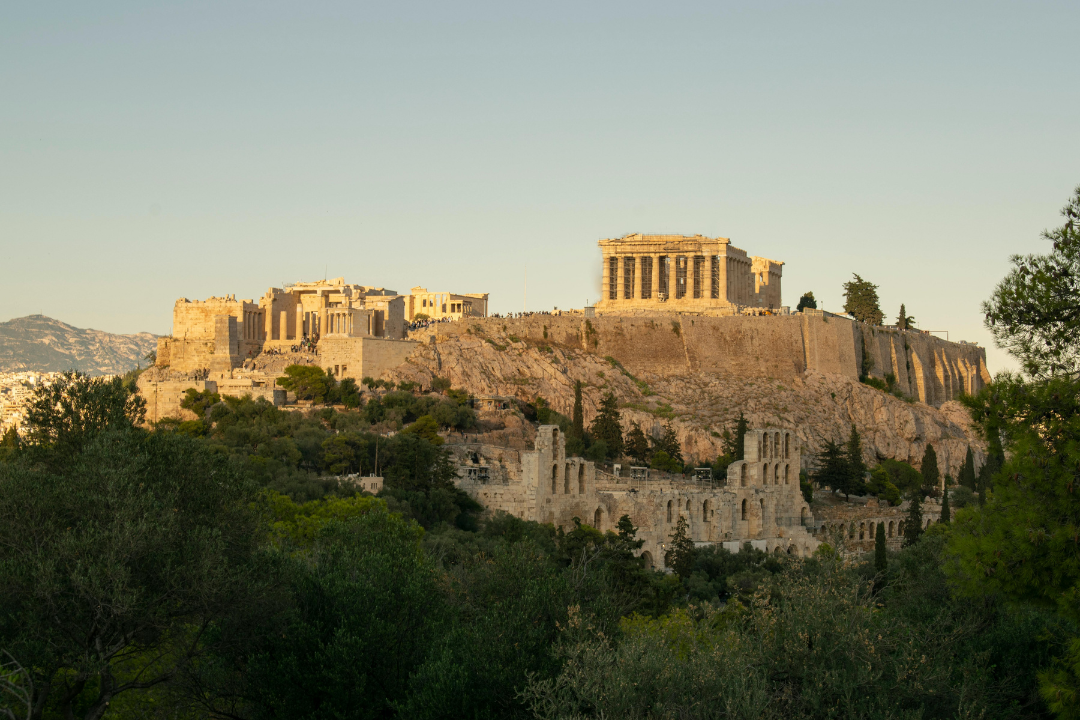
The Acropolis Museum, opened in 2009 at the foot of the sacred rock, is one of the most intelligently designed museums in Europe. It is built above an archaeological neighbourhood from the fifth century that can be seen being excavated through the glass floor of the entrance. The ground floor displays objects found on the Acropolis slope. The intermediate floor shows the Parthenon’s friezes and metopes arranged in the exact orientation they had on the original building.
The top floor is the argument. The Parthenon frieze gallery is oriented exactly as the Parthenon on the hilltop above, and original fragments alternate with plaster casts of the marbles that the Scottish diplomat Lord Elgin removed between 1801 and 1812 and sold to the British Museum, where they remain. The gaps — the contrast between original marble and white plaster — are Greece’s most eloquent claim. No Greek political speech about the marbles is as effective as seeing the room where the gaps are.
The Heraklion Museum: the civilisation Europe forgot
The Minoan civilisation, which flourished in Crete between 2600 and 1100 BC, is the most advanced that Europe produced in the Bronze Age, and also the least known outside academic circles. The Minoans built the first palaces in Europe, developed two writing systems (Linear A and Linear B, the latter deciphered in 1952), traded with Egypt and Mesopotamia, and produced a visual art — the frescoes — with a sensuality and modernity that continues to astonish.
The Archaeological Museum of Heraklion has the world’s finest Minoan collection, which is to say the only Minoan collection at this level anywhere. The frescoes from the Palace of Knossos — the Prince of the Lilies, the dolphins, the bull-leapers — are here, restored and mounted. The ivory and gold Snake Goddess figurines. The Kamares ware pottery. It is a museum where one grasps that Europe had a fully developed civilisation before Rome existed, before classical Greece existed, and that this civilisation vanished from collective memory for centuries.
Site museums: Olympia, Epidaurus, Delphi
The museums accompanying Greece’s great archaeological sites are frequently underestimated. The Delphi Museum has the Charioteer of Delphi — one of the finest surviving Greek bronzes — and the collection that explains the oracle’s workings. The Olympia Museum, beside the site of the ancient Games, holds the reconstruction of the Temple of Zeus pediment — colossal sculptures from the classical period — and the marble Hermes of Praxiteles, an original of a sculptor whose originals are almost entirely lost.
The Santorini Museum in Fira displays the Minoan paintings rescued from Akrotiri: the city that the volcanic eruption of the seventeenth century BC buried beneath metres of pumice, preserving it as the Pompeii of the ancient world. The frescoes of the boxers, the flying fish, the blue monkeys have a vividness that conventional Greek ruins do not. The island of Santorini was, 3,600 years ago, a centre of Minoan civilisation. The eruption that destroyed it probably contributed to the collapse of that civilisation across the eastern Mediterranean.
The complete Far Guides Greece guide includes detailed routes across the mainland and islands, interactive maps and all the practical information you need to plan your independent trip.
More on Greece
Keep reading.
Other pieces from the same destination.


Next step
Ready for Greece?
The guide is for travelling.
Offline maps, itineraries and everything that doesn't fit in an article.
Get the Greece guide