
Uzbekistan · 14 April 2026
Samarkand: from the Registan to Shah-i-Zinda
A narrative guide to Samarkand, the most legendary city on the Silk Road. What to see, what to understand, and why what you are looking at matters.
Samarkand is one of those cities that have been legendary for so long that the traveller arrives with an expectation almost impossible to meet. Two thousand five hundred years of history, the capital of Tamerlane, the crossroads of the Silk Road, the city that impressed Alexander the Great: how can any real place compete with that accumulation of myth?
The answer is that it can. And it does so in a way that surprises even those who come forewarned. But for Samarkand to work — for it not to be a parade of monuments photographed and forgotten — you need to know how to look. You need to understand what you have in front of you and why it is there. This article aims to offer that perspective.
Arriving and getting your bearings
Samarkand has a human scale that belies its historical importance. The monumental centre can be walked in a long day, and the main sights — the Registan, Bibi-Khanym, Shah-i-Zinda, Gur-e-Amir — are all within walking distance of each other.
The city has two visible faces. On one hand, the Soviet city: wide avenues, apartment blocks, the University boulevard. On the other, the historic quarter, concentrated around the Registan and extending northward to the hill of Afrosiab, where the original city stood before the Mongols wiped it from the map in 1220.
If you arrive by train from Tashkent, the station is to the northwest, about six kilometres from the centre. A taxi via Yandex Go costs less than a euro. If you stay in the Registan area — the most advisable choice — you can do everything on foot.
The Registan: the square that aspired to be the centre of the world
Starting with the Registan is not just a matter of tourist importance. It is a matter of honesty: if you came to Samarkand, you came for this. And it deserves your time — not the twenty minutes a package tour gives it.
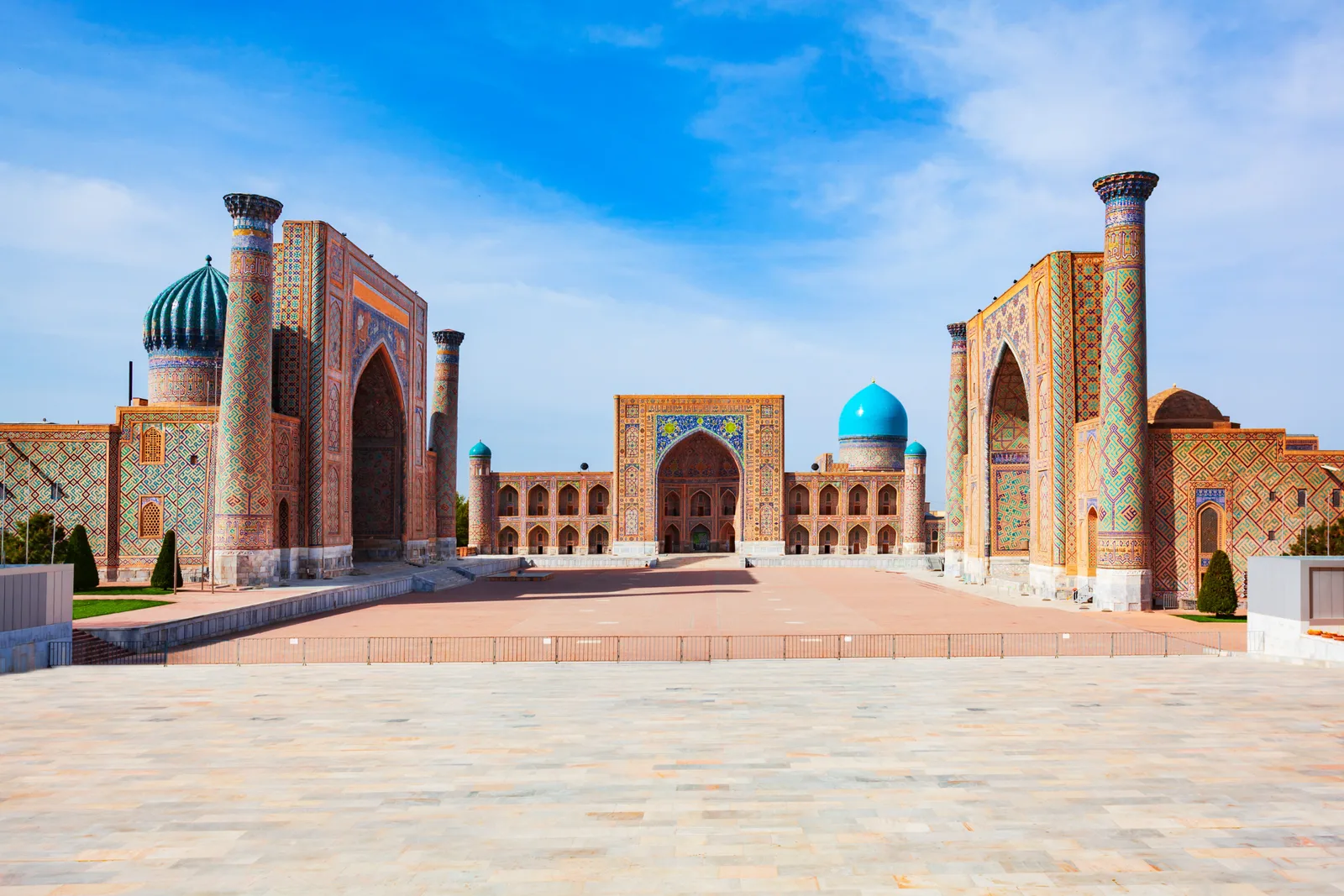
The Registan square is flanked by three monumental madrasas, built over two centuries but designed to function as an ensemble. Each deserves individual attention.
The Ulughbek Madrasa (1417-1420) is the oldest and, in many respects, the most important. Ulughbek, Tamerlane’s grandson, was an unusual ruler: more scientist than warrior, more astronomer than conqueror. His madrasa was not merely a Quranic school; it was a research centre where astronomy, mathematics and philosophy were taught. Ulughbek himself gave lectures here. His astronomical tables, compiled at the observatory he built on the outskirts of the city, were the most precise in the world for two centuries.
The facade of the madrasa has a decorative programme based on ten-pointed stars — a geometric motif that is no coincidence in the school of an astronomer. The original tiles, in the few fragments that survive, display a level of mathematical precision in their patterns that historians of Islamic art continue to study.
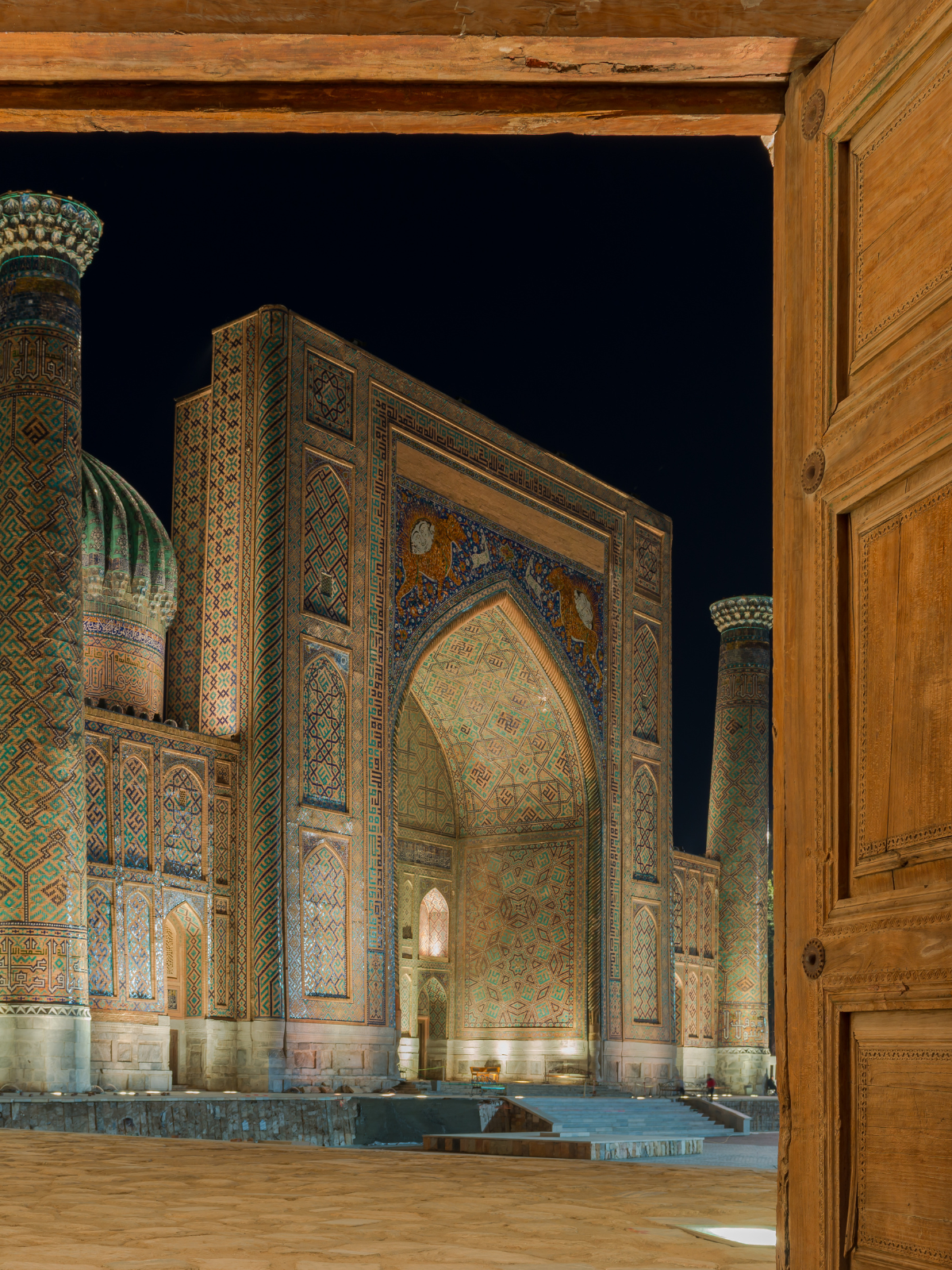
The Sher-Dor Madrasa (1619-1636) stands opposite, on the other side of the square, and is the most striking to the untrained eye. Its facade shows two tigers (actually lions, but the popular name stuck) chasing deer with a humanised sun at their backs. This image is remarkable because Islamic art, in its most orthodox interpretation, prohibits figurative representation. That the rulers of Samarkand in the seventeenth century allowed themselves to place human faces and animals on the facade of a religious school says a great deal about Central Asian Islam: pragmatic, syncretic, more interested in beauty than in dogma.
The Tilya-Kori Madrasa (1646-1660) closes the square on the north side. It also serves as a congregational mosque, and its interior is the most spectacular of the three: the dome is entirely gilded using the kundal technique, a mixture of gold, paint and relief that creates an effect of three-dimensional depth. The name Tilya-Kori means “adorned with gold,” and the first time you walk in and look up, you understand why.
How to see it well: Visit the Registan at least twice: once early in the morning, when the light comes in low and the square is nearly empty, and again at sunset, when the tiles shift in tone and the artificial lighting begins to compete with the natural light. If you can, sit on the steps or on a side bench and simply observe for a long while. The scale of the place needs time to be absorbed.
Bibi-Khanym: ambition and its price
A ten-minute walk from the Registan, heading north along the pedestrian street that cuts through the Siab bazaar, brings you to the Bibi-Khanym mosque. There is a story here worth telling.
Tamerlane ordered this mosque built in 1399, after his victorious campaign in India. He wanted it colossal: the largest in the Islamic world. According to the chronicles, he used ninety Indian elephants to transport the materials and thousands of artisans brought from every corner of his empire. Construction proceeded at a furious pace; Tamerlane, already old, wanted to see it finished.
And it was finished. But ambition outstripped engineering. The dome was too large for the techniques available. It began to crack almost immediately. Over the centuries it deteriorated until it lay in ruins. What you see today is largely a twentieth-century reconstruction, debatable in certain details but impressive in scale.
Bibi-Khanym works as an unintentional metaphor for the entire Timurid project: grandiose, ambitious, built too fast and, in the end, unable to support its own weight. Tamerlane created an empire that did not survive two generations after his death. But the cities he built remain.
In front of the mosque, the marble lectern that holds a giant Quran is one of the most photographed spots in Samarkand. Local tradition holds that women who pass beneath it are blessed with fertility. It is one of those customs that probably dates back no more than a hundred years but is presented as ancient. No matter: it is part of the living fabric of the city.
Shah-i-Zinda: the living king
If the Registan is the most impressive monument in Samarkand, Shah-i-Zinda is the most beautiful. And the most difficult to explain to anyone who has not seen it.
Shah-i-Zinda — “the living king” — is a necropolis, an avenue of mausoleums built along a narrow corridor ascending the slope of Afrosiab hill. The mausoleums date mainly from the fourteenth and fifteenth centuries and hold the remains of nobles, relatives of Tamerlane and religious figures.
The name comes from a legend: Qusam ibn Abbas, cousin of the Prophet Muhammad, is said to have arrived in Samarkand in the seventh century to preach Islam and, when faced with death, to have hidden in a well where he remains alive, awaiting the moment of his return. His supposed shrine stands at the end of the avenue and remains an active place of pilgrimage.
What makes Shah-i-Zinda extraordinary is not the legend but the ceramics. Each mausoleum vies with the next in the quality and detail of its tilework. Cobalt blue, turquoise, emerald green, white: the colours combine in geometric and floral patterns of a complexity that defies the eye. There are mausoleums with cuerda seca tiles, others with mosaics cut piece by piece, others with painted majolica. It is a catalogue of the finest ceramic techniques of the Islamic world, concentrated in just a few metres.
The most important advice: Go early. In the first hours of the morning, Shah-i-Zinda is nearly empty and the light enters at an angle between the mausoleums, illuminating the tiles in a way that is not repeated at any other hour. By mid-morning the tour groups arrive and the narrow corridor becomes congested. The difference between 8:00 and 11:00 is the difference between a spiritual experience and a queue.
Walk up the entrance staircase counting the steps. There is a local superstition: if you count the same number of steps going up as coming down, your heart is pure. It is not a bad way to make sure you are paying attention.
Gur-e-Amir: where Tamerlane rests
To the southwest of the Registan, about ten minutes on foot, stands the Gur-e-Amir — “the tomb of the emir” — the mausoleum where Tamerlane rests alongside his grandson Ulughbek and other members of the Timurid dynasty.
The building is more modest in scale than the Registan or Bibi-Khanym, but its fluted dome, covered in sky-blue tiles, is one of the most recognisable images of Samarkand. The interior is dark and solemn: the dark marble tombstones (Tamerlane’s is of green nephrite jade, the largest stone of its kind cut in that era) are at floor level, but the actual tombs lie in the crypt below.
Gur-e-Amir has a macabre story worth knowing. In 1941, Soviet anthropologist Mikhail Gerasimov opened Tamerlane’s tomb to examine his remains. According to legend, the tombstone bore an inscription that warned: “Whoever opens my tomb shall unleash an invader more terrible than I.” Gerasimov opened the tomb on 20 June 1941. Two days later, Nazi Germany invaded the Soviet Union.
The story is almost certainly a coincidence, and some historians doubt the inscription existed before the opening. But it is too good not to tell, and Uzbeks recount it in all seriousness. Tamerlane’s body was reburied with full Islamic honours in November 1942, just weeks before the Red Army began to turn the Battle of Stalingrad. Another coincidence, the sceptics will say. The Samarkandis smile.
Gerasimov at least left something useful behind: thanks to the facial reconstruction he made from the skull, we know what Tamerlane looked like. A man tall for his time (1.72 m), stocky, with Mongol features and a pronounced limp in his right leg. The “Timur the Lame” of the chronicles was real.
Afrosiab: the city that no longer exists
North of Shah-i-Zinda, beyond the Muslim cemetery that spreads across the hillside, a desolate plateau opens up, covered in grass and irregular mounds. This is Afrosiab: the remains of the original Samarkand, the Sogdian and later Islamic city that was destroyed by the Mongols in 1220 and never rebuilt.
Tamerlane, when he chose Samarkand as his capital, did not rebuild on Afrosiab but to the south, where the present city stands. Afrosiab was left as a field of ruins that archaeology has been patiently excavating since the nineteenth century.
The Afrosiab Museum, at the edge of the site, is small but contains an extraordinary piece: the seventh-century frescoes found in what was the residence of a Sogdian ruler. These wall paintings show diplomatic scenes, processions, hunts and rituals of an artistic quality that rivals anything produced in the same period in Europe or China. The colours — reds, blues, golds — are preserved with a vividness that seems impossible for something painted fourteen hundred years ago.
The Afrosiab frescoes are the best visual argument for something that history books tend to forget: that Central Asia, before the Mongol conquests, was one of the most sophisticated and cosmopolitan regions in the world. It was not a desert with camel caravans. It was a centre of civilisation.
Ulughbek’s Observatory: science as a political act
A couple of kilometres to the northeast of Afrosiab stand the remains of the observatory that Ulughbek built in the 1420s. Of the original structure, a three-storey cylindrical building, only the underground section of the sextant survives: a marble rail arc that descends into the earth along eleven metres.
It is visually unspectacular. But what it represents is enormous. With this instrument, Ulughbek and his team calculated the length of the sidereal year with an error of less than one minute compared to modern measurements. His star catalogue, which recorded the positions of more than a thousand stars, was the most accurate in the world until Tycho Brahe compiled his own in the sixteenth century, a hundred and fifty years later.
Ulughbek paid for his scientific passion with his life. In 1449, his own son Abdal-Latif had him assassinated, partly for political reasons and partly because the more conservative religious factions considered astronomy incompatible with the faith. The observatory was destroyed shortly after.
The irony is bitter: Ulughbek is today the most remembered Timurid ruler after Tamerlane, not for his conquests (which were modest) but for his science. The madrasas and the mausoleums impress, but it is the observatory — destroyed, barely visible, a furrow in the earth — that connects Samarkand to the universal history of knowledge.
The Siab Bazaar: where the city lives
Between the Registan and Bibi-Khanym stretches the Siab bazaar, Samarkand’s largest market. It is not a tourist destination, or at least not primarily: it is where the people of Samarkand buy their food.
Mountains of tandyr bread stacked in perfect towers. Dried fruits sorted by type and quality. Spices ground on the spot. Hanging meat, round cheeses, mountains of tomatoes. And, in season, the melons of Samarkand, which are reputed to be the best in Central Asia — and the competition is fierce.
The Siab bazaar needs no historical explanation or cultural context. It is the life of the city functioning as it has for centuries: people selling, people buying, bargaining, conversation, tea. If you could do only one thing in Samarkand that was not a monument, it would be to spend an hour here on a weekday morning.
Walking Samarkand: a way of understanding
Samarkand’s monuments are spectacular, but the city is understood by walking between them. It is in the transit — from the Registan to Bibi-Khanym through the bazaar, from Shah-i-Zinda to Gur-e-Amir through the residential streets, from the Soviet centre to the old quarter — where the pieces fall into place.
Samarkand is not an open-air museum. It is a city of half a million people who live and work among the remnants of a greatness that most of the world has forgotten but that here remains present, physically and symbolically. Children play in medieval squares. Cars drive past six-hundred-year-old minarets. The muezzin calls to prayer from a mosque that watched Tamerlane pass by.
That is what makes Samarkand work: not the perfection of its monuments, but the coexistence of the monumental and the everyday. A city that was the centre of the world and is now an Uzbek provincial capital, carrying that duality with a naturalness that disarms.
The traveller who devotes two or three days to Samarkand — without haste, without a checklist to complete, stopping to look — takes away something more than photographs of tilework. They take away the sense of having understood, even if only partially, a place that for centuries was more important than any European city. And that, in a world saturated with interchangeable tourist destinations, is priceless.
For the full picture of every city, route and hidden corner in Uzbekistan, the Far Guides complete guide has it all: interactive maps & itineraries, information that stays up to date.
More on Uzbekistan
Keep reading.
Other pieces from the same destination.

Next step
Ready for Uzbekistan?
The guide is for travelling.
Interactive maps & itineraries and everything that doesn't fit in an article. Always the latest published version.
Get the Uzbekistan guide