

Greece · 11 August 2026
Athens history: five thousand years in a city that never rests
Athens has been inhabited for 5,000 years. It has been a Minoan settlement, capital of the ancient world, a Roman town, an Ottoman city and a modern state capital. Each layer explains the next.

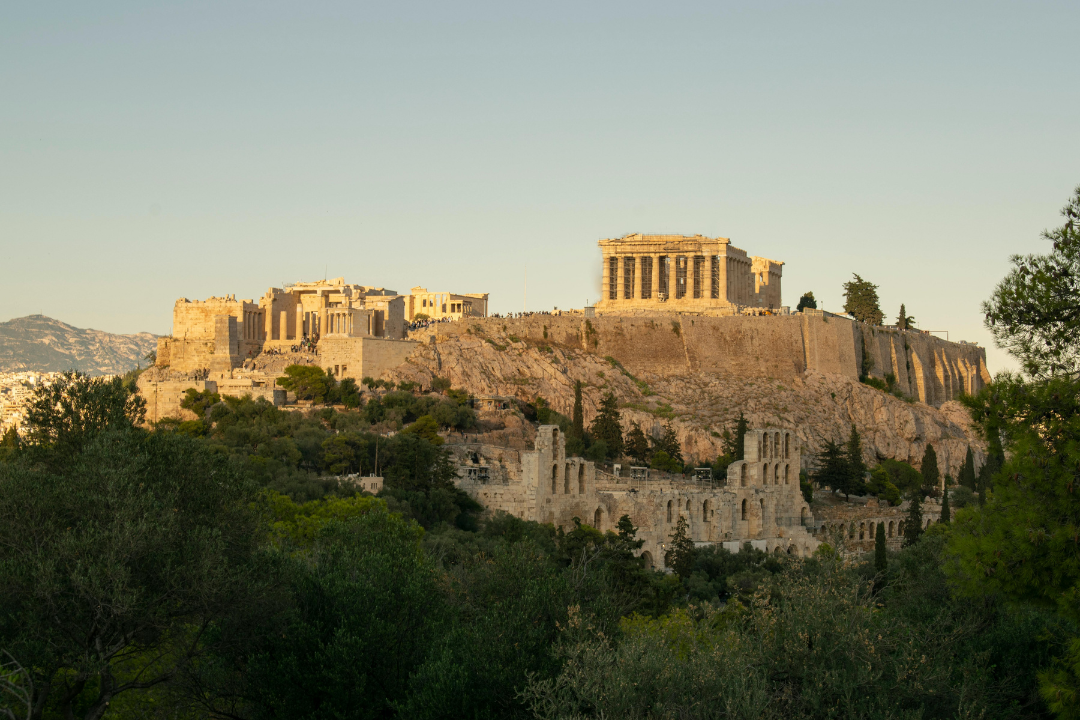
When Athens was chosen as the capital of the new Greek state in 1834, it had a population of approximately six thousand people. King Otto I of Bavaria, recently crowned monarch of Greece, chose Athens over Nafplio — which was the provisional capital and had more inhabitants and better infrastructure — for a reason that had nothing to do with administrative logic: the symbolic value of the Acropolis. The capital of the new modern Greek state had to be the city where Western civilisation was born. Archaeology as political argument.
That decision captures something deep about Athens: it is a city whose identity is in large part shaped by its past, and whose past has been interpreted and used in very different ways in very different eras. Five thousand years of continuous habitation is not just a statistic. It is the history of how a place changes meaning while remaining in the same location.
Origins: from the Neolithic to the golden age
The first settlements on the Acropolis date from the Neolithic period, around 3000 BC. The rock had obvious advantages: high, with a single easy approach from the west, with water available from nearby springs. Mycenaean and Minoan civilisations left traces in Attica before 1000 BC, though the dark age following the Bronze Age collapse around 1200 BC erased almost all evidence of that early occupation.
What defined Athens as a political and cultural entity was the fifth century BC. The victories over the Persians at Marathon (490 BC) and Salamis (480 BC) consolidated Athenian prestige and provided the confidence and resources for the monumental programme that Pericles launched from 461 BC. The Parthenon, the Propylaia, the Erechtheion and the Temple of Athena Nike were all built within less than forty years. In that same period, Aeschylus, Sophocles and Euripides created Western theatre. Socrates taught in the Agora. Thucydides invented historiography as an intellectual discipline. Herodotus documented the Persian Wars with a methodology that remains influential.
The Athenian democracy needs to be understood for what it was: a system of direct government for male citizens born in Athens of Athenian parents. It excluded women, slaves — who represented between a quarter and a third of the population — and metics, the resident foreigners. It was a system with a deeply aristocratic social base, even if it operated on the principle of equality among those who qualified as citizens. Understanding it accurately neither invalidates nor diminishes it: it remains the first experiment in popular government in history. But romanticising it serves no one.
Fall, Rome and the Hellenistic period
Defeat in the Peloponnesian War (431-404 BC) against Sparta ended Athens’s period of hegemony. The city remained the intellectual and cultural capital of the Greek world during the Hellenistic period — Plato founded the Academy, Aristotle the Lyceum — but political power had passed to Sparta first, then Thebes, then finally Macedonia when Philip II won at the Battle of Chaeronea in 338 BC.
The Roman conquest of 146 BC treated Athens with calculated respect. Rome recognised in the city the source of much of its own culture: the philosophers, sculptors, and teachers of rhetoric that Romans hired were Greek, many from Athens. Emperor Hadrian, in the early second century AD, was the most generous patron the city had since its classical apogee: he built a library, completed the Temple of Olympian Zeus begun six centuries earlier, and added a new district east of the old city. Hadrian’s Arch — still standing beside the Olympian temple — marked the boundary between the “city of Theseus” (ancient Athens) and the “city of Hadrian” (the Roman extension).
The Ottomans and the forgotten city
The Ottoman conquest of Athens in 1456 — four years after the fall of Constantinople — turned the city into a second-rate provincial capital. The Parthenon, which had been a temple to Athena and then a Christian church, became a mosque. A minaret was added inside. The Acropolis was used as a powder magazine. In 1687, during the Venetian-Ottoman war, the Venetians bombarded the Acropolis with artillery. A projectile hit the powder magazine housed in the Parthenon and caused the explosion that destroyed most of the building. Until that point, the Parthenon had stood for over two thousand years in relative integrity.
Ottoman Athens was a town of a few thousand inhabitants among the ruins of the ancient city. European engravers arriving for the Grand Tour in the eighteenth century found shepherds camped under the columns of the Olympieion and Turkish houses built against the walls of the Acropolis.
The twentieth century and the city that grew without a plan
Greek independence and the transfer of the capital to Athens in 1834 created a city where there was insufficient infrastructure to be one. Twentieth-century growth was rapid and poorly planned. Athens went from two hundred thousand inhabitants in 1900 to four million by 2000. The economic crisis of 2010 halted construction and, paradoxically, left intact neighbourhoods that would otherwise have been demolished for office buildings. The street art of Exarchia and Psyrri, which turned grey facades into one of the most interesting muralist spaces in Europe, was partly a consequence of that crisis: artists without work and available surfaces.
Athens today is one of the European cities with the greatest density of real history per square kilometre, and one of the least thoroughly examined by the average traveller. Five thousand years fit into a weekend. Not comfortably. But something of it is better than nothing.
The complete Far Guides Greece guide includes detailed routes across the mainland and islands, interactive maps and all the practical information you need to plan your independent trip.
More on Greece
Keep reading.
Other pieces from the same destination.


Next step
Ready for Greece?
The guide is for travelling.
Offline maps, itineraries and everything that doesn't fit in an article.
Get the Greece guide