


Iceland · 22 May 2026
Driving in Iceland: Everything You Need to Know
A complete guide to driving in Iceland: vehicle types, insurance, F-roads, fuel, rules, and mistakes worth avoiding.
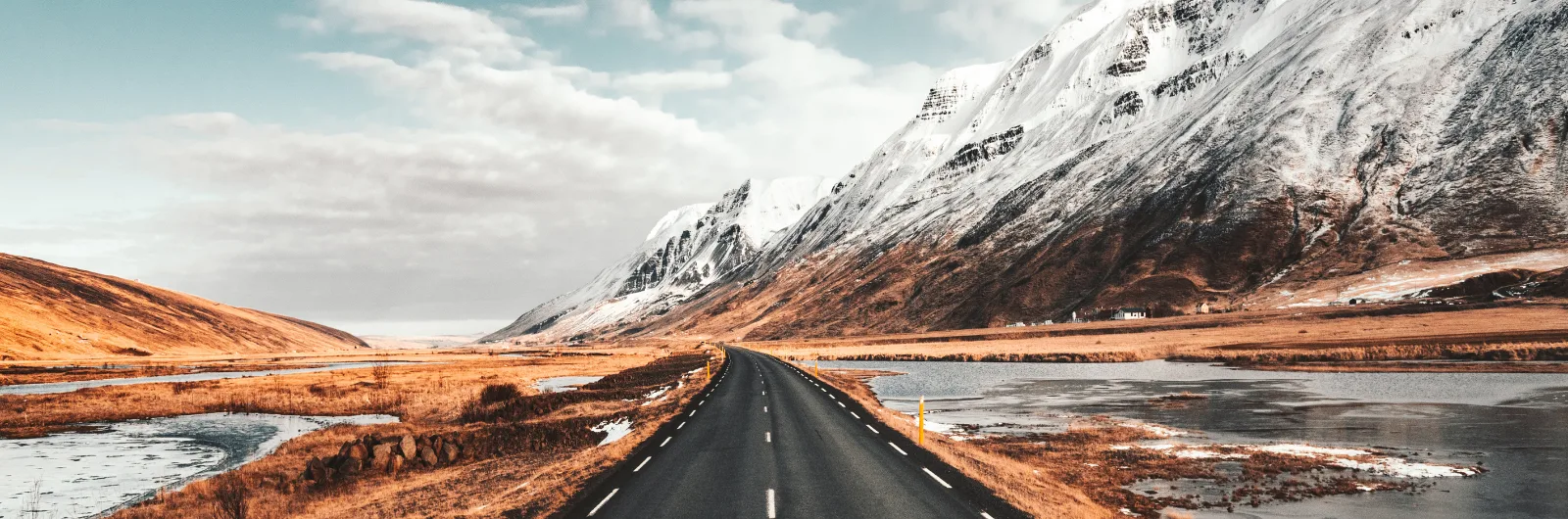
Iceland is a country best understood from behind the wheel. Not because driving is the only way to see it — buses, domestic flights, and organised tours all exist — but because the relationship between landscape and distance is the core of the experience. The waterfalls are not in a city: they are between two villages separated by eighty kilometres of asphalt, gravel, or nothing at all. The glaciers are not visited from a fixed point: they reveal themselves around a bend you did not expect. Driving in Iceland is, in a meaningful sense, the journey itself. But doing it well requires understanding a set of rules, conditions, and decisions unlike those of any other European country.
The vehicle debate: 2WD or 4x4
This is the first question every traveller faces, and the answer depends entirely on where you want to go. If your plan is to drive the Ring Road — Route 1, the highway that circles the island — and visit the main attractions along the south coast, the Golden Circle, Akureyri, and the eastern villages, a conventional two-wheel-drive car is sufficient. The Ring Road is paved along almost its entire length and maintained reasonably well even in winter, though conditions can change quickly.
A 4x4 becomes necessary — not optional, necessary — in two situations: the F-roads of the interior and winter driving. F-roads are mountain tracks without pavement that cross the highlands, many of them involving river fords with no bridges. They are legally restricted to four-wheel-drive vehicles, and rental companies will not cover damage if you take a standard car onto them. In winter, even the Ring Road can present stretches of ice, compacted snow, and crosswinds that make a 4x4 an investment in safety rather than a luxury.
The price difference is significant. A Dacia Duster or similar costs between sixty and ninety euros per day in high season, while a compact car can be had for thirty-five to fifty. If you travel in summer with no plans for the interior, the savings over a fifteen-day trip with a compact car can exceed five hundred euros. If you need to reach Landmannalaugar, Askja, or Kerlingarfjoll, the 4x4 is non-negotiable.
A nuance that few people mention: some secondary roads that are not officially F-roads have stretches of rough gravel where a low-clearance car struggles. Route 939 towards Seydisfjordur, for example, has steep gradients and unpaved bends that, without technically being an F-road, test the ground clearance of a small vehicle. Route 612 to Latrabjarg in the Westfjords is another case. Before deciding, check your specific route, not just the general vehicle category.
Insurance: what each policy covers and what it does not
The rental insurance system in Iceland is more complex than in the rest of Europe because the risks are different. It is not just about collisions and theft: wind, gravel, volcanic ash, and water are real threats that standard insurance from other countries does not address.
The CDW (Collision Damage Waiver) is the basic coverage included in almost every booking. It reduces your liability in the event of collision damage but leaves an excess that can range from two hundred to three thousand euros depending on the company and the vehicle. It does not cover damage from gravel, water, wind, or ash.
The SCDW (Super CDW) reduces that excess to zero or near zero for collision damage. It is the most common upgrade and typically costs between five and fifteen euros per day. If you drive carefully and stay on paved roads, this coverage is usually sufficient.
The GP (Gravel Protection) covers damage caused by stones thrown up on gravel roads: cracked windscreens, damaged paintwork, broken headlights. In most countries this seems unnecessary, but in Iceland it makes real sense. A truck overtaking you on a gravel road can launch stones that crack your windscreen in seconds. It costs between four and ten euros per day and is worth it if you plan to drive on any unpaved roads — which will be many.
The SAAP (Sand and Ash Protection) covers damage from sandstorms and volcanic ash. It sounds exotic until you learn that sandstorms in southern Iceland — particularly between Vik and Hofn — are frequent and can strip a car’s paint in minutes. This insurance is cheaper than repainting a vehicle and more relevant than it appears. The Myrdalssandur area, the vast black volcanic sand desert south of the Myrdalsjokull glacier, is particularly prone to these episodes when wind exceeds forty kilometres per hour.
There are also supplementary policies covering undercarriage damage and water damage from river crossings. If you plan to drive F-roads with river fords, the latter is essential. A miscalculated ford can flood the engine, and the repair bill easily exceeds ten thousand euros.
F-roads: a different world
F-roads (Fjallvegir, literally “mountain roads”) are the routes that cross Iceland’s uninhabited interior. They begin with the letter F followed by a number — F26, F35, F88, F208 — and represent an entirely different category of driving. They are not poorly maintained roads: they are tracks designed to be traversed by prepared vehicles, under specific conditions, within a limited time window.
Several characteristics define them. First, they have no pavement: they are gravel, dirt, rock, and in some stretches, simply tyre marks across volcanic sand. Second, many include unbridged river crossings. The water can reach knee height or more, the current can be strong, and the riverbed is uneven. Crossing a ford requires technique: enter slowly at the widest and shallowest point, maintain constant revs, never stop in the middle of the water. Third, they are closed for most of the year. Most do not open until late June or early July and close in September or October depending on conditions. The website road.is publishes the current status of each road.
Driving on a closed F-road is illegal and carries severe fines. Beyond the fine, the reason for closure is usually practical: the ground is too soft, and vehicles cause permanent damage to a surface that takes decades to recover. Icelandic vegetation grows with a slowness that defies intuition: a tyre mark on moss can take seventy years to disappear.
The best-known F-roads have distinct personalities. The F35 (Kjolur) is the most accessible and connects south to north through the interior, with relatively few fords and reasonably stable terrain. The F26 (Sprengisandur) is longer, more remote, and crosses the island’s vastest volcanic desert. The F208, which leads to Landmannalaugar, includes several deep fords and is an initiation rite for many travellers. The F88 to Askja is long and isolated, with river crossings that vary enormously depending on the time of day and temperature — glaciers feed the rivers, and flow increases in the afternoon when meltwater peaks.
Single-lane bridges, blind hills, and sheep
The Ring Road and many secondary roads feature single-lane bridges, signposted with a sign reading “Einbreid bru.” The rule is simple: the vehicle that arrives first has priority. If you arrive second, you wait. But the practical application requires attention, because sometimes the bridge sits on a curve or beyond a hill, and you cannot see whether someone is coming until you are upon it.
Blind hills (blindhaed) are another distinctive element. On many secondary roads, the rolling terrain creates crests from which you cannot see what lies on the other side. The “blindhaed” sign means you should reduce speed and, on narrow roads, be prepared to encounter an oncoming vehicle. This is not a theoretical warning: accidents on blind hills happen every season.
And then there are the sheep. Iceland has more sheep than people — roughly eight hundred thousand sheep compared to three hundred and eighty thousand people — and in summer they graze freely across the entire territory, including road verges and the roads themselves. Icelandic sheep have a particular tendency to cross the road at the last possible moment, often in groups, with lambs heading in the opposite direction from their mother. If you see a sheep on one side of the road, slow down, because there is probably another on the other side about to cross.
Fuel: planning your stops
Petrol stations in Iceland are more widely spaced than European drivers are accustomed to. On the Ring Road, the maximum distance between stations is usually one hundred to one hundred and fifty kilometres, but there are stretches — especially in the east and the Westfjords — where the gap can reach two hundred kilometres or more. In the interior, there are simply no stations.
The practical rule is straightforward: if you see a station and your tank is below half, fill up. Do not wait for the next one. N1 and Orkan are the most widespread chains. Many operate as unstaffed self-service pumps, especially outside business hours: you insert a credit card with a PIN, select the amount, and fill up. It is important that your card supports PIN entry, because many automated stations do not accept signature or contactless payment.
Fuel prices are high — around two euros fifty per litre in 2026 — with diesel somewhat cheaper. A full circuit of the Ring Road (roughly thirteen hundred kilometres) uses between seventy and one hundred litres in a standard car, which means between one hundred and seventy and two hundred and fifty euros in fuel alone. In a large 4x4, consumption can double.
For those driving electric vehicles, the charging network has improved enormously in recent years. The Ring Road has charging points in the main towns, but the range between chargers in the east and north requires careful planning. In the highlands and the Westfjords, electric infrastructure is virtually non-existent.
Speed limits, cameras, and fines
The speed limit in Iceland is ninety kilometres per hour on paved roads outside towns, eighty on gravel roads, and thirty or fifty in urban areas. Speed cameras exist and function, though they are less numerous than in other European countries. What does exist are mobile radar units that police deploy at varying locations.
Fines are severe. Exceeding the limit by more than twenty kilometres per hour can cost four hundred euros or more, and by more than thirty the figure rises considerably. Fines are sent to the address associated with the rental vehicle, and rental companies pass them on to the driver with an additional administrative charge.
But the reason to respect the limits is not the fine: it is the road. At ninety kilometres per hour on asphalt, a lateral gust of wind can push the car half a metre. At ninety on gravel, braking distance multiplies and cornering control drops dramatically. The most serious tourist accidents in Iceland involve excessive speed on gravel or loss of control due to wind.
Wind: the factor nobody plans for
Wind in Iceland is not like wind elsewhere. It is not an unpleasant breeze: it is a constant, variable, and sometimes dangerous force that directly affects driving. Gusts of one hundred kilometres per hour are not exceptional, especially in winter, and gusts of sixty or seventy are common even in summer.
Wind affects driving in three ways. First, lateral displacement: a strong gust can literally push the car into another lane. Second, doors: opening a car door in strong wind can rip it off its hinges. This is damage that standard insurance does not cover and that rental companies charge for without exception. You must always hold the door when opening, using your body as a brake. Third, visibility: wind lifts sand, dust, and sometimes snow that can reduce visibility to metres.
The website vedur.is (the Icelandic meteorological service) publishes detailed wind forecasts and colour-coded alerts. Yellow means caution, orange indicates dangerous conditions, and red means you should not be on the road. The real-time wind map is a tool worth checking every morning before setting out.
Driving on gravel: a specific skill
Much of Iceland beyond the Ring Road has gravel roads. These are not roads in poor condition: they are roads designed this way, maintained as gravel. Driving on them requires adjusting both expectations and technique.
Speed should be lower than the limit allows. The limit on gravel is eighty, but many stretches are comfortable only at fifty or sixty. Loose gravel reduces grip in a non-linear way: at forty kilometres per hour you have reasonable control; at seventy, an emergency brake becomes a long skid. Curves on gravel require anticipation: brake before the curve, not during it.
The greatest danger on gravel roads is the encounter with other vehicles. When two cars pass each other on gravel, both must reduce speed significantly. The stones thrown by a passing car can shatter the windscreen of the oncoming vehicle. Courtesy and caution are not optional: they are practical survival.
Parking in Reykjavik
Reykjavik has a zone-based parking system that, while not complicated, is worth understanding. The centre is divided into zones P1 (red, most expensive), P2 (blue, mid-range), and P3 (green, cheapest). Payment is by mobile app — Parka is the most widely used — or at meters that accept cards. Parking is free in the evenings and on Sundays. Outside the centre, parking is free and plentiful.
Beyond Reykjavik, parking at tourist attractions has changed in recent years. Many sites that were once free now have paid parking: Seljalandsfoss, Skogafoss, Kerid, Solheimasandur, and Reynisfjara beach, among others. Fees are usually five hundred to one thousand Icelandic kronur (three to seven euros) and are paid at machines or by app. It is a minor cost, but it accumulates if you visit many sites in a single day.
When not to drive
There are situations where the right decision is not to go out. The Icelandic winter presents conditions that can change from acceptable to dangerous in less than an hour. A road that is clear in the morning can be covered in black ice by afternoon. A snowstorm can reduce visibility to zero.
The website road.is is the essential tool. It shows the status of every road in real time, with colours ranging from green (good conditions) to dark red (impassable). If a road is marked as closed, it is closed. There is no room for interpretation and no exceptions for tourists in a hurry.
As a general rule, if the wind forecast exceeds twenty-five metres per second (ninety kilometres per hour), driving is risky in any vehicle. If it exceeds thirty-five metres per second, it is dangerous even in a heavy 4x4. The Icelandic meteorological service issues specific alerts for drivers that are worth following.
The other time not to drive is after a long flight without rest. Iceland receives many overnight flights from Europe and North America that arrive early in the morning. The temptation to collect the car at Keflavik and head straight onto the Ring Road is understandable but inadvisable. Fatigue, combined with unfamiliar roads and potentially adverse conditions, is a combination that produces accidents every season. Rest before driving: Iceland will still be there after a nap.
A note on rental companies
Iceland has a competitive car rental market with dozens of companies. The large international brands (Hertz, Europcar, Avis) operate at Keflavik airport and offer standard guarantees. Local companies (Blue Car Rental, Lava Car, Lotus, Go Car, SADcars) often have lower prices and fleets adapted to Icelandic terrain, but the experience varies.
What matters more than the company is reading the terms: which insurance the base price includes, what the real excess is, which types of damage are excluded (doors torn off by wind, water damage, driving on restricted roads). Photographing the car thoroughly when collecting it — including the underside, the roof, and the wheels — is a basic precaution that prevents disputes on return.
Comparing on aggregators like Northbound, Guide to Iceland, or directly on company websites usually gives a complete picture of the market. Booking early — three or four months ahead for summer — is practically mandatory: demand exceeds supply in July and August, and last-minute prices can double those of early bookings.
Driving in Iceland is not difficult if you understand the context. It is not a country where the road is a formality between two points: it is a country where the road is part of the landscape, and where the landscape demands respect. Adjusting your speed, respecting closures, carrying the right insurance, and checking conditions before setting out are habits that transform driving from a risk into a pleasure. And that pleasure — the freedom to stop wherever you want, to detour towards a fjord that was not in the plan, to reach a place that only exists at the end of a gravel track — is what makes driving in Iceland worth every kilometre.
More on Iceland
Keep reading.
Other pieces from the same destination.

Next step
Ready for Iceland?
The guide is for travelling.
Interactive maps & itineraries and everything that doesn't fit in an article. Always the latest published version.
Get the Iceland guide