

History of Romania
From the Dacians to Ceaușescu, through Rome, the Ottomans and the Habsburgs: why Romania looks like Romania.
The history of Romania is not that of an ancient nation: it is the history of a nation that invented itself in the 19th century on the remains of three distinct political projects, and that turned its own fragmentation into identity. Understanding it requires accepting first that "Romania" is a late name, and that what today appears as a single country was for two thousand years a border between civilizations that had no intention of meeting.
Dacia: the first empire north of the Danube
Before Rome, present-day Romania was inhabited by the Dacians, a Thracian people who under King Decebalus (87-106 AD) built a kingdom organized and powerful enough to seriously trouble the Roman Empire. Two wars were needed — the second narrated on Trajan’s Column in Rome — to defeat the Dacians and turn their territory into the Roman province of Dacia Traiana in 106.
It was one of the Empire’s last conquests, and one of its briefest: only 165 years later, in 271, Emperor Aurelian abandoned the province as indefensible. But that Roman parenthesis was enough to transform the country linguistically. The colonists Latinized enough so that, when Goths, Huns, Avars, Bulgars and Slavs passed over in the following centuries, the Latin language survived — rural, spoken by shepherds, but alive.
That residual Latinity is, in itself, a unique case in Eastern Europe. All neighboring peoples ended up speaking Slavic, Greek or Magyar. The Romanians preserved a Romance language for a thousand years without prestige, without a state, without a Latin Church. When in the 19th century nationalist intellectuals begin to build the narrative of Romania, it rests on that double heritage — Dacian and Roman. Hence the very name: român, Roman.
The Middle Ages: three principalities and three enemies
In the 14th century, as the fog of the invasions begins to clear, three distinct political entities appear on the map that will mark Romanian history for the next 500 years:
Wallachia
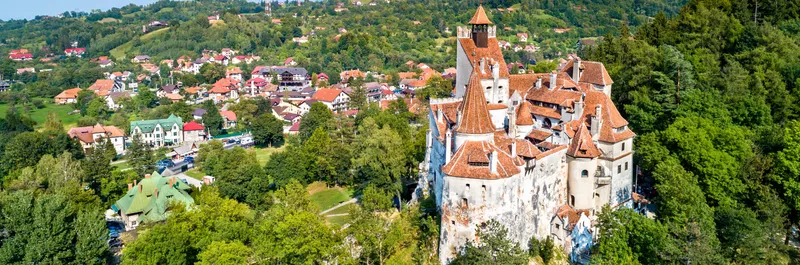
from 1330The southern principality, capital at Curtea de Argeș and later Târgoviște. Open to the Danube plain, in direct contact with the Ottoman Balkans. Its voivodes swung between vassalage to Hungary, to Poland, or to the Sultan, as circumstances dictated. Here ruled Vlad III Țepeș (1448, 1456-1462, 1476), the Impaler, whose terror policy against the Ottomans was real and effective, and whose myth — Stoker's Dracula — is Victorian and Irish.
Moldavia
from 1346The northeastern principality, capitals in succession at Siret, Suceava and Iași. More oriented toward Poland and Kyiv than toward the Balkans. Its peak figure is Stephen the Great (1457-1504), who defeated the Ottomans at Vaslui (1475) — the battle for which the Pope called him "athlete of Christ" — and whose legacy is the first fortified monasteries of Bucovina. He won thirty-three of his forty-six battles.
Transylvania
12th century – 1918Region on the plateau enclosed by the Carpathians, under Hungarian sovereignty from the 12th century and settled through planned colonization. The Hungarian kings brought in Saxons (Germans from Saxony-Luxembourg-Moselle) to defend the borders, and Székelys (border Hungarians). Romanians — the demographic majority — remained outside the system of medieval Transylvanian "nations". That exclusion will fuel Romanian nationalism in the 19th century.
For four hundred years, these three principalities live apart, with separate fates. Wallachia and Moldavia pay tribute to the Sultan but preserve internal autonomy (they are, technically, vassals, not provinces). Transylvania is first part of the Kingdom of Hungary, then of the Habsburg Empire after 1699. Each develops its own architecture, its own political life, its own elites. That is why Brașov today resembles Nuremberg, Iași looks like Kyiv, and Bucharest like neither.
Michael the Brave: the forty-two-day union
In 1600, a Wallachian voivode named Michael (Mihai Viteazul) unites, for the first — and for centuries, the last — time, the three principalities under one rule. He enters Alba Iulia, capital of Transylvania, with the opportunistic support of his usual rivals, and for forty-two days he is ruler of Wallachia, Moldavia and Transylvania. A Polish-Hungarian coalition has him assassinated in 1601.
The real history is more complicated than the nationalist narrative: Michael was not trying to “unite the Romanians”, he was trying to build a personal domain taking advantage of Ottoman weakness and Habsburg chaos. But 19th-century Romantic storytelling turned him into the first unifier, and the city of Alba Iulia — where he entered in 1600 — would for that reason become the chosen stage in 1918 to proclaim Greater Romania.
The Ottomans: four hundred years of border
Wallachia and Moldavia spend four centuries in the Ottoman orbit, but — unlike the Balkans south of the Danube — they are never truly conquered. They keep their voivodes, their Orthodox Church, their laws, their language. They pay tribute (the haraç) and, from the 18th century, accept the imposition of Greek Phanariot rulers (from Istanbul’s Fanar district) whom Constantinople sells to the highest bidder.
That Phanariot regime (1711-1821) is, for Romanians, one of the darkest periods of their history: systemic corruption, devastating taxes, cultural decline. But it is also a period of forced modernization, in which the courts of Bucharest and Iași fill with libraries, Greek schools and Mediterranean contacts. When the Greek revolution of 1821 shakes the empire, Wallachia and Moldavia demand — and obtain — the return of Romanian voivodes.
The construction of Romania (1859-1918)
During the 19th century, what were once three separate countries begin to think of themselves as a single nation. The intellectuals of the Transylvanian School — Greek Catholic priests trained in Rome — rediscover Latinity. The 1848 revolution breaks out simultaneously in all three principalities. The Crimean War (1853-56) weakens Russian tutelage.
On 24 January 1859, the two Danubian principalities — Wallachia and Moldavia — elect the same candidate, Alexandru Ioan Cuza, as prince. It is a legally questionable personal union, but politically irreversible. In 1866 they replace him with a German prince of the house of Hohenzollern-Sigmaringen (Carol I), seeking dynastic stability and European backing. In 1877 Romania proclaims its independence from the Ottoman Empire after the Russo-Turkish war. In 1881 it becomes a kingdom.
Transylvania — still under the Habsburgs — remains outside. The First World War changes that. Romania enters on the Allied side in 1916, loses ground to Germany, but wins everything at the peace: the Austro-Hungarian Empire disintegrates and, on 1 December 1918, an assembly of 1,228 delegates proclaims in Alba Iulia the union of Transylvania with the Kingdom of Romania.
That moment — the Marea Unire, the Great Union — is still Romania’s national date. The Coronation Cathedral of Alba Iulia is built to commemorate that unification and to crown King Ferdinand and Queen Marie in 1922 as sovereigns of Greater Romania.
The interwar period and the Second World War
Interwar Romania is, on paper, a modern European country: parliament, universities, a brilliant cultural scene (Brâncuși, Enescu, Ionesco, Eliade, Cioran). But it is also a country with deep ethnic tensions — a third of the population is minority — and with a growing radical right: the Iron Guard, a specifically Romanian fascist-Orthodox movement that combines antisemitism with religious mysticism.
In 1940 Romania loses territories to the Soviet Union (Bessarabia and northern Bucovina), Hungary (northern Transylvania) and Bulgaria (southern Dobruja). King Carol II abdicates. General Ion Antonescu takes power and aligns the country with Nazi Germany. Romania fights on the Eastern Front, recovers Bessarabia, and participates in the Holocaust: approximately 280,000 Romanian Jews are murdered, half of them in camps administered by the Romanian regime itself in Transnistria.
In August 1944, with the Red Army at the border, King Michael I stages a coup, arrests Antonescu and switches sides. Romania ends the war on the Allied side, but under Soviet occupation.
Communism and Ceaușescu (1947-1989)
In 1947 the communists force King Michael to abdicate. Four decades of single-party rule begin. The first phase — under Gheorghe Gheorghiu-Dej — is one of brutal Sovietization: nationalizations, forced collectivization, the Romanian gulag (Sighet, Gherla, Aiud) where the pre-communist political and religious elite dies.
In 1965 Nicolae Ceaușescu comes to power. At first it looks like an opening: Romania condemns the Soviet invasion of Czechoslovakia in 1968, keeps relations with China and the West, Nixon and de Gaulle visit. But from the 1970s the regime drifts into a personality cult of North Korean intensity. Demographic obligation is imposed (abortion ban, five children per woman as target), the country is indebted to pay for megalomaniac infrastructure, Bucharest’s historic center is demolished to erect the “House of the People”.
The Securitate and the fear
The Romanian political police — Department of State Security, popularly Securitate — came to have one agent or informant for every 43 citizens (approximately 500,000 collaborators against a population of 22 million). Its archive, partially opened after 1989, occupies 27 km of shelves. Surveillance was total: letters read, phones tapped, microphones in hotels, denunciations between neighbors institutionally incentivized. What distinguished Ceaușescu's regime from other real socialisms was not only the intensity of control, it was the atmosphere: a society that learned to distrust even the silence of its own home. That inherited institutional distrust is still traceable in contemporary Romanian politics.
The fall comes abruptly and bloodily. In December 1989, a protest in Timișoara against the deportation of the Hungarian pastor László Tőkés turns into insurrection. The army switches sides. On 22 December the crowd storms the Central Committee in Bucharest. On the 25th, after a two-hour summary trial, Nicolae and Elena Ceaușescu are shot against a wall in Târgoviște. It is the only anti-communist revolution in the bloc that ended with the dictator executed.
Contemporary Romania
The transition was long and chaotic. The 1990s were a lost decade: hyperinflation, industrial collapse, the 1990 “mineriad” in which miners were used as a militia against protesters. The 2000s brought recovery and integration: NATO in 2004, EU in 2007, Schengen (air and maritime) in 2024.
The country of 2026 is radically different from that of 1989, but still carries its contradictions. Cluj is now the fourth tech hub in Central Europe. Bucharest has a gastronomic scene comparable to Budapest’s or Belgrade’s. At the same time, the countryside — which still employs 20% of the active population — carries structural problems: poor infrastructure, rural exodus, aging.
What the traveler finds is a country that has traveled further in 35 years than others have in a century and a half, and that nevertheless keeps — in Maramureș, in Bucovina, in the Saxon villages of Transylvania — patches of the pre-industrial European world in real working order. Romania is, in that sense, the European country where the most layers of history coexist simultaneously over the same territory. That is probably why it is also the hardest to summarize.