
Greece · 15 September 2026
Greece in September: why those who know choose this month
The Aegean in September has its warmest water of the year, August tourists are gone, prices drop 30% and the light is perfect for ruins. There is no better month.

The Aegean reaches its maximum temperature not in July, when most people have their holidays, but in August and September, when months of accumulated heat have warmed the sea to 26-28 degrees Celsius in the Cyclades. This creates a curious situation: the sea is at its best precisely when fewest people are enjoying it. Because the mass beach tourism departs at the exact moment when the water is at its most perfect.
Those who have been to Greece in September rarely go in August. The difference is not only price — though price is a real and significant factor. It is atmosphere, scale, the proportion of tourists to place. Greece in September is the same country, with the same sun and the same sea, but with the volume turned down three notches.
The sea at its best
The Mediterranean is not a body of cold water that warms in summer and cools in autumn. It is a closed sea with thermal memory: the solar energy of June, July and August accumulates in the surface layer, and the maximum temperature arrives six to eight weeks after the peak of solar radiation. In practice, this means that the Aegean in September is warmer than in June or July.
Specific figures vary by area: in the Cyclades — Santorini, Mykonos, Paros, Naxos — water temperature in September ranges between 25 and 27 degrees. In the Ionian — Corfu, Cephalonia, Zakynthos — it is slightly warmer, averaging around 26-28 degrees. Off southern Crete, temperatures reach 27-28 degrees in September. These temperatures are ideal for swimming, snorkelling and any water activity. July water, by comparison, is two to three degrees cooler.
Air temperature in September is perfectly summery: 26-30 degrees on the islands, 24-28 in Athens. The autumn rains that characterise the Mediterranean climate do not arrive on most Greek islands until late October or early November. September is dry. The meltemi pattern — the north wind that sweeps the Aegean in July and August — weakens progressively through September, which also means calmer seas.
The price difference
The Athens-Santorini conventional overnight ferry costs between €45 and €65 per person in high season (July-August). In September, the same route drops to €32-45. The fast ferry — around five hours from Piraeus — can cost €80-90 in August and €55-70 in September. Hotels follow a similar pattern: studios that cost €120-200 per night on a mid-sized Cycladic island in August drop to €80-130 in September. On Mykonos or Santorini, where prices are structurally higher, the relative discount is similar but the absolute numbers remain elevated.
The practical implication is that the same budget that buys eight days on an island in August buys ten or twelve in September, at comparable accommodation level. Or the same number of days with better accommodation and more frequent taverna visits.
Ruins with the best light of the year
August is the worst month for visiting Greek archaeological sites. The heat — which on the Acropolis can exceed 38 degrees on the exposed terrace at midday — is a real physical limitation, and the crowding at the most visited sites turns the experience into something close to an endurance event. The Acropolis receives fifteen thousand visitors on peak August days. The queue at the Propylaia can mean forty minutes waiting in full sun.
September changes this on two dimensions. The first is temperature: with averages of 26-28 degrees in Athens, midday visits are comfortable again, though early morning remains the best option for light quality. The second is the people: cruise tourists continue to arrive in September, but independent beach tourism drops sharply after 31 August. The result is that sites have between 30 and 50% fewer visitors in the first week of September than in the last week of August.
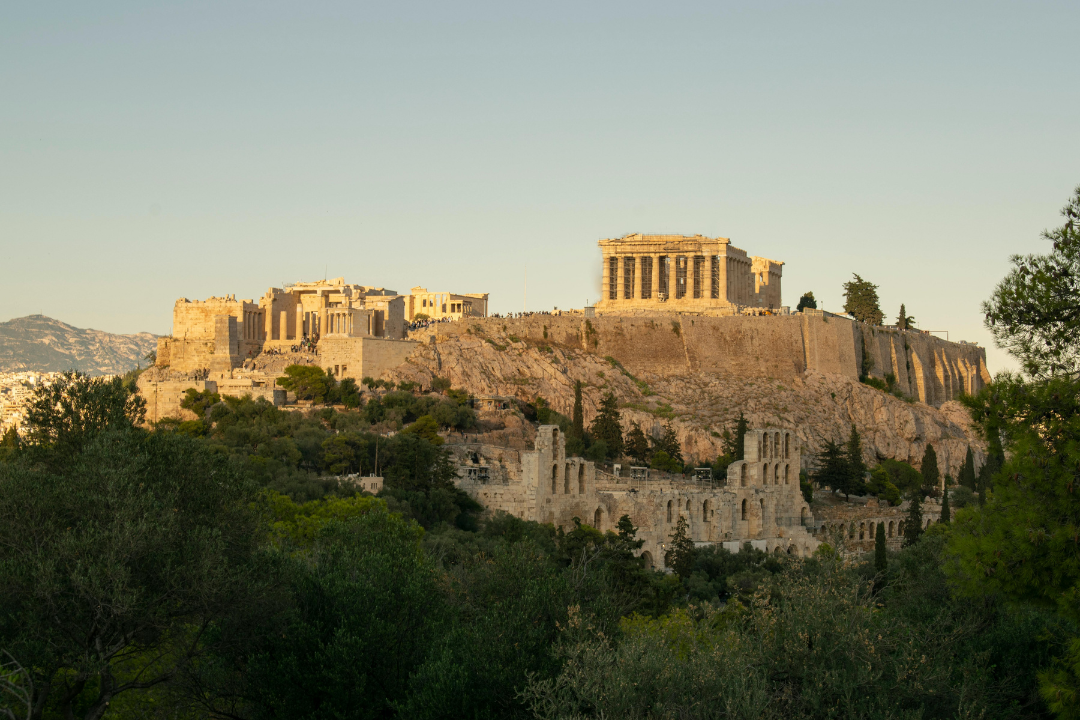
September’s light has a different quality from August’s. The solar angle is lower, the light is more golden and directional, shadows are longer. This is not sentiment: it is physics. Archaeological photographers know that September and October are the best months of the year for documenting Greek ruins because the lateral light reveals stone detail better than the harsh overhead light of midsummer.
What the quieter season does to tavernas
In August, the best tavernas on the most visited islands run at full capacity for weeks. Cooks work under maximum pressure, service suffers, and the temptation to simplify the menu or use lower-quality ingredients is real. In September, with fewer customers but supply chains still active and seasonal ingredients at their peak — the August-September grapes, dried figs, seasonal lamb, the last summer tomatoes — cooking tends to recover the attention it loses in the most frenetic months.
Tavernas that had a waiting list at nine in the evening in August have tables available at eight-thirty in September. Owners have time to talk, to recommend the wine of the day, to bring something that wasn’t on the menu. This is not idealisation: it is the difference between a business in survival mode and a business in hospitality mode.
The local markets in September have the most interesting products of the year: the grape harvest begins in August and continues through September, and cooperative stalls stock this year’s wines alongside new olive oil. The dried figs, the cured olives, the cheese that never reaches city supermarkets: September is the month when the local economy of the islands shows itself most clearly.
The complete Far Guides Greece guide includes detailed routes across the mainland and islands, interactive maps and all the practical information you need to plan your independent trip.
More on Greece
Keep reading.
Other pieces from the same destination.


Next step
Ready for Greece?
The guide is for travelling.
Offline maps, itineraries and everything that doesn't fit in an article.
Get the Greece guide