




Greece · 5 May 2026
Ferries in Greece: how to get between islands
Practical guide to Greek ferries: how to book, which companies to use, main routes and tips for organising your island-hopping.
There comes a moment, when planning a trip to the Greek islands, when everything gets complicated. You have chosen the islands — say Santorini, Naxos, Paros, Milos — and now you need to link them up. And then you discover that the Greek ferry system is a universe unto itself, with its own rules, its own companies, schedules that change every season and connection patterns that are not always intuitive.
It is not as complicated as it seems. But it helps to understand how it works before booking, because the difference between a well-planned island-hopping trip and a chaotic one usually comes down to a handful of decisions made before you leave home.
The ports of Athens: not all are equal
Athens has three ferry ports, and knowing which one you need is the first step.
Piraeus is the main port. The largest, the most chaotic and the one with connections to the most destinations. Ferries depart from here to the Cyclades (Santorini, Mykonos, Naxos, Paros, Milos), the Dodecanese (Rhodes, Kos), Crete (Heraklion, Chania), the Saronic Islands and the eastern Aegean islands. If you do not know where your ferry leaves from, it is probably Piraeus. It has twelve boarding gates, and they are quite spread out, so arrive with time to spare and check the exact gate — the port’s information boards are not always reliable, and the shipping company’s app tends to be more accurate.
Piraeus is connected to central Athens by metro line 1 (green line). From Monastiraki it takes about 25 minutes. By taxi, between 15 and 40 minutes depending on traffic.
Rafina is the second port, east of Athens, closer to the airport. It is smaller, more manageable and generally less stressful than Piraeus. Ferries from Rafina go to Andros, Tinos and Mykonos (the three are aligned on that route), as well as to some islands in the northern Aegean. If you are flying into Athens and your first island is Mykonos, Rafina makes a lot of sense: it is half an hour from the airport, compared to the hour and a half you need to reach Piraeus.
Lavrio is the third port, to the southeast, and the least used. It has connections to Kea and Kythnos, two islands in the western Cyclades that Greeks love and tourists barely know about. If you are heading to Kea — which we recommend: it is the closest island to Athens, perfect for a weekend — Lavrio is your departure point.
The companies: who runs what
The Greek ferry market is dominated by a handful of companies, each with its own character and fleet.
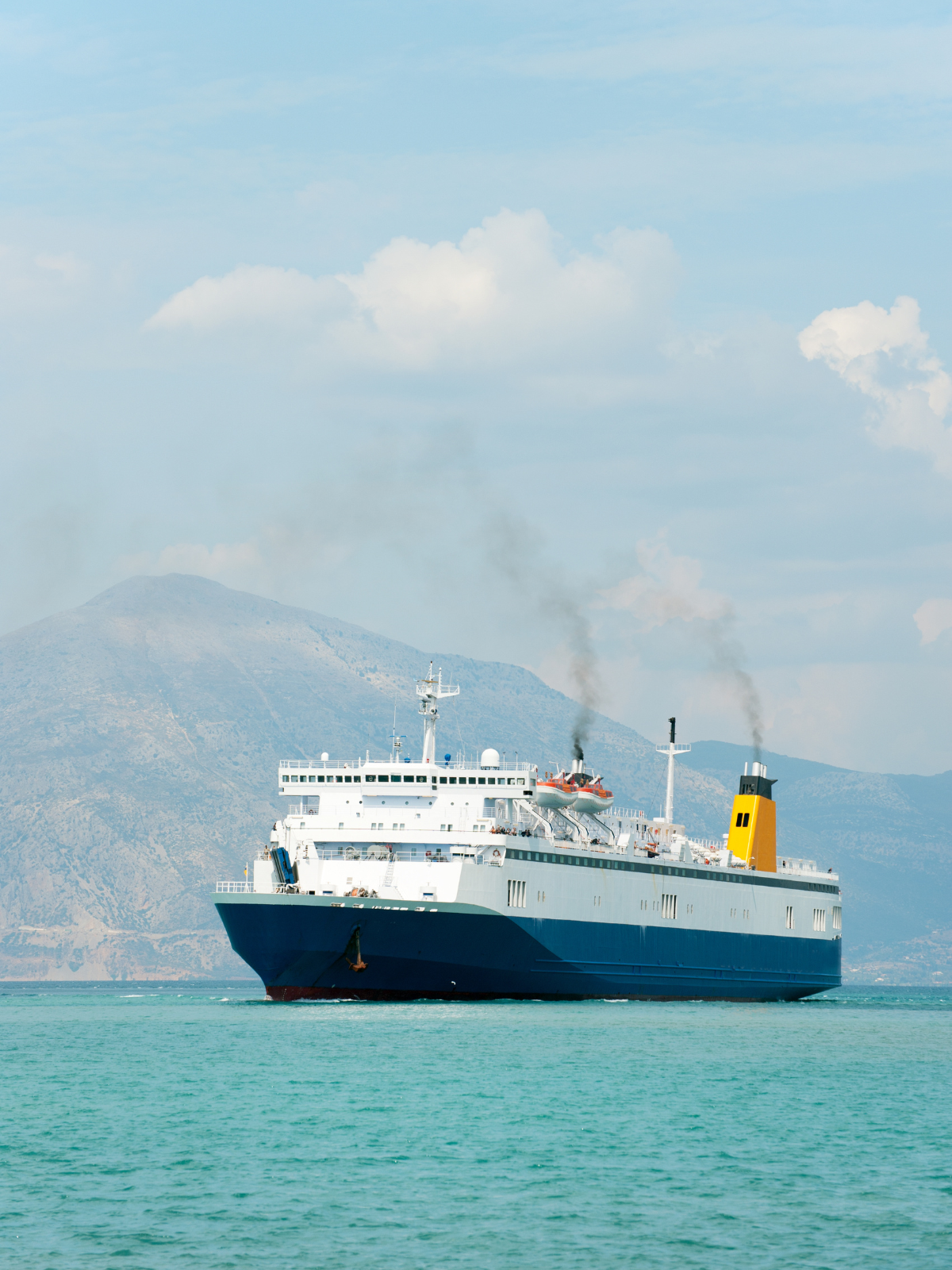
Blue Star Ferries is the benchmark for the Cyclades and the Dodecanese. It operates the large conventional ferries — the ones that take longer but are more comfortable and cheaper. A Blue Star to Santorini from Piraeus takes about eight hours; to Naxos, about six. These are enormous ships, with spacious outdoor decks, cafeterias, a restaurant and the option of booking a cabin if you are travelling overnight. They are reliable, reasonably punctual and sail in bad weather when the fast ferries stay in port. If you are only going to remember one name, make it Blue Star.
SeaJets operates the fast ferries (catamarans and hydrofoils). They are significantly more expensive — sometimes double the price — but cut travel times by half or more. A SeaJets to Santorini does the trip in under five hours. The downside: the boats are smaller, they pitch more in rough seas, and when winds are strong (a frequent occurrence in the Aegean, especially with the meltemi in July-August) they cancel more easily than the large ferries.
Hellenic Seaways is another option for both fast and conventional routes. It runs high-speed and regular ferries on several Cycladic and Saronic routes. Its service is comparable to SeaJets, perhaps slightly less punctual but with a good fleet.
Minoan Lines and ANEK Lines dominate the Athens-Crete route. The overnight ferries to Heraklion and Chania are an experience in themselves: large ships with cabins, a restaurant, a cinema and an outdoor deck where you can watch the sun rise over Crete. The crossing takes about eight hours. You leave Piraeus at nine in the evening and arrive at six in the morning. It is one of the best ways to start a trip to Crete — and it saves you a night’s hotel.
Fast Ferries and Golden Star Ferries run complementary routes, mainly from Rafina. They have a good reputation and competitive prices.
How to book: the essential tool
Ferryhopper (ferryhopper.com) is, by a wide margin, the best platform for searching, comparing and booking ferries in Greece. It lets you see all companies and schedules in a single search, compare prices and travel times, and book with an e-ticket that is scanned directly at boarding. The interface is clear and works well on mobile.
The alternative is to book directly on each shipping company’s website. This can make sense if you want a specific cabin on an overnight ferry (Ferryhopper does not always show every cabin category) or if the company has a direct offer. But for 90% of cases, Ferryhopper is the most practical option.
An important note: in peak season (July-August, and especially the first two weeks of August, when Greeks take their holidays), ferries to the most popular islands fill up. Santorini, Mykonos, Paros and Naxos can have fully booked crossings weeks in advance. If you are travelling on those dates, book your ferries as soon as your dates are set. In shoulder season (May-June, September-October) you can book with less urgency, but do not leave it to the last day either.
The hub-and-spoke system of the Cyclades
Logistically, the Cyclades function as a hub-and-spoke system centred on Athens. Most ferries depart from Piraeus or Rafina and make several island stops before reaching their final destination. This has a fundamental practical implication: direct connections between islands do not always exist.
Mykonos and Santorini, for example, are connected — there are direct ferries, especially in high season. But Milos and Mykonos have no regular direct connection. To get from one to the other, you often need to go via an intermediate island (Naxos or Paros typically serve as connection hubs) or accept a long crossing with multiple stops.
Naxos and Paros are the best-connected islands in the Cyclades. They sit at the geographic centre of the archipelago and virtually every ferry travelling from Athens to Santorini calls at one or both. If you want to maximise flexibility, including one of these two in your itinerary simplifies the logistics enormously.
The general rule: plan your route as a line, not a zigzag. If you can go north to south (or south to north), do it. Jumping from one end of the archipelago to the other multiplies travel times and costs.
A logical two-week itinerary might be: Athens, Paros, Naxos, Amorgos, Santorini, Milos, Athens. Each hop is short, each connection is frequent, and the route forms a coherent arc through the heart of the Cyclades.
Fast ferry vs. conventional ferry
The temptation to always take the fast ferry is understandable — who wants to spend eight hours on a boat when you could do it in four? But there are reasons to choose the conventional.
Price is the most obvious. A deck seat on a conventional ferry from Piraeus to Naxos costs around 35-40 euros. The same journey on a high-speed can cost 55-65 euros. Multiplied across several people and several crossings, the difference adds up.
Comfort is the second. The large ferries have enormous outdoor decks where you can lie in the sun, watch the islands go by and feel that the journey is part of the experience, not a chore between destinations. The fast catamarans are like planes: fixed seats, windows that do not open, air conditioning on full blast. You arrive sooner, but you have not really travelled — you have been transported.
And reliability is the third. The large ferries sail in winds up to force 8. The fast ones start cancelling at force 6-7. In July and August, when the meltemi blows from the north with force, cancellations of fast ferries are frequent. If your plan depends on a catamaran that cannot sail because there are two-metre waves, you have a problem. If you have a booking on a Blue Star, you will most likely sail regardless.
The recommendation: use the fast ferry for long crossings where the time difference is significant (Athens to Santorini, for example: five hours vs. eight). For short hops between nearby islands (Paros to Naxos, Naxos to Amorgos), the conventional is more than enough and the time difference is minimal.
What to expect on board
Greek ferries, especially those of Blue Star and Minoan Lines, are surprisingly comfortable. Do not expect cruise-ship luxury, but do not expect the spartan experience you might imagine either.
Deck-class tickets are the cheapest option. You are free to sit wherever you like: in the indoor lounges, on the outdoor deck or in the common areas. There is no assigned seat. On long crossings, Greeks spread sleeping bags on the outdoor decks and sleep in the open air — it is a tradition that is part of the experience.
Reserved seats are like an aeroplane seat: reclining, with an assigned number, in an air-conditioned lounge. The price difference from deck class is small and worth it if the journey is long.
Cabins are the premium option on overnight ferries. They come in two-berth and four-berth configurations, with or without a window, with or without a private bathroom. A double cabin on the overnight ferry to Crete costs between 80 and 120 euros per cabin (not per person), making it a very reasonable alternative to a hotel plus the flight.
All large ferries have a cafeteria and, on overnight crossings, a restaurant. The food is not memorable but it is decent: Greek salads, sandwiches, respectable coffee. Prices are reasonable — it is not the price trap you might expect.
The meltemi: the wind that rules
Between mid-July and late August, the meltemi — the northerly wind of the Aegean — can reach force 7-8 for days on end. It is a dry wind that brings no clouds or rain, but it raises waves of two to three metres and turns ferry crossings into experiences that not everyone enjoys.
The meltemi affects the Cyclades above all, sitting as they do in the middle of the Aegean with no shelter. The eastern islands of the archipelago (Amorgos, Astypalaia) tend to get more wind than the western ones (Milos, Sifnos). Connections are cancelled when wind exceeds certain thresholds, and there is not much to do except wait.
If you are travelling in the height of July-August, always have a plan B. Do not book return flights on the same day as your last ferry. Leave a buffer of at least 24 hours between your ferry arrival in Athens and your outbound flight. The meltemi does not give much advance warning, and being stranded an extra night on a Greek island sounds romantic until you miss your flight.
The ideal season
May-June and September-October are the ideal months for island-hopping. The weather is good (25-30 degrees), the sea is calm (especially in May-June, before the meltemi sets in), ferries operate at reasonable frequency and the islands are not overcrowded.
In May the water is still fresh for swimming (20-22 degrees), but everything else is perfect. In June the water has warmed up and the season is in full swing without the crowds of July-August. September is, for many, the perfect month: the water is at its warmest of the year (25-26 degrees), the meltemi has eased and prices start to drop. October is a gamble — some ferry services are reduced by mid-month, and the weather can be unsettled — but when it works out, it is magical.
July and August are viable but require more planning. Book everything in advance, accept that there will be crowds, and be patient with the wind.
Five final tips
First: download the app of the ferry company you are travelling with. Notifications about delays and gate changes arrive there before anywhere else.
Second: arrive at the port at least an hour before departure. Large ferries start boarding cars 90 minutes ahead, and foot passengers can board up to 30 minutes before. But in peak season, with queues and checks, that margin can feel tight.
Third: if you are taking a car, always book the ferry ticket with the vehicle included. Car space is limited and sells out before passenger seats. The surcharge varies but is typically between 30 and 60 euros per crossing, depending on the distance and the size of the vehicle.
Fourth: bring food and water for the journey, especially if you are travelling in deck class. The onboard cafeterias are fine for a coffee, but for a full lunch on an eight-hour crossing, you will be glad you stopped at a bakery before boarding.
Fifth: enjoy the crossing. The ferry is not just transport. It is part of the Greek experience. The outdoor deck, the wind, the islands appearing on the horizon, the moment you spot your destination and the anticipation of what lies ahead. A forty-minute domestic flight does not give you that. The ferry forces you to slow down, and in Greece, slowing down is almost always the best decision.
For the full picture of every island, route and hidden corner in Greece, the Far Guides complete guide has it all: interactive maps & itineraries, information that stays up to date.
More on Greece
Keep reading.
Other pieces from the same destination.


Next step
Ready for Greece?
The guide is for travelling.
Interactive maps & itineraries and everything that doesn't fit in an article. Always the latest published version.
Get the Greece guide