
Thailand · 2 May 2026
Bangkok in 3 days: a realistic itinerary without rush or saturation
A three-day route through Bangkok with the essential temples, the less touristy neighbourhoods, the dawn markets and the nightlife of the city at human pace.

Bangkok gets a bad rap in Thailand itineraries. It is framed as the necessary hassle before the beaches or the north: two days of temples, a floating market, done. That view is unfair to one of Asia’s great cities and, further, produces trips that leave behind the feeling of not having understood where you have been. Three well-organised days let you see the fundamental monuments, cross to the other side of the river, walk through the less touristy neighbourhoods and leave with a clear sense of why Bangkok is what it is.
This itinerary is built around the city’s rhythm. Early mornings are for temples and markets, midday for food and heat respite, afternoon for walking through neighbourhoods, night for urban life. It does not try to fit everything. It leaves out the weekend Chatuchak, many secondary temples and the Silom area. It prioritises understanding over inventory.
Day 1: Rattanakosin, the historic core
The first day is for Rattanakosin island, the historic kernel where the three founding monuments of real Bangkok are concentrated. The key is starting early: arriving at the Grand Palace at half past eight, twenty minutes before official opening, avoids the bulk of organised groups that arrive around ten.
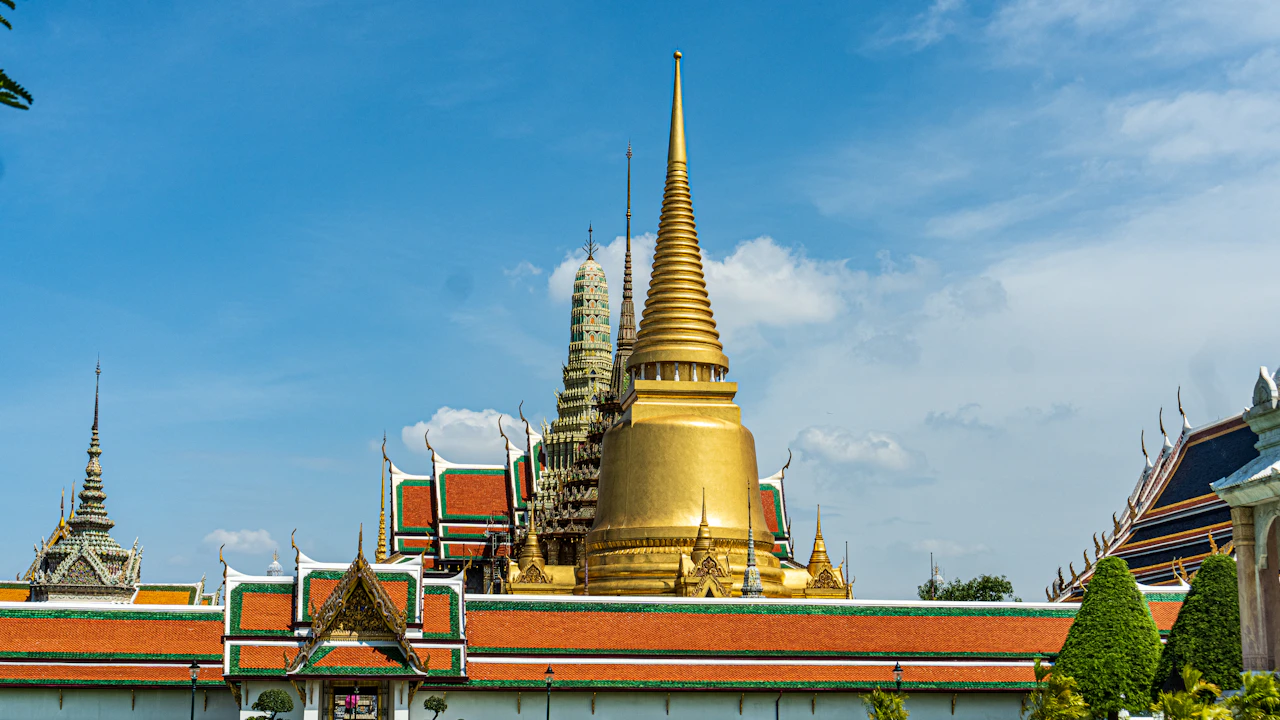
The Grand Palace and Wat Phra Kaew (the Emerald Buddha Temple) are the most important architectural complex in Thailand. The visit should not be limited to the Buddha photograph; the real treasure is in the Ramakien murals — the Thai version of the Ramayana — that run along the eighteen hundred metres of perimeter cloister, a hand-painted comic from the eighteenth century. Two well-spent hours. There is a strict dress code: shoulders and knees covered for both men and women; if you turn up in tank top or shorts, they lend robes at the entrance.
Ten minutes on foot, Wat Pho, the reclining Buddha temple. The forty-six-metre figure is impressive in scale but the temple’s interest is in the ensemble: hundreds of mosaic chedis, cloisters lined with Buddhas, and, above all, the traditional massage school operating inside the precinct. A thirty-minute massage in Wat Pho — under the same roof where Thai massage has been taught for centuries — for about eight euros is a better experience than any tourist spa.
Quick lunch at the Maharaj Pier stalls and river crossing by boat. The crossing costs four baht. On the other side, Wat Arun — the temple of dawn, with its central chedi clad in broken Chinese porcelain in mosaic — merits the climb to the intermediate terrace. The best view is not from the temple itself but from the opposite bank: Khun Mae and other cafés at Tha Tien pier have riverside terraces at sunset.
Dinner at Thip Samai, Mahachai street: the most famous pad thai in Bangkok, in a house that has been serving it since 1966. Half-hour queue, worth every minute. If the queue is unmanageable, Jay Fai on Mahachai (informal Michelin-starred) serves crab omelettes for those accepting the price and the wait; or the Phra Athit stalls, cheaper and without ceremony.
Day 2: Chinatown and river, from dawn to night
The second day starts even earlier. At six in the morning, the Pak Khlong Talat flower market is at its peak: trucks unloading orchids, jasmine, roses and lotuses that in a few hours will fan out across Bangkok’s temples, hotels and houses. It is a real working market, not a tourist attraction, which is why you need to go at working hours. By nine the interesting part is over.
Breakfast at any stall in the area — jok (rice congee) with pork, or pa thong ko (Thai churros) with soy milk — and entry to Chinatown (Yaowarat) on foot, walking up Charoen Krung. Daytime Chinatown is less famous than the night version but has its own identity: the nineteenth-century Chinese temples, the gold markets, the traditional medicine streets, and the corners of the Sino-Thai community that arrived in the 1800s to work the canals. Mid-morning walking at ease.
Lunch at Raan Jay Fai or any restaurant on Soi Texas with a Sino-Thai menu: the fishermen, Cantonese duck, toasted noodles. Local prices, real flavours.
Afternoon, hotel rest (Bangkok has the most aggressive heat in Thailand due to humidity) and leaving again towards sunset. The orange Chao Phraya Express boat from Si Phraya Pier to Tha Tien or Wat Rakhang costs fifteen baht and lets you see the city from the water at the most beautiful light hour of the day. Get off at Tha Maharaj for riverside dinner or continue to Tha Phra Chan to enter Banglamphu.
Night in Chinatown: Yaowarat Road turns into a street food festival after eight. Plastic chairs take over the sidewalks, stalls boil their woks, and the air is a mixture of oyster sauce, fried garlic, coriander and charcoal. T&K Seafood at the corner of Padsai has sea snails and curry crab for a reasonable price; Nai Ek Roll Noodle is the classic reference for kuay chap (square noodles with pork offal).
Day 3: Thonburi and less-visited neighbourhoods
The third day crosses to the west bank, the historic Thonburi, which was the capital between the fall of Ayutthaya in 1767 and the founding of Bangkok in 1782. It is a different Bangkok, slower, with klongs (canals) still functioning as arteries.
The most interesting option is hiring a private longtail boat at Maharaj Pier — negotiable between 1,000 and 1,500 baht for two hours — and cruising the canals: Bangkok Noi, Bangkok Yai, the secondary branches. You see domestic life in the wooden stilt houses, kids jumping into the water, laundry women, minor temples. It is the experience many seek in the tourist floating markets without realising that real floating markets no longer exist.
Stop at Wat Paknam, in Phasi Charoen district. The green-and-gold five-storey pagoda, with its starry-backed dome interior painted by a Bangkok artist, is one of the most photogenic temples in the city without the saturation of Wat Arun or Wat Pho. The inside of the chedi, visible from a central stairway, has an almost cinematic visual experience. Free entry, few tourists.
Lunch at a canal restaurant (any of those local people frequent; the protocol is to point and smile) and free afternoon to choose. Two strong options:
The first, Ari and Phahon Yothin, the hipster neighbourhood where young Thais go. Speciality coffee shops, design stores, independent galleries. Nothing touristy in the traditional sense, but it is the contemporary face of Bangkok and helps understand the country in 2026.
The second, Lumpini Park at sunset and dinner in Silom. It is the Bangkok of office workers, glass towers, high-end restaurants. Less typical but more revealing of economic Bangkok.
For the final night, a rooftop with a view: Vertigo at the Banyan Tree, Sirocco at Lebua, or — cheaper but better atmosphere — Above Eleven in Sukhumvit. The cocktails are expensive (€15-25) but the 360-degree view of the lit city is the logical farewell.
What you leave out
Three days does not cover everything. Out goes the Chatuchak market (weekends only), the commercial floating markets (Damnoen Saduak and Amphawa are two hours away and mostly tourist constructions — if you go, better Amphawa than Damnoen), the Jim Thompson House (interesting if a slot opens), the National Museum (for going deeper into Thai history, but heavy in the morning), and the contemporary museum circuit (MOCA Bangkok is extraordinary for those coming from the art world).
The full Far Guides Thailand guide includes detailed routes through the lesser-known neighbourhoods, exact addresses with hours and interactive maps for each of the sites mentioned.
More on Thailand
Keep reading.
Other pieces from the same destination.


Next step
Ready for Thailand?
The guide is for travelling.
Interactive maps & itineraries and everything that doesn't fit in an article. Always the latest published version.
Get the Thailand guide