
Uzbekistan · 25 September 2026
Uzbekistan budget 2026: what independent travel really costs
Uzbekistan remains one of Asia's most affordable destinations. Updated 2026 budget guide: accommodation, food, transport and entry fees with real prices.

In 2017, the first full year of Mirziyoyev’s tourism opening, Uzbekistan was extraordinarily cheap: 1990s prices, minimal tourism infrastructure, and a combination of a newly liberalised exchange rate and a low-wage local economy that meant a European traveller could live very well for twenty dollars a day. That Uzbekistan no longer exists.
The tourism boom of recent years has pushed prices up consistently in the most visited categories — Bukhara’s boutique guesthouses, the restaurants around the Registan, entry fees to the main monuments. The country remains affordable by European standards, but it is no longer the ultra-cheap destination it was a decade ago. Factoring that in when planning avoids unpleasant surprises on the ground.
Currency and cash
The Uzbek currency is the sum (UZS). At the end of 2025, the exchange rate was around 12,500 UZS per euro, but rates fluctuate and it is worth checking before travel. The economy is predominantly cash-based for everyday spending — food at local restaurants, taxi transport, bazaars — though category hotels and some tourist restaurants accept cards.
The most practical approach is to bring US dollars in cash (50$ and 100$ bills get a better rate than smaller denominations) and exchange at banks or the exchange offices in hotels and on the main streets of each city. The black market rate disappeared with the 2018 liberalisation and there is no reason to look for it.
ATMs work in the main cities with Visa and Mastercard. Fees vary — between two and four dollars per withdrawal — and withdrawal limits can be low. As a backup, always carrying some cash in foreign currency is advisable.
Accommodation: three spending levels
Backpacker level ($20-35/night): Dorm bed in a hostel or basic double room in a family guesthouse without particular pretensions. In Bukhara and Samarkand there are clean, well-located guesthouses in this range. In Tashkent the backpacker level costs somewhat more.
Comfortable level ($40-70/night): Double room with private bathroom in a good guesthouse, typically in a historic house with a courtyard, breakfast included. This is the level we recommend for most travellers: the experience improves exponentially from the previous level and the price remains very reasonable for what is received.
Premium level ($80-150/night): Design boutique hotels in the historic cities, or the large international chain hotels in Tashkent. The experience improves in amenities but not necessarily in authenticity.
Food: eating well for little
Food is where the budget stretches most favourably. A full Uzbek breakfast at a guesthouse — freshly baked non, cheese, fruit, eggs, chai — is included at most comfortable-level accommodation. If bought outside, it does not exceed three dollars.
Lunch or dinner at a local restaurant — plov, shurpa, lagman, samsa — costs between four and eight dollars per person with a drink. Tourist-facing restaurants around the Registan or the Lyabi-Hauz charge between ten and twenty dollars, for dishes that are not always better. The practical rule: if the menu has photographs and is in four languages, the price reflects that.
A full day of food at the comfortable level — breakfast included in accommodation, lunch at a local restaurant, dinner at a slightly better one — runs to 12-18 dollars per person.
Transport
The Afrosiyob (Tashkent-Samarkand or Samarkand-Bukhara): $15-25 in economy class. The overnight train Tashkent-Urgench (for Khiva): $15-25 in kupé. Internal flights Urgench-Tashkent or Bukhara-Tashkent: $40-80 depending on how far ahead you book. City taxis (Yandex Go): $1-3 for standard city journeys.
The transport cost for the classic two-week circuit — Tashkent, Samarkand, Bukhara, Khiva, return to Tashkent — adds up to between 80 and 130 dollars using efficient public transport, or double if private taxis are added or the overnight train is avoided in favour of a flight to Urgench.
Entry fees
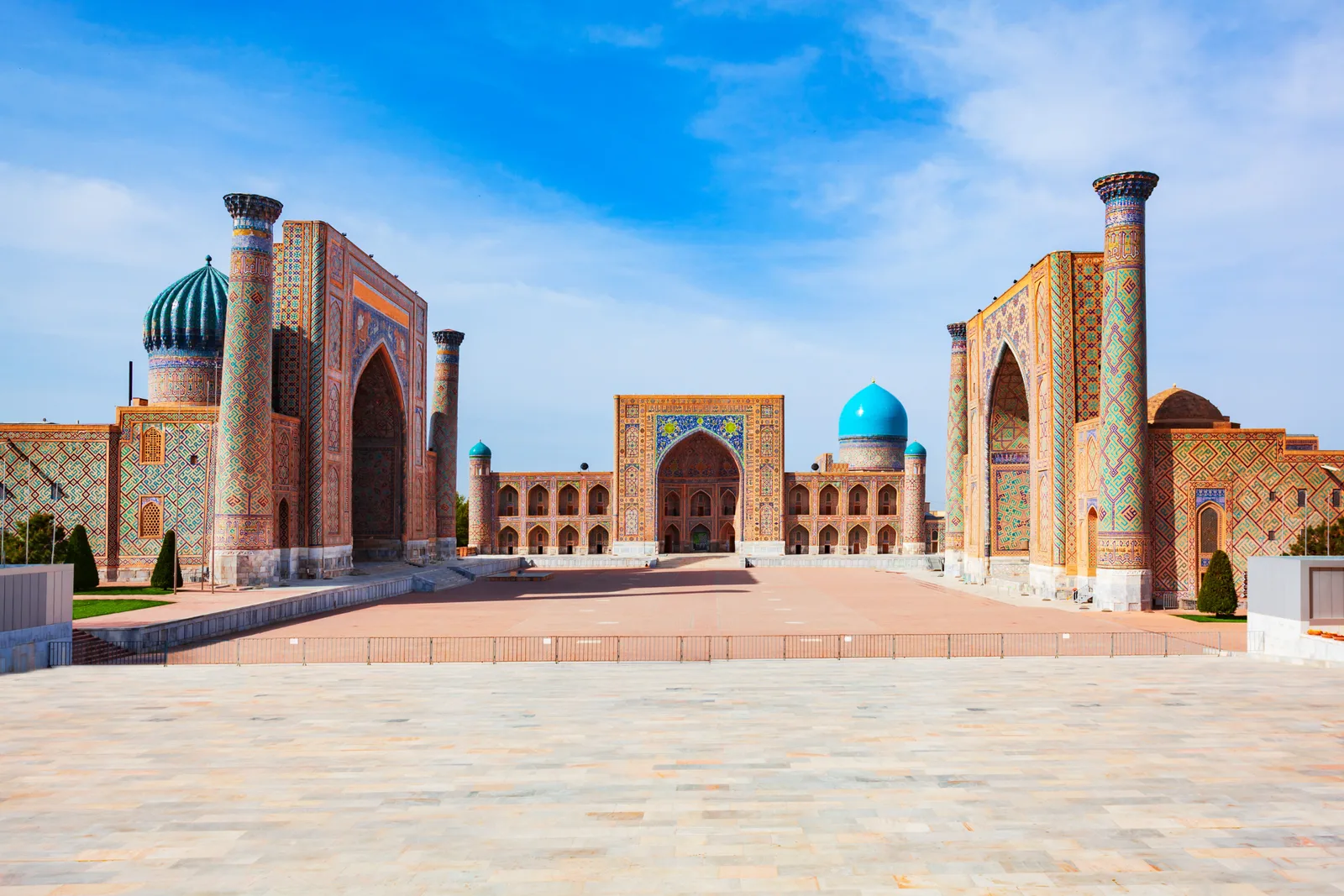
Entry fees to the main monuments have risen in recent years. In 2026: the Registan costs $8, Shah-i-Zinda $4, Gur-e-Amir $3, Bibi-Khanym $3. The Ichan Kala monument package in Khiva — covering access to most of the walled precinct’s monuments — costs $15. Tashkent museums between $3 and $8 each. The Bukhara monument package (Ark, Kalon, Samanid, Lyabi-Hauz): around $12.
The real budget: three profiles
Backpacker: Accommodation $25, food $10, transport $8, entry fees $5, miscellaneous $5 = $53/day. A 14-day trip: $740 excluding flights.
Comfortable traveller: Accommodation $55, food $20, transport $10, entry fees $8, miscellaneous $10 = $103/day. A 14-day trip: $1,440 excluding flights.
Premium: Accommodation $120, food $40, transport $15, entry fees $10, private guide $100, miscellaneous $20 = $305/day. A 14-day trip: $4,270 excluding flights.
Flights from Europe: in 2026, a return ticket from London, Paris or Frankfurt to Tashkent with Turkish Airlines, Uzbekistan Airways or FlyDubai ranges between 400 and 700 euros depending on how far ahead you book and the season. Booking two or three months in advance in mid-season (May-June, September-October) typically gives the best prices.
The complete Far Guides Uzbekistan guide includes detailed Silk Road routes, interactive maps and all the practical information you need to plan your independent trip.
More on Uzbekistan
Keep reading.
Other pieces from the same destination.


Next step
Ready for Uzbekistan?
The guide is for travelling.
Offline maps, itineraries and everything that doesn't fit in an article.
Get the Uzbekistan guide