Egypt · 5 April 2026
The Pyramids of Giza: what you're actually looking at
A narrative guide to the Pyramids of Giza — not just what to see, but what they mean, how they were built, and why four thousand years later they still demand your attention.

There is a moment, the first time you see the Pyramids of Giza, when your brain refuses to cooperate. You know they are large. You have seen them in photographs a thousand times. You have read the numbers — 146 metres, 2.3 million blocks, 4,500 years. None of that prepares you for the physical reality. They are not buildings. They are geology with intent.
The problem with the pyramids is not a lack of information. It is the opposite: the pyramids are so famous, so saturated with popular culture, conspiracy theories and tourist clichés, that it is difficult to see them clearly. This article is an attempt to strip away the noise and explain what you actually have in front of you when you stand on the Giza plateau.
Getting there and orienting yourself
The Giza plateau sits on the western edge of Cairo, about twelve kilometres from the city centre. The pyramids are not in the desert in any romantic sense — they are at the end of a suburban street, with a Pizza Hut and a KFC visible from the entrance. This is disorienting the first time, but it is also a reminder: the pyramids were never isolated monuments. They were built at the edge of the Nile floodplain, precisely where the fertile land ended and the desert began. The boundary between life and death. That geography was deliberate.
From central Cairo, a taxi via Uber or Careem costs 3-5 EUR. The metro does not reach Giza directly, but Line 3 gets you close, with a short taxi ride from the station. Budget at least half a day, preferably a full one. The site is vast — far larger than photographs suggest — and rushing through it misses the point.
The main entrance is on the north side, near the Great Pyramid. Tickets cost approximately 12 EUR for the plateau, with separate charges for entering the pyramids themselves (the Great Pyramid interior is extra, around 20 EUR, and limited to a few hundred visitors per day). Buy the interior ticket if you can — more on that below.
The Great Pyramid of Khufu: the one that matters most
The Great Pyramid is the oldest and largest of the three, built for Pharaoh Khufu (Cheops in Greek) around 2560 BC. For nearly four thousand years it was the tallest structure on Earth, a record broken only in the fourteenth century by Lincoln Cathedral’s spire. Consider that for a moment: nothing humanity built for four millennia surpassed what a Bronze Age civilisation achieved on this plateau.
The numbers are staggering but they deserve repeating because they are hard to absorb in the abstract. The base covers 5.3 hectares — roughly ten football pitches. The original height was 146.6 metres, now reduced to 138.8 metres because the smooth limestone casing that once covered the surface was stripped away over the centuries and reused in Cairo’s mosques and palaces. Each side of the base is 230.4 metres long, and the four sides are aligned to the cardinal points with an accuracy of less than one-twelfth of a degree. In the twenty-sixth century BC.
The stones are not uniform. The core is made of rough limestone blocks quarried from the plateau itself — you can still see the quarry pits to the south. The casing stones, the smooth outer layer, were of fine white Tura limestone brought across the river from quarries on the east bank. The interior chambers use granite transported from Aswan, eight hundred kilometres upriver. All of this moved without wheels, without pulleys in the modern sense, without iron tools.
Going inside: The interior of the Great Pyramid is not for the claustrophobic. You enter through a low passage and ascend the Grand Gallery, a corbelled corridor that rises at a twenty-six-degree angle for forty-seven metres. The construction of this gallery alone — massive granite blocks stacked in a narrowing progression — is a feat that architects still study. At the top, the King’s Chamber holds an empty granite sarcophagus. The room is austere, immense, and strangely moving. There is nothing to see in the conventional sense. But standing inside a structure built forty-five centuries ago, in a chamber that was sealed for millennia, is an experience that does not need decoration.
Khafre and Menkaure: the supporting cast
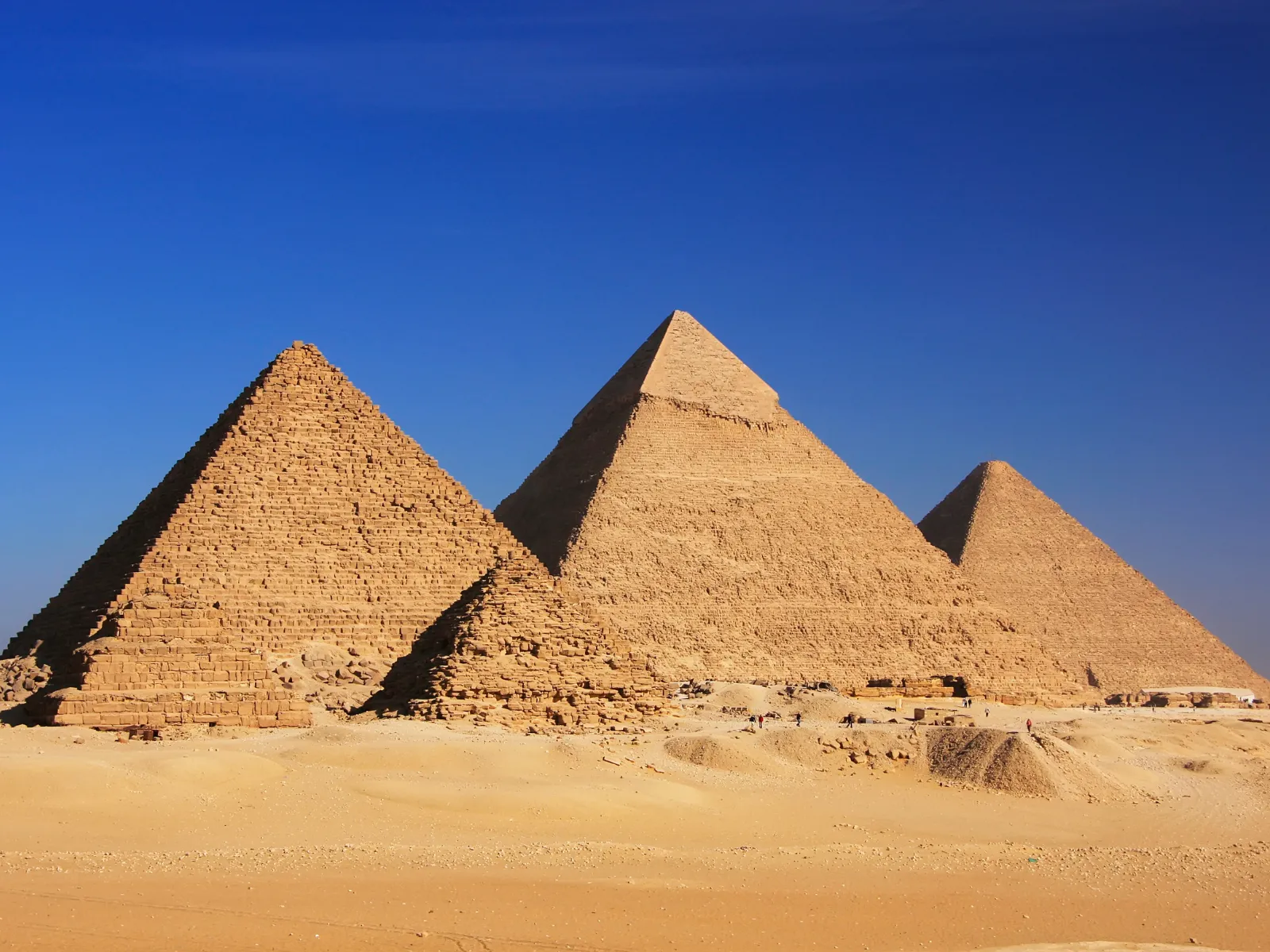
The second pyramid, Khafre’s (Chephren), appears taller than the Great Pyramid from most angles because it sits on higher ground. It is actually slightly smaller — 136 metres originally — but the optical illusion is so effective that it probably pleased Khafre, who was Khufu’s son and presumably lived in his father’s shadow. Khafre’s pyramid retains a cap of the original white casing stones at its apex, giving a hint of what all three looked like when new: smooth, gleaming white against the desert, visible from across the Nile valley.
The third pyramid, Menkaure’s, is substantially smaller — sixty-five metres — and was originally cased partly in red granite from Aswan, an extravagance that even Khufu did not attempt. Three small queen’s pyramids sit beside it, and the complex around Menkaure’s pyramid gives a better sense of the funerary architecture that surrounded each pyramid: mortuary temples, causeways, valley temples. The pyramids were not standalone structures but the centrepieces of elaborate ritual landscapes.
The Sphinx: older than its reputation
The Great Sphinx crouches in front of Khafre’s valley temple, carved from a single outcrop of limestone that was already sitting on the plateau. It is seventy-three metres long and twenty metres high, and its face — probably a portrait of Khafre himself, though this is debated — has been staring east toward the rising sun for four and a half millennia.
The Sphinx’s nose, famously missing, was not shot off by Napoleon’s troops. That story is a myth. Drawings from before Napoleon’s expedition already show the nose absent. The most likely culprit is Muhammad Sa’im al-Dahr, a Sufi zealot who reportedly damaged it in the fourteenth century as an act against idolatry. Or it may simply have fallen off due to erosion. The limestone the Sphinx is carved from is softer than the pyramid blocks and erodes unevenly.
What is genuinely interesting about the Sphinx is its relationship to the plateau. It was not placed here randomly. It guards the causeway leading to Khafre’s mortuary temple. At the spring and autumn equinoxes, the sun sets directly behind the Sphinx when viewed from the east — an alignment that was almost certainly intentional. The entire Giza complex is a machine of astronomical precision wrapped in stone.
How they were built: what we know and what we don’t
The honest answer is: we do not know exactly how the pyramids were built. We know a great deal — far more than the conspiracy theorists suggest — but certain details remain genuinely uncertain.
What we know: the workforce was not slaves. Archaeological evidence from the workers’ village south of the pyramids shows a well-organised labour force of perhaps twenty to thirty thousand men, housed in barracks, fed generously (cattle, fish, bread, beer), and organised into competing teams whose names they inscribed on the blocks. These were seasonal workers, likely farmers during the Nile flood season when the fields were underwater and labour was available.
The blocks were quarried using copper tools and wooden wedges. They were transported on sledges, probably lubricated with water — a tomb painting from the period actually shows this. The ramp system used to raise them is the great debate: straight ramp, spiral ramp, internal ramp, some combination. Each theory has supporters and problems. The internal ramp theory, proposed by Jean-Pierre Houdin, is currently the most compelling but unproven.
What matters for the visitor is not the specific mechanism but the scale of organisation. Building the Great Pyramid required not just labour and stone but logistics, mathematics, astronomy, and a centralised state capable of sustaining a decades-long construction project. The pyramids are not evidence of alien intervention. They are evidence of what human beings can achieve when an entire civilisation commits to a single purpose.
The view from the desert
Most visitors stay near the entrance and the Sphinx. This is a mistake. Walk — or take a camel ride, if you must — to the panoramic viewpoint on the desert side, to the southwest of the pyramids. From here, the three pyramids align against the skyline, the city of Cairo disappears behind them, and for a few minutes you see what a traveller in any century would have seen: three geometric mountains on the edge of the desert, absurd in their perfection, silent.
This is also where the scale finally registers. From up close, the pyramids are walls of stone. From a distance, they are shapes against the sky, and the mind can finally grasp their proportions — and fail to grasp them, which is the point.
The workers’ cemetery: the human side
South of the pyramids, archaeological excavations since the 1990s have uncovered the cemetery and living quarters of the workers who built the pyramids. This is not a glamorous site — no gilded artefacts, no painted walls — but it is arguably the most important discovery at Giza in recent decades.
The graves are simple but not impoverished. The skeletons show evidence of healed fractures — meaning these workers received medical care. The remains of their meals include bread, beer, cattle and fish in quantities that suggest a well-fed labour force. Graffiti on some blocks records the names of work gangs: “Friends of Khufu,” “Drunkards of Menkaure.” These were not slaves. They were organised workers with team identities, medical support and decent rations. The pyramids were built not by whips but by logistics, and the workers’ cemetery is the proof.
The site is not always open to the public, but when it is, it offers a counterpoint to the monumentalism of the pyramids themselves. The colossi represent the ambition of kings. The cemetery represents the labour of ordinary people. Both are necessary to understand what happened on this plateau.
Practical notes
Best time to visit: Early morning, as soon as the site opens (8:00 AM). By mid-morning the tour buses arrive, and in summer the heat becomes punishing by noon. Winter months (November-February) offer the most comfortable temperatures.
The sound and light show: A nightly spectacle projected onto the pyramids with narration. It is cheesy and overproduced. Many visitors enjoy it anyway. It is not essential.
Touts and camel drivers: Persistent. A firm “no thank you” repeated without engagement is the most effective strategy. Do not get angry — it achieves nothing and spoils your mood.
Photography: The plateau is photogenic at any hour, but golden hour (sunrise and the hour before sunset) is transformative. The warm light on the limestone makes the stones glow amber and brings out textures that are invisible at midday.
Saqqara and Dahshur: If the pyramids of Giza leave you wanting more, the necropolis of Saqqara (thirty minutes south) contains the Step Pyramid of Djoser — the oldest monumental stone structure in the world, predating Giza by a century — and a wealth of tombs with vivid painted reliefs depicting daily life in the Old Kingdom. Dahshur, further south, has the Bent Pyramid and the Red Pyramid, both built by Khufu’s father Sneferu, which show the evolutionary steps that led to the perfected form at Giza. Together, Saqqara and Dahshur make a compelling half-day trip.
The pyramids do not need a sales pitch. They have been selling themselves for forty-five centuries. What they need is context — the understanding that turns a photograph into an experience. Stand on the Giza plateau knowing what you are looking at, and the pyramids do the rest.
For the full picture of every monument, route and hidden corner in Egypt, the Far Guides complete guide has it all: interactive maps & itineraries, information that stays up to date.
More on Egypt
Keep reading.
Other pieces from the same destination.


Next step
Ready for Egypt?
The guide is for travelling.
Interactive maps & itineraries and everything that doesn't fit in an article. Always the latest published version.
Get the Egypt guide