Ecuador · 20 September 2026
Ecuador in two weeks: the most complete circular itinerary (with 10-day variants)
Ecuador can be traveled in a circular route that touches the Andes, the Amazon, the Coast and the Galápagos without repeating a single road. This is the two-week itinerary that concentrates the best of the country, with variants for those who have less time or are skipping the Galápagos.

Ecuador has the advantage of compactness. In a territory roughly the size of the UK, it concentrates four radically distinct regions — the Andean Sierra, the Pacific Coast, the Amazon and the Galápagos — connected by a road and airport network that makes it possible to move between them with a speed that in other Latin American countries would require double the time. An organized traveler can visit the Otavalo market on Monday, be in the Galápagos on Friday and arrive in the Amazon jungle the following Tuesday, without the travel itself consuming more than a fraction of the available time.
The problem with compactness is also its temptation: the ease of movement invites over-compression — two nights in each place, knowing none of them properly. This itinerary tries to find the balance between seeing what matters and having enough time in each destination for the experience to have some density.
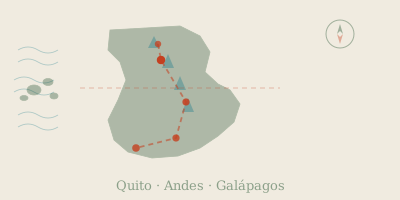
The two-week route: the complete circuit
Fourteen days is the minimum for doing Ecuador with any dignity. With fewer than ten days you get a general impression; with more than sixteen you can develop depth in specific regions. The fourteen days below assume arrival and departure through Quito, with no specific priority destination predetermined.
Days 1–2: Quito
Quito deserves more than two days, but in the context of a fourteen-day circuit, two well-used days cover the essentials. Day one for the historic center — the Plaza Grande, La Compañía church, the San Francisco convent, the Panecillo in the afternoon — and day two for the Teleférico in the morning (best before eleven, before the clouds arrive) and La Floresta or La Mariscal in the afternoon and evening.
What to avoid: spending both days in the same neighborhood. Quito is large and varied; the temptation to stay in the historic center is strong but should be resisted.
Days 3–4: Otavalo and surroundings
The bus from Quito to Otavalo leaves from Terminal Carcelén and takes two hours. Arriving the day before Saturday means waking early and being at Plaza de los Ponchos when the market opens at seven in the morning. The rest of Saturday can go to Cuicocha lagoon (twenty minutes by taxi) or to San Pablo del Lago.
On Sunday, if the itinerary allows, Otavalo’s animal market — in the La Cascada area on the outskirts of the village — runs from seven in the morning and is considerably less tourist-oriented than the craft market.
- Quito → Otavalo 2 h · $3 · Terminal Carcelén
- Accommodation 2 nights in or around Otavalo
Days 5–6: Cotopaxi
Cotopaxi National Park, ninety minutes south of Quito, has the world’s highest active volcano (5,897 meters) and one of the most impressive vistas in the Ecuadorian Andes. Access to the José Rivas refuge (4,800 meters) requires no technical equipment and is a one-hour walk from the park car park.
The best way to do Cotopaxi from Quito is with one night at one of the lodges inside or near the park: the early start needed to see Cotopaxi clear (before eleven) rewards being nearby. Some of the country’s best lodges — Tambopaxi, Secret Garden Cotopaxi — are in this area and offer a high-altitude experience that justifies the price.
- Refuge altitude 4,800 m · 1 h walk from car park
- Park entry $5 per person
- Altitude Altitude sickness possible even when acclimatized
Days 7–8: Baños de Agua Santa
From Cotopaxi or back through Quito, the bus to Baños takes two to three hours. Baños warrants two nights: one day for the waterfall route (ideally by bicycle to Pailón del Diablo) and another for an adventure activity — rafting, canopy, or the Casa del Árbol visit if the Tungurahua is clear.
The melcocha market — the sugar cane candy that Baños vendors stretch by hand on wooden hooks in the streets of the town center — is a stop that appears in no brochure and is impossible to ignore when passing through: the process is visual and the result is an edible souvenir that outlasts any photograph.
Day 9: Riobamba and the Devil’s Nose
From Baños, ninety minutes by bus to Riobamba. The overnight in Riobamba allows catching the train first thing — the Devil’s Nose trains run on Wednesdays, Fridays, Saturdays and Sundays, so the itinerary must align with these days.
The train from Riobamba to Alausí, with its spectacular switchback descent, fills the morning. From Alausí, bus to Cuenca (three hours).
Days 10–11: Cuenca
Cuenca warrants at least two nights. The colonial city — the most intact in the Ecuadorian Andes, with the four towers of the New Cathedral dominating the skyline and four rivers crossing it — is more compact and quieter than Quito. The rhythm is different: Cuenca invites aimless walking, sitting in a café and taking the time the city’s scale suggests.
Cajas National Park, thirty minutes from the city, has a landscape of high-altitude glacial lakes (between 3,500 and 4,400 meters) that contrasts radically with the colonial city atmosphere and is one of the country’s most accessible páramo ecosystems.
Days 12–14: Galápagos
The flight from Guayaquil (three hours by bus from Cuenca) or from Quito takes between ninety minutes and two hours. Three days in the Galápagos allow an island base — Santa Cruz is the most logistically organized — with day excursions to other points.
With three days: the first two at Santa Cruz (Charles Darwin Research Station, Tortuga Bay, snorkeling at Playa de los Perros) and the third on a day trip to Española Island or to San Cristóbal for blue-footed boobies and sea lion colonies.
10-day variant: without the Galápagos
If the Galápagos doesn’t fit the budget (internal flights plus accommodation can add $1,200–2,000), the ten-day itinerary without the archipelago reorganizes as follows:
Days 1–2 Quito · Days 3–4 Otavalo · Days 5–6 Baños · Days 7–8 Riobamba + Devil’s Nose + transit to Cuenca · Days 9–10 Cuenca + Cajas.
This version is more geographically coherent and allows more depth in each destination. The only regions that fall out are the Amazon and the Coast, which in a ten-day itinerary without the Galápagos would require a prioritization decision based on what matters most to the specific traveler.
Variant including the Amazon
For those who want both Galápagos and the Amazon in fourteen days, the most efficient solution is adding the Amazon at the beginning or end of the circuit, from Quito:
Quito → Tena (4h by bus, northern Amazon) → 2 nights → return to Quito → rest of the circuit as above.
Tena, the capital of Ecuadorian Amazon tourism, is close enough to Quito to be a natural extension of the first or last days of the trip.
What this itinerary doesn’t include and might need consideration
The Ecuadorian coast — Montañita, Puerto López and the humpback whales, Isla de la Plata — falls outside any fourteen-day itinerary that includes the Galápagos. Combining both in the same visit requires more time or sacrificing Cotopaxi or Cuenca. The decision of what to cut depends on season: humpback whales are only present July–September, making that section of the coast a seasonal destination that can justify its own short trip from Guayaquil.
Mindo and the cloud forest is two hours from Quito and can easily be added as an extension of days 1–2: leaving Quito on day 3 heading to Otavalo via Mindo adds no more than four hours to the journey, and the cloud forest justifies the detour.
Cotopaxi deserves a note of its own: the volcano is occasionally off-limits due to eruptive activity, and the National Park authorities can close access to the high trails on short notice. Always check current status at the park’s official website or through your hotel before building a fixed schedule around it.
More on Ecuador
Keep reading.
Other pieces from the same destination.


Next step
Ready for Ecuador?
The guide is for travelling.
Offline maps, itineraries and everything that doesn't fit in an article.
Get the Ecuador guide