Bulgaria · 23 September 2026
Bulgaria in Two Weeks: The Most Complete Circular Itinerary
Sofia, Rila, Plovdiv, the Valley of Roses, Veliko Tarnovo, the Black Sea coast and Shumen. A circular route with a 10-day variant, transport between points and what to cut based on available time.

Bulgaria has an underappreciated virtue: it's compact. The whole country fits into the surface area of Spain three times over, which means a two-week itinerary can combine mountains, medieval history, coast and Thrace with reasonable distances between points. The challenge isn't distance but decision — what to include, what to sacrifice, what order makes the most geographical and thematic sense. This itinerary is the result of thinking through those questions carefully and without the anxiety of putting too many pins on the map.
The Organising Principle
Bulgaria has three axes that merit serious attention: its historic interior cities (Sofia, Plovdiv, Veliko Tarnovo), its monasteries and mountain landscape (Rila, Koprivshtitsa, the Rhodopes), and the Black Sea coast (Nessebar, Sozopol, Balchik). Any two-week itinerary can cover all three if transport is planned sensibly and if you accept that some places deserve more time than the schedule allows.
The circular route described here starts and ends in Sofia, which simplifies flights and eliminates the one-way car rental penalty. It’s designed to combine intercity bus, minibus and rental car depending on the segment: not everything requires a car, but there are stretches — especially the northern coast and the Shumen area — where public transport is insufficient to make the most of the time.
The Itinerary: Day by Day
Days 1–2: Sofia
Arrive in Sofia without trying to see everything on the first day. The city needs two nights to find its rhythm: the first for the historic centre (the Alexander Nevsky cathedral, the sixth-century Saint Sofia basilica, the Roman Serdica lying under the metro’s feet), the second for the Lozenets and Studentski Grad neighbourhoods and for the National History Museum with the Panagyurishte Treasure — nine pieces of fourth-century BC Thracian gold that constitute one of the most extraordinary ancient goldsmithing collections in Europe.
Sofia doesn’t photograph well but works very well on foot. The centre is compressed: within two square kilometres stand Roman ruins, an Ottoman mosque, a Sephardic synagogue, an Orthodox cathedral and Soviet-era public baths. That concentration of historical layers in a small space says a great deal about what Bulgaria is: a territory that has been a crossroads of everything.
Where to stay: Centre or Lozenets. Boutique hotels from 60 €, hostels from 15 €.
Transport to the next point: Rental car recommended for Day 3 (Rila requires your own car or an organised tour). Bus only if going directly to the monastery without detours.
Day 3: Rila Monastery
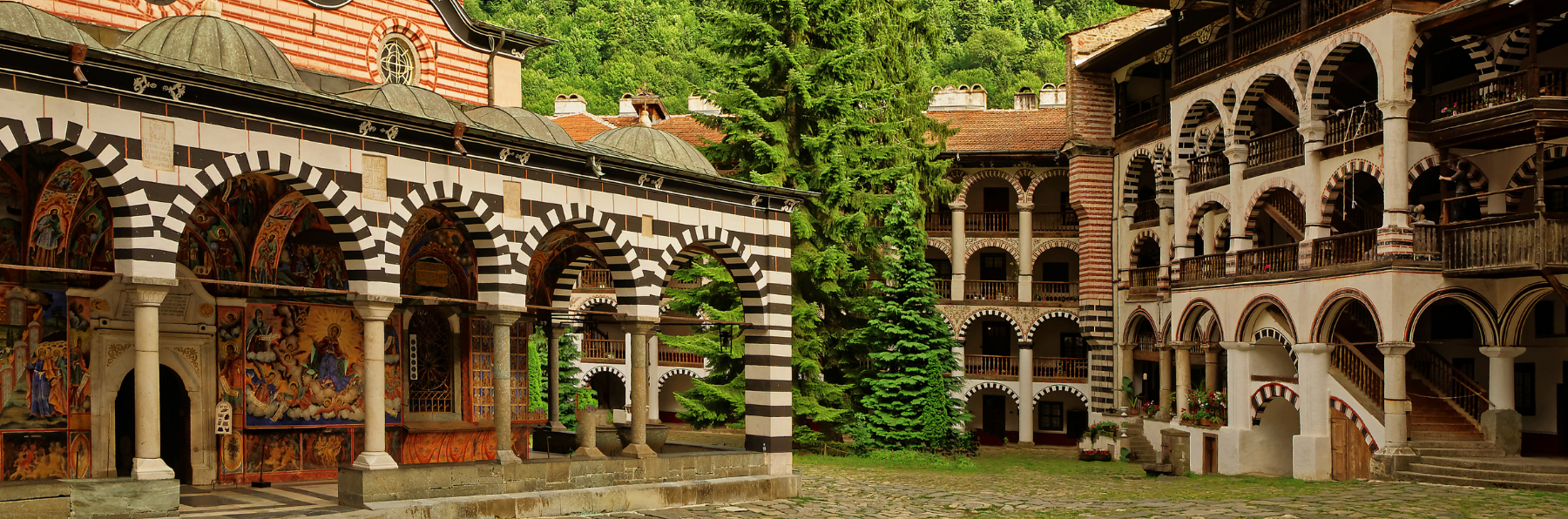
One hundred and twenty kilometres south of Sofia, the Rila Monastery is the largest and most important in Bulgaria and one of the most impressive monastic complexes in the Balkans. Founded in the tenth century by the hermit John of Rila, destroyed and rebuilt several times, the current building dates primarily from the nineteenth century — the Bulgarian national revival period — and combines arcaded porticoes, intensely coloured frescoes and a fourteenth-century medieval tower that survived the fire that destroyed the rest.
Rila Monastery
10th century – rebuilt 1833–1847UNESCO World Heritage Site since 1983. Houses more than 1,200 frescoes in the main church, a library of 250 medieval manuscripts and the Tower of Hrelyo (1335), the only surviving element of the original medieval complex. Monks still reside here — it is not a museum but an active monastery.
- Entry Monastery free, museum 8 BGN
- Recommended time 3–4 hours
- From Sofia Bus (2h) or car (1h45)
- Option Sleep in the monastery (basic rooms, advance booking)
If time permits, the detour to the Seven Rila Lakes from the monastery adds half a day of high-altitude hiking that shifts the journey’s register entirely. Access is by cable car from Panichishte (30 minutes from the monastery by car). Not compatible with the monastery visit on the same day unless starting very early.
Days 4–5: Plovdiv
Plovdiv is the country’s second city and, for many visitors, the most satisfying to walk. The old town — the Stariya Grad, spread across three hills — is a collection of nineteenth-century houses from the Bulgarian national revival period with whitewashed facades, wooden bay windows and interior courtyards that in no way resemble what one would expect from a Balkan city. They appear designed with deliberate architectural intent, which is partially true: the merchants who enriched Plovdiv under the Ottoman Tanzimat built their houses as declarations of cultural status.
The city also has a second-century Roman theatre — one of the best preserved in the Balkans, still in use for summer concerts — and a Thracian bastion that protrudes from the central park like a reminder that before the Romans there was someone here too.
Two nights allow exploring the Old Town at leisure on the first day and spending the second on the surroundings: the Roman city of Philippopolis (the site beneath the modern centre, accessible via the pedestrian underpass on Kniaz Alexander Street), the Kapana district with its galleries and restaurants, and possibly an afternoon at Bachkovo — the country’s second most important monastery, 30 kilometres south.
Transport: From Rila by own car or return to Sofia + bus to Plovdiv (2 hours, frequent). If going by bus, leave the car in Sofia and rent another in Plovdiv for the coast.
Day 6: Valley of Roses and Kazanlak
The Valley of Roses exists as both a geographical and economic concept: the Tundzha river valley, between the Balkan Mountains and the Rhodopes, produces 70% of the world’s Damascene rose oil. The bloom lasts three weeks between late May and early June. If the itinerary doesn’t coincide with that period — the most likely scenario — the valley doesn’t offer the photogenic spectacle of fields in flower, but Kazanlak offers something more durable.
The Kazanlak Thracian Tomb (third century BC) is a UNESCO World Heritage Site and contains the most complete known Thracian frescoes: banquet and procession scenes in colours that after 2,300 years remain readable. The original is closed for preservation; the exact replica built beside it is what one visits, and the debate about whether a perfect replica of something unique remains unique is itself part of the experience.
Days 7–8: Veliko Tarnovo
The former capital of the Second Bulgarian Empire (1185–1393) is built across three hills embraced by the Yantra river in a natural horseshoe. The Tsarevets fortress, on the central hill, was the palace-citadel where Bulgarian tsars governed for two centuries until the Ottomans took it in 1393.
Two nights allow visiting the fortress on the first day (including the evening sound-and-light show, which in summer runs several times weekly and is kitsch with self-awareness) and spending the second on the surroundings: the Ivanovo Rock Monastery (UNESCO, fourteenth-century frescoes), the houses of Arbanasi (5 km north, a village of seventeenth-century mansions) and the first stage of the route toward the coast.
Transport from Kazanlak: Bus or car, 2 hours.
Days 9–10: Black Sea Coast — Nessebar and Sozopol
The coastal segment requires decisions. The Bulgarian coast is 378 km long and it’s worth distinguishing what deserves time from what doesn’t. Nessebar (UNESCO World Heritage Site, medieval peninsula with 40 churches) and Sozopol (the country’s best coastal destination, with a wooden old town above the sea) are the two solid arguments. Sunny Beach, which lies literally between them, is dispensable.
Reaching the coast from Veliko Tarnovo via the interior route (Shumen → Varna, or directly toward Burgas) allows combining the journey with a stop. The most direct option is bus or car to Burgas and staying in Sozopol for two nights, with a half-day excursion to Nessebar.
Seasonal advice: Nessebar in July-August at 10am is a procession. At 8am or 7pm it’s completely different. The difference is three hours and thousands of people.
Day 11: Balchik and Cape Kaliakra (Northern Coast)
If the itinerary includes an extra day on the coast, use it in the north: Balchik (Queen Marie’s palace, botanical garden with 2,000 cacti and succulents) and Cape Kaliakra (70-metre cliffs, nature reserve, history of a Thracian fortress). Requires a car — public transport doesn’t efficiently connect these points.
Day 12: Shumen and Madara
On the return toward Sofia, the Varna-Shumen-Sofia route allows stopping at two places that combine well in half a day. Shumen has the Monument to the Founders of the Bulgarian State (1981), a colossal concrete sculpture in Brutalist style that summarises what happened when communism attempted to process medieval Bulgarian history with twentieth-century aesthetics. The result is enormous and entirely improbable.
Eighteen kilometres away, the Madara Rider is a rock relief carved in the eighth century into a 100-metre-high cliff face: a warrior on horseback crushing a lion, with Greek inscriptions above recording the campaigns of three Bulgarian khans. It is a UNESCO World Heritage Site and one of the most singular monuments in Europe — not because of its scale but because nothing like it exists on the continent.
Days 13–14: Return to Sofia and Buffer
Arrive in Sofia on Day 13 with genuine margin for the Day 14 flight. Don’t plan anything significant for the last full day — transport surprises in Bulgaria are part of the journey, not an exception.
10-Day Variant
With ten days instead of fourteen, the most sensible reduction is eliminating the northern coastal segment (Balchik + Kaliakra) and reducing the coast to one night in Sozopol with a half-day visit to Nessebar. Kazanlak can also be cut if the Thracian tomb is not a priority, and Sofia compressed to a single night.
The scheme would read: Sofia (1 night) → Rila (1 night) → Plovdiv (2 nights) → Veliko Tarnovo (2 nights) → Sozopol/Nessebar (1 night) → Shumen/Madara (transit day) → Sofia.
Transport: What Works and What Doesn’t
The Bulgarian intercity bus covers the main city-to-city routes well: Sofia-Plovdiv, Sofia-Varna, Sofia-Burgas, Plovdiv-Veliko Tarnovo. The Union Ivkoni and Biomet companies have frequent services with online booking.
The train exists but is generally slower than the bus on almost all relevant routes, with the exception of Sofia-Plovdiv (2 hours, comfortable) and Sofia-Varna (the train exists but takes 7 hours).
Rental car becomes essential for: Rila Monastery without an organised tour, the Rila Lakes, Balchik and Kaliakra, Madara, the Ivanovo rock monasteries and any serious foray into rural areas. You can rent in Sofia at the start and return in Burgas or Varna when reaching the coast, which simplifies the itinerary though it increases rental cost.
Bulgarian roads on the main routes (A3 Sofia-Vidin, the E80 toward Plovdiv, the E73 toward Kazanlak) are in good condition. Secondary roads toward monasteries and natural formations require patience with irregular surfaces.
The Far Guides complete Bulgaria guide develops each of these points in independent sections with specific accommodation, updated timetables, transport prices and historical context to understand what you’re seeing.
More on Bulgaria
Keep reading.
Other pieces from the same destination.


Next step
Ready for Bulgaria?
The guide is for travelling.
Offline maps, itineraries and everything that doesn't fit in an article.
Get the Bulgaria guide