
Ecuador · 26 July 2026
Baños de Agua Santa: waterfalls, an active volcano and the town that refused to leave
Baños doesn't exist despite its volcano — it exists because of it. The town sits at the foot of Tungurahua, one of Ecuador's most active peaks, surrounded by dozens of waterfalls where the Andes meet the Amazon. The danger is real. So is the beauty.

Baños de Agua Santa occupies a specific and unlikely geography: a narrow valley at 1,800 meters where the Andean plateau drops sharply toward the Amazon basin, at the base of a volcano that has been erupting intermittently for as long as humans have lived nearby. The town exists because of a combination of geothermal springs, Catholic devotion and a stubborn attachment to this particular piece of earth that transcends what outside observers might consider rational. When the Tungurahua forced an evacuation in 1999, many residents simply walked back before the authorities said it was safe.
It is a place that rewards the traveler who takes time to understand the relationship between the town and its landscape — not just the waterfalls and the rafting and the swing that has become the most photographed object in Ecuador, but the deeper logic of why twenty thousand people choose to live eight kilometers from an active volcano and consider this home.
The Tungurahua: a volcano neighbors have learned to accept
The name comes from Kichwa: “throat of fire.” At 5,023 meters, the Tungurahua is one of Ecuador’s most persistently active volcanoes. It erupted seriously in 1999, forcing a full evacuation of Baños that lasted months. It erupted again in 2006 with greater force. As recently as 2016 it was producing significant ash columns visible for hundreds of kilometers.
And yet the town rebuilt each time. Not because the residents lacked alternatives, but because the alternatives lacked something the residents weren’t willing to give up. The valley has geothermal springs that have been used medicinally since pre-Columbian times — “Baños” means baths, and the bathing tradition is one of the oldest in the region. The land is extraordinarily fertile. The location, at the crossroads between the Sierra and the Oriente, has been commercially strategic for centuries.
The relationship between the town and the Tungurahua is mediated by the Basilica of the Virgin of Holy Water, whose tower dominates the central square. According to local tradition, the Virgin has intervened multiple times to redirect lava flows or halt eruptions threatening the town. The ex-votos inside the basilica — naive paintings commissioned by survivors of various disasters over several centuries — constitute an involuntary historical archive of the relationship between faith and geology in the Ecuadorian Andes.
For the traveler, the Tungurahua offers something rare in volcano tourism: proximity without technical difficulty. The Pondoa trailhead at 2,800 meters, accessible by taxi, gives clear views of the summit on good days. If you happen to be in Baños during a period of nighttime activity — worth checking with Ecuador’s Geophysical Institute before visiting — the spectacle of glowing lava against a dark sky is the kind of sight that doesn’t leave you.
The waterfall route: forty kilometers of falling water
The highway connecting Baños to Puyo — the road that descends from the Andes to the Amazon — happens to follow the Pastaza River through a canyon it has been carving for millions of years. In forty kilometers, the river drops from 1,800 meters to the Amazon plain, and dozens of waterfalls pour from the canyon walls along the way.
The route can be driven, bussed, or — the option that everyone who has done it recommends — cycled downhill on a rented bicycle. The gradient is almost entirely favorable: the elevation loss does the work. The rental costs around $10 for the day, includes a helmet, and can usually be arranged with a pickup truck return from the far end if you don’t want to cycle back.
- Start Baños de Agua Santa (1,800 m)
- Optional end Puyo (950 m) · 60 km total
- Bike rental $8–12 / day including helmet
- Time to Río Verde 2–3 h by bike
Pailón del Diablo
The most famous waterfall on the route, and the one that justifies the trip on its own. Pailón del Diablo — “the devil’s cauldron” — sits sixteen kilometers from Baños near the village of Río Verde, where the Pastaza River narrows and drops roughly eighty meters in a single vertical plunge over black volcanic rock. The mist is permanent and soaks everything within fifty meters. The scale is disorienting: people standing at the viewpoint look like insects.
There are two viewing platforms. The upper one, accessed by a metal walkway, gives the frontal view that appears in every photograph. The lower one, reached by a sometimes slippery dirt path, takes you to river level where the sound becomes physical. Both are worth doing.
- Entry $2 per person
- Visit 45–90 min depending on viewpoints
- Note Bring waterproof clothing or accept getting soaked
Manto de la Novia
Where the Pailón overwhelms, the Manto de la Novia — “the bride’s veil” — seduces. The waterfall drops in a thin, wide curtain across a wall of dark moss, tall rather than wide, with a morning light that creates rainbows in the spray. Access is by tarabita — the cable car basket that swings across the gorge on a steel cable — which adds a minor adventure of its own. The word “tarabita” describes the system precisely: a metal basket on a cable, hand-operated from shore, swinging you over a gorge at what feels like insufficient speed.
Rafting, canopy and the swing at the end of the world
Baños is Ecuador’s adventure capital, and the activities available are genuinely tied to the geography rather than being artificial attractions imposed on a landscape. The rafting on the Pastaza River uses the same water that feeds the waterfalls — fast, cold, and running through a canyon that changes character every kilometer.
River rapids range from Class II to Class IV depending on the season and the specific section. The operators in Baños run groups every morning; the quality difference between the cheapest and the most professional tends to be meaningful in ways that are hard to assess from the street. Asking specifically about guide experience and certification matters more than comparing prices by dollar amounts.
Casa del Árbol, a few kilometers above Baños toward the Tungurahua, has become internationally famous for a specific reason: a swing mounted at the edge of a cliff with the volcano in the background. The image — person on swing, erupting volcano behind — has circulated on every platform and turned the place into an inevitable pilgrimage. The reality is somewhat less cinematic than the photos suggest (you need the swing at the right moment, clear sky, no queue), but the panoramic view from the hillside is worth the visit with or without the swing.
Getting there and when to go
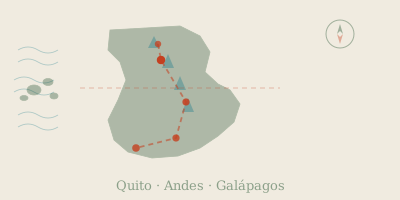
Baños is three hours from Quito by direct bus from Terminal Quitumbe, and ninety minutes from Riobamba. It sits naturally on the central Ecuador circuit: Quito → Cotopaxi → Riobamba → Baños → Puyo, or as a connection point between the Andes and the Amazon.
The dry season (June through September) offers more clear days for views of the Tungurahua and the waterfall route. But the waterfalls themselves are more powerful in the wet season, when the river runs higher. The Pailón del Diablo in November, with the river in full flood, is a different experience — louder, more overwhelming — than the same place in August.
- From Quito 3 h · $3–4 · Terminal Quitumbe
- From Riobamba 1.5 h · $2
- Best season Jun–Sep (dry) · waterfalls more powerful Nov–Feb
- Accommodation Wide range · $15–25 hostel · $50–80 hotel with volcano views
What Baños actually is
Baños has a reputation as a destination for young backpackers chasing adrenaline, and that reputation is partly accurate. But reducing it to that misses the town’s historical and religious depth — the centuries of devotion to the Virgin of Holy Water, the markets where people from the valley come on Saturdays, the tradition of making melcocha (sugar cane candy stretched by hand over wooden hooks) that has been performed on the same street corners for generations.
The ex-votos inside the basilica, painted by anonymous local artists over five centuries, document floods, eruptions, accidents and recoveries with an honesty that no museum can replicate. They are the town’s autobiography, painted in the naive style of people who had something specific to say and no art school training in which to say it.
Baños exists because people chose to stay next to a volcano. That choice, repeated across generations, is the most interesting story the town has to tell.
More on Ecuador
Keep reading.
Other pieces from the same destination.


Next step
Ready for Ecuador?
The guide is for travelling.
Offline maps, itineraries and everything that doesn't fit in an article.
Get the Ecuador guide