Introduction to Bulgaria
The most Orthodox and most Thracian country in the Balkans — and why you can't really grasp it without slowing down.
Bulgaria is one of those European countries that most travellers could locate on a map but very few could describe. It was the first Slavic nation to adopt Christianity, the one that invented the Cyrillic alphabet, the one that kept an Orthodox monastic tradition alive through five centuries of Ottoman occupation, and the one that still preserves — today — pagan rituals that have survived nowhere else in Europe. The problem is that almost none of this comes up when people think of Bulgaria.
This chapter is the country’s entrance. It is not an index — it is a set of coordinates aimed at three questions almost no one asks before travelling and almost everyone asks on arrival. What is Bulgaria, how does it resemble and differ from the rest of the Balkans, and why does it reward slow travel — a week at minimum — rather than a weekend in Sofia.
A country between two worlds
Bulgaria covers 110,994 km² — slightly larger than Iceland, similar to Cuba — with 6.7 million inhabitants and falling. It borders Romania to the north (the Danube acts as natural border for 470 km), Serbia and North Macedonia to the west, Greece and Turkey to the south, and the Black Sea to the east. It is the real hinge between central Europe and the Near East: from Sofia, Vienna is the same distance as Istanbul.
- Area 110,994 km²
- Population 6.7 million
- Mountains 30% of territory
- Language Bulgarian (Slavic, Cyrillic alphabet)
- Currency lev (BGN), euro from 2026
That geographic position explains almost everything else. Bulgaria has always been the obligatory corridor between the Aegean and the Danube, and every empire that wanted to control the route — Roman, Byzantine, Ottoman, Russian, Soviet — left its layer. What travellers find today are those layers, barely concealed: a 19th-century Russian cathedral in front of a 14th-century mosque, atop a 6th-century Byzantine basilica, atop a visitable Roman necropolis. Same plot, in Sofia.
A language with its own alphabet
Bulgarian is a Slavic language — related to Russian, Serbian or Macedonian — but with a peculiarity: it was the first Slavic language to be written. The Cyrillic alphabet was developed here, in the 9th century, from the work of the disciples of Saints Cyril and Methodius after their exile from Moravia. Bulgaria later exported it to Russia, Serbia and the entire Slavic Orthodox world.
For travellers the practical consequence is clear: outside Sofia and big cities, signage is in Cyrillic only. Learning the alphabet — which can be done in a couple of evenings — radically changes the experience. There is no way to read a menu in a Rhodope village without it.
Orthodoxy with Thracian roots
Bulgaria is one of the most Orthodox countries in the world — around 70% of the population — but its Orthodoxy has a little-known trait: it overlays, never fully, a pagan Thracian substrate that never disappeared. The Thracians — an Indo-European people who lived here before Christ, and whose cultural heirs included figures like Spartacus and Orpheus — worshipped a solar goddess and held fire cults. Many of the living traditions still visible in Bulgaria — the nestinari fire-dance, the kukeri masked rites of January, the horo still danced in villages — are Thracian inheritance with a Christian veneer layered over between the 9th and 14th centuries.
To this add a significant Muslim minority — ethnic Turks and Pomaks (Bulgarians converted to Islam under Ottoman rule) — who today make up 10% of the population and concentrate in the eastern Rhodopes and the north-east.
The empire we forgot
Most travellers arrive in Bulgaria without knowing that, between 681 and 1018, and again between 1185 and 1393, this was one of the most powerful European empires of its age. The First Bulgarian Empire came close to Constantinople. The Second, based in Veliko Tarnovo, controlled most of the Balkans. Bulgaria only disappears from the map after 1396, when the Ottomans absorbed it, and does not return to independence until 1878.
Two medieval empires
Between the 9th and 14th centuries Bulgaria had its own court, its own patriarchate, its own literary school and a frontier with the Byzantine Empire on equal footing. The Literary School of Preslav was one of the great cultural foci of medieval Orthodox Christianity.
Five Ottoman centuries
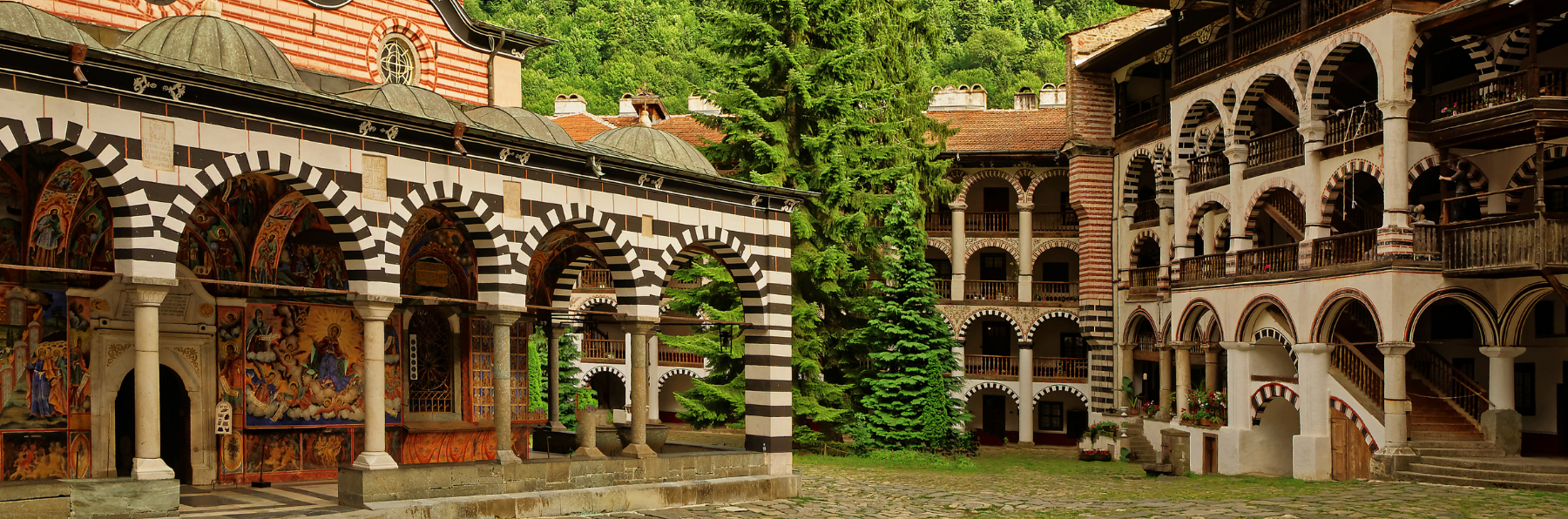
From 1396 to 1878 Bulgaria was an Ottoman province. The Bulgarian church lost its patriarchate; the written language survived only in monasteries. That cultural isolation explains the central role monasteries — Rila, Bachkovo, Troyan — play in the national identity.
That five-century gap is the key to understanding why Bulgaria, when it regains independence in 1878, does so with huge identitarian urgency: it has to rebuild a country that has survived in monastic books while disappearing in the street.
What travelling to Bulgaria in 2026 means
Bulgaria is one of the cheapest countries in the European Union, a member since 2007, in Schengen (air and sea) since 2024. Even so, tourism remains concentrated on the Black Sea coast — by far the least interesting part of the country — and on the ski resorts of Bansko and Borovets. The interior — Plovdiv, Veliko Tarnovo, the monasteries, the Rhodopes — receives far fewer visitors than it deserves.
For the independent traveller this is an advantage. Plovdiv is one of the oldest continuously inhabited cities in Europe — older than Rome, older than Athens — with an intact old town. Monasteries preserve medieval frescoes visible without crowds. You can walk a week in the Rhodopes without crossing another foreigner. And the traditional festivals — kukeri in January, nestinari in June, roses in June — are still celebrated without the mass-tourism filter that already spoils Pamplona or Oktoberfest.
How to use this guide
The sections follow a thematic and geographic logic. We start with history — which in Bulgaria is not optional, it is the key to reading the country — and then walk through the three essential cities: Sofia (modern capital), Plovdiv (oldest city) and Veliko Tarnovo (former medieval capital). Then we move to regions — monasteries, coast, mountains — and devote a full section to living traditions, because in Bulgaria they are as important as the monuments.
Practical information is at the end by design: come back to it when you need to solve something concrete (rent a car, read a bus timetable, figure out Cyrillic). You don’t need to read it before travelling — you need to know it’s there.
The rest is Bulgaria.