Introduction to Albania
A small, young country newly reopened to the world — and why it's worth understanding before you travel it.
Albania is, probably, the least understood country in the Mediterranean. For nearly fifty years it was closed — more than Hoxha's communist Albania, it was an Albania isolated even from its allies — and when it reopened in 1991 it did so without a manual, without tourists and without reference points. What travellers find today is a place that hasn't had time to become predictable.
This chapter is the entry point to the country. It isn’t a “must-see” list: it’s a set of coordinates aimed at answering three questions almost no one asks before travelling to Albania, and almost everyone asks once they arrive. What Albania is, where it does and doesn’t resemble the rest of the Balkans, and why it’s worth travelling slowly rather than rushing through Tirana and Sarandë in four days.
A country the size of a province
Albania fits into 28,748 km² — a little larger than Belgium, half the size of Croatia — with 2.8 million inhabitants. It’s a small country and, at the same time, astonishingly diverse. Seventy per cent of the territory is mountain. The rest is a narrow coastal strip that first faces the Adriatic and then, from the latitude of Vlorë, the Ionian. Nothing is really far from anything: Tirana to the Blue Eye is 230 km as the crow flies, but 5 hours on roads that twist endlessly.
- Area 28,748 km²
- Population 2.8 million
- Mountain 70% of the land
- Language Albanian (own branch)
- Currency lek (ALL)
That compressed diversity is, in itself, a reason to make the trip. In a week you can cross the country north to south and move through four landscapes that have almost nothing in common: the northern Alps, the central agricultural valley, the Ottoman towns of the south, and the Ionian coast. Rarely do 300 kilometres contain so much.
A language that looks like nothing else
Albanian is not Slavic, not Greek, not Romance. It’s a branch of its own in the Indo-European family — like Greek or Armenian — and linguists still debate whether it descends directly from Illyrian, from Thracian, or from a mix of both. The practical consequence for travellers is tangible: apart from the basic English you find in Tirana and on the tourist coast, there are no linguistic shortcuts. Italian doesn’t help. Knowing a bit of Serbo-Croatian doesn’t help. English fails you outside the tourist circuit.
Curiously, Italian is spoken reasonably well across much of the country: a legacy of the Fascist occupation (1939–1943) and, above all, of the fact that during the two decades of Hoxha’s isolation the only window on the outside world for many Albanians was RAI, picked up clandestinely along the coast. A whole generation learned Italian by watching forbidden television.
Three religions and a tacit pact
Albania is the only European country with a Muslim majority — around 58% —, though with a very particular variant of Islam, mostly Sunni with a strong Bektashi minority (Bektashism, a heterodox Sufi branch, has its world headquarters in Tirana). On top of that, Orthodox Christians in the south (~7%) and Catholics in the north (~10%), plus a high percentage of people who simply don’t define themselves: the state atheism imposed by Hoxha between 1967 and 1990 left a mark.
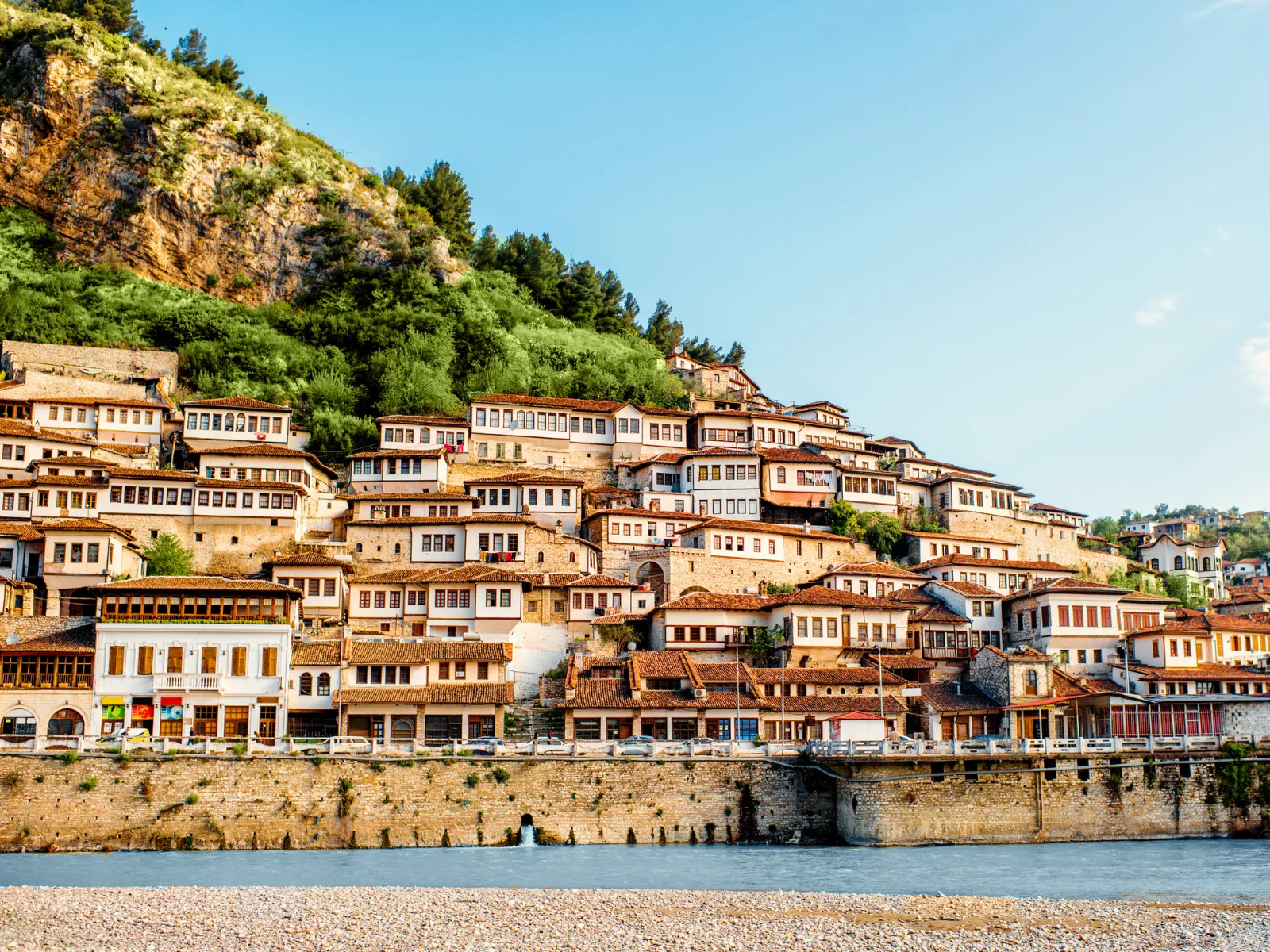
What is remarkable isn’t the composition but the coexistence. In Berat, Christian and Muslim families live on either side of the same river and cross the same 18th-century bridge to trade. In Gjirokastra, Orthodox churches sit next to Ottoman houses. There is — and this matters — no memory of religious conflict in the country. The line attributed to the 19th-century poet Pashko Vasa, “the religion of the Albanians is Albanianism”, still works as a description.
The isolation that explains almost everything
The most closed country in Europe
Between 1976 and 1990 Albania was, by some measures, more isolated than North Korea. Leaving was forbidden, entering was forbidden, foreign radio was forbidden, religion was forbidden, private cars were forbidden.
A country without filter
When it reopened in 1991 there was no tourism, no hotel infrastructure, no motorways, no brands. Thirty-five years later the transformation is dizzying but uneven: the coast has modernised, the interior is still the country it was.
Hoxha broke with Yugoslavia in 1948 (over Tito’s “revisionism”), with the Soviet Union in 1961 (over Khrushchev’s “revisionism”), and with China in 1978 (over Deng’s opening). Each break left the country more isolated and more militarised: the famous 173,000 bunkers — still dotting the landscape — were built in anticipation of an invasion that never came.
The 173,000 bunkers: the 20th century's most absurd public works project
The official figure — revised downward by historians, 173,000 against the myth of 700,000 — still describes one of the most extreme civilian militarisations in European history: one bunker per 16 inhabitants, spread across coast, border, countryside and mountain. The standard design, by engineer Josif Zagali, was a three-ton concrete dome meant — in theory — to withstand direct tank impact; production drained the country of cement for decades, to the point that even in the 1980s there wasn't enough to build public housing in Tirana. After 1991, not one was ever used. Today they survive as involuntary memorials: some turned into bars (Tirana), restaurants (the coast), guesthouses (Himarë), or simply silent in the fields. They are, probably, the most honest symbol of what state paranoia can end up costing.
That paranoia has consequences still felt today. It explains why Albania doesn’t have — for better and worse — the uniform tourism infrastructure of Croatia or Greece. It explains the institutional mistrust that weighs on any bureaucratic interaction. And it explains, positively, the extraordinary hospitality Albanians extend to foreigners: for decades, there weren’t any.
What travelling to Albania means in 2026
Albania is at the precise point where it stops being “the alternative” and starts being “the fashionable option”. The Riviera is living an unprecedented boom — prices rising 20% a year, new developments in Ksamil, low-cost flights to Tirana multiplying — while at the same time Theth and Valbona remain valleys of 300 inhabitants where hospitality is negotiated in Albanian.
For the independent traveller this is a narrow window. Not because the country is about to ruin itself — well-managed tourism could work — but because the speed of change is such that some things are going to transform irreversibly. Ksamil as it was in 2015 no longer exists. The useful question is not “is it worth going?” but “where do I start to understand what’s still here?”.
How to use this guide
The structure of the sections follows a geographical logic, not alphabetical. We start with history — which in Albania is not optional, it’s the reading key — and work from north to south: Tirana as the starting point, Durrës on the coast, Krujë as the Skanderbeg chapter, Shkodra and the northern Alps, then Berat and Gjirokastra in the Ottoman south, and finally the Riviera from Vlorë to Ksamil.
The practical information section sits at the end by design: it’s the one to come back to when you need to resolve something concrete (rent a car, understand the Koman ferry schedule, work out what happens when you cross into North Macedonia in a rental). You don’t need to read it before travelling: you need to know it’s there.
Everything else, is Albania.