Bulgaria · 6 May 2026
Rila Monastery: where Bulgaria survived for five centuries
Bulgaria's most important monastery and the Orthodox Balkans' key site. How to get there from Sofia, what to look at in the frescoes, and why Rila is more than a day trip.

Rila isn’t just Bulgaria’s most important monastery. Through the five centuries of Ottoman occupation, when Bulgarian was taught in secret and the imperial elite had vanished, Rila was the physical repository of Bulgarian culture: copying manuscripts, training teacher-monks, hiding books, preserving Cyrillic. Without Rila we’d probably speak of Bulgaria today as another Turkified province. This is the most meaning-laden visit in the country.
What it is and why it matters
Founded in the 10th century by the hermit Ivan of Rila — Bulgaria’s patron saint — the monastery settled at 1,150 m altitude in the Rila range, in a remote valley that always offered refuge. The current building (1834-47) is Bulgarian Revival: rebuilt after the devastating 1833 fire, funded by rising Bulgarian merchants and entire villages that donated wages. It was a political statement: telling the Ottomans “we are still here”.
UNESCO since 1983. Home to ~60 active monks today — meaning it remains a functional monastery, not just a museum.
- Founded 10th c. (buildings 1834-47)
- Monastery entry Free
- Historical Museum 8 BGN
- From Sofia 2 h by car / 3 h by bus
How to get there from Sofia
- Direct bus: from Sofia central bus station leaves once a day, 10:20, returning at 15:00. Price: 22 BGN return (11 €). Cheapest but only 3 hours at the monastery — enough for essentials, no time for hikes.
- Group tour: 35-60 € with Get Your Guide or local agencies. Comfortable but with group.
- Rental car: best option. 2 h via motorway + mountain road. 100-120 km from Sofia. Lets you combine Rila with Boyana church (crossed roughly halfway) or with the Seven Rila Lakes (1 h further southwest).
- Taxi / private transfer: 80-130 €, 3-4 people.
If one day only: bus or tour. If two days, sleep a night at the monastery or in the nearby village (Rila town).
What to look at: the narthex frescoes
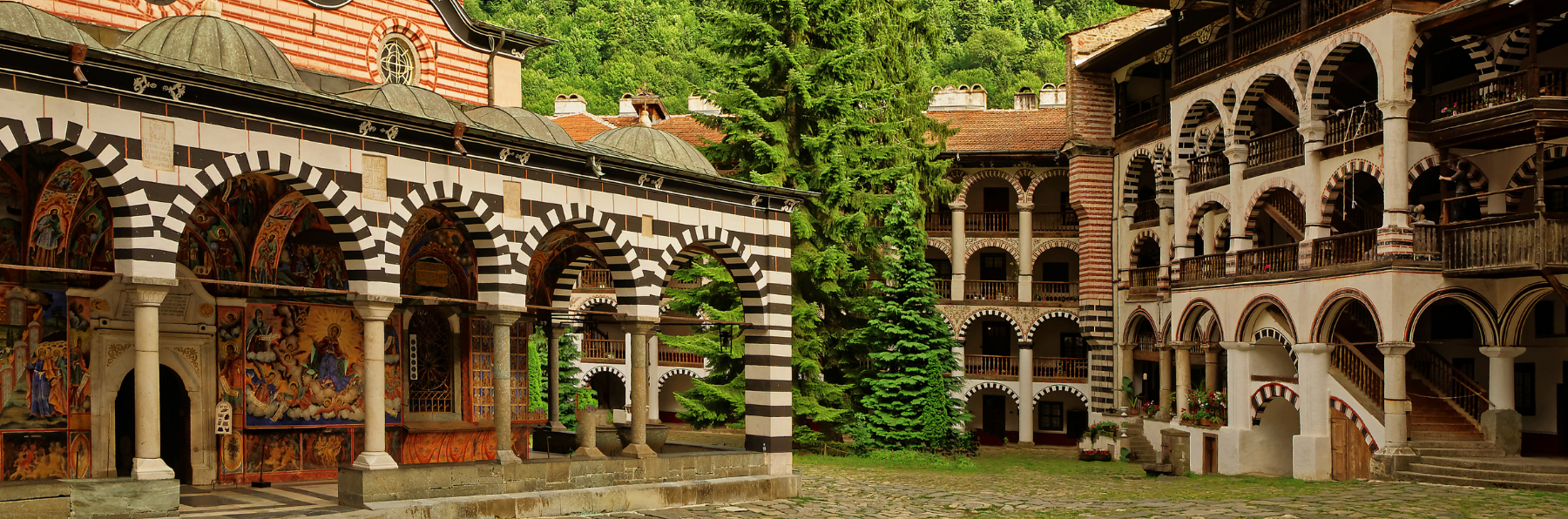
The main building is the Church of the Nativity of the Virgin (1834). Outside: white and ochre arcades, five domes, the forest behind. Don’t take the photo from the gate — walk to the second courtyard to see the monastery with the mountains at the back.
Inside, the outer narthex (the covered porch around the church) contains the most important frescoes: the Last Judgement on the left, and apocalyptic scenes on the right. By painter Zahari Zograf (1810-1853), one of Bulgaria’s finest 19th-c. artists. Painted between 1844 and 1848.
What to look for:
- The seven-headed dragon (right): traditional apocalyptic iconography.
- Sinners being devoured: anatomical detail is realistic, not symbolic — late Italian school influence.
- Bulgarian angels: hybrid dress, Byzantine-Revival mix.
- Tsar Samuel (left): the monastery includes discreet patriotic references — homage to figures of the First Bulgarian Empire.
Hrelyu’s Tower (1335)
The only medieval part that survived the 1833 fire. Fortified, 25 m high, four storeys. Going up usually not allowed but you can enter the ground floor. It’s the only 14th-century Bulgarian architectural element you’ll see at Rila, and connects the monastery with the context of the Second Bulgarian Empire.
The historical museum
Inside the complex, 8 BGN (4 €). Essential even with only 30 min. Contains:
- Rafael’s Cross (1790-1802): miniature carved with 104 microscopic biblical scenes. Monk Rafael took 12 years and lost his sight. Magnifier included in the case.
- Gospels and manuscripts: some from the 11th century — the oldest surviving manuscripts in Bulgaria.
- Icons: masterpiece collection.
Sleeping at the monastery
Yes, you can. Monastic rooms basic (bed, sink, shared bathrooms) for 60-80 BGN (30-40 €). Must email the monastery directly (info on their official site) or arrive early and ask (may be full in summer). Rules: silence after 22:00, no parties, no alcohol in rooms, optional participation in services.
It’s a singular experience. Sleeping here changes your relationship with the place — you see it at dawn before the buses, hear the matins bells, eat in the simple refectory.
Excursions from the monastery
The Seven Rila Lakes: 1 h by car + 30 min chairlift + 2 h hike from the monastery. Seven glacial lakes at 2,200-2,500 m. Season: June to September (snow before). One of the most spectacular excursions in the Balkans.
St Ivan’s Cave: original hermitage of the monastery’s founder, 1 h walk uphill. Up and back, 3 h total. Lovely and full of historical context.
What to eat nearby
In the village of Rila (5 km downhill from the monastery) there are several mehanas (traditional taverns). Try baklava with monastery-bee honey — monks sell honey in the shop (15-25 BGN a jar).
Inside the monastery a small, simple restaurant for pilgrim lunch: soup, shopska salad, kyufte (meatballs), ayran. 15-25 BGN.
Ivan of Rila (880-946)
10th centuryHermit, founder of the monastery, Bulgaria's patron saint. Lived as an ascetic in a mountain cave, eating herbs. His relics moved to Tarnovo, then Hungary, returning to Bulgaria in 1469. They are a central point of Orthodox pilgrimage.
Is it worth deviating from Sofia just for Rila?
Yes, absolutely. Rila is Bulgaria’s symbol in a way that has no equivalent. If your Balkan route has two days in Bulgaria, one must be Sofia and the other Rila. It’s as culturally important as Meteora for Greece or the Sistine Chapel for Italy.
The complete Bulgaria guide from Far Guides has a full section on Rila with fresco map, mass schedule, phone number to book overnight stays, and combined route with the Seven Lakes.
More on Bulgaria
Keep reading.
Other pieces from the same destination.


Next step
Ready for Bulgaria?
The guide is for travelling.
Interactive maps & itineraries and everything that doesn't fit in an article. Always the latest published version.
Get the Bulgaria guide