

Bulgaria · 26 April 2026
Bulgaria's history: thirteen centuries of Thrace, Byzantium and two empires
From Orpheus's Thracians to post-communism. Bulgaria had two medieval empires, invented Cyrillic and spent five centuries under the Ottomans. Essential context.

Bulgaria confuses anyone arriving with the idea of “small Balkan country”. Historically it isn’t. It was the first Slavic state Christianized in Europe (864), the place where the Cyrillic alphabet was formalized (c. 886, in Preslav and Ohrid), and had two empires of its own that reached three seas — Aegean, Adriatic and Black. Understanding this changes what you see at Rila, Veliko Tarnovo or Plovdiv.
Thracians: before Greeks and Romans
The Bulgarian lands were Thracian before being anything else. The Thracians — Indo-European, not Greek — occupied today’s Bulgaria, southern Romania and northern Greece from 1500 BC. They left no written literature but did leave sophisticated goldsmithing that surpasses in technique Greek gold of the same period.
The Thracian treasures of Panagyurishte (gold rhytons and amphora, 4th c. BC) and Valchitran (ceremonial vessels, 13th c. BC) live in the National Historical Museum in Sofia. When you see them, remember: this was made before classical Athens, with a technique the Greeks hadn’t yet mastered.
From Greek mythology, Bulgaria absorbed Orpheus (supposedly Thracian, from the Rhodope) and Spartacus (rebel gladiator, Thracian of the Medi). The Thracian identity never quite died — it dissolved into the substrate over which Romans and later Slavs arrived.
Rome and Byzantium (46 AD — 7th century)
Rome annexed Thrace in 46 AD. Serdica (now Sofia) became imperial capital under Aurelian (271) and later Constantine’s favourite residence before founding Constantinople. The emperor said “Serdica is my Rome”. The ruins under the Serdica metro are literally that city.
With the 395 partition, Thrace passed to the Eastern Roman Empire — Byzantium. For three centuries the Bulgarian lands were a Byzantine frontier province, Christianized in Greek.
First Bulgarian Empire (681 — 1018)
In 681 the Bulgars (Turkic people from the Volga) and the Slavs (already settled in the Balkans since the 6th century) united under khan Asparuh and defeated Byzantium north of the Danube. Constantinople signed peace and recognized a state south of the Danube with capital at Pliska.
Two centuries later, Tsar Boris I Christianized Bulgaria in 864 — and did so in Slavic, not Greek. He invited the disciples of Cyril and Methodius expelled from Moravia, gave them Preslav and Ohrid as centres, and there the Glagolitic alphabet was first formalized and then the Cyrillic (named after Cyril but developed by his Bulgarian disciples).
Under Simeon the Great (893-927), the empire reached the Aegean and the Adriatic, controlled the Balkans and rivalled Byzantium. His capital, Preslav, had libraries, monastic scriptoriums and translated Greek thought into Slavic — 10th century, while Western Europe was barely emerging from Carolingian collapse.
Decline came with the Byzantine wars. Basil II “the Bulgar-slayer” defeated Tsar Samuel in 1014 and — according to chronicles — blinded 15,000 prisoners leaving one one-eyed man per hundred to guide them home. Samuel died of shock at the sight. In 1018 Bulgaria went from empire to Byzantine province.
Second Bulgarian Empire (1185 — 1396)
In 1185 the brothers Asen and Peter rebelled in Veliko Tarnovo (today’s medieval city) against Byzantium and founded the Second Bulgarian Empire. Their capital, Tarnovgrad, was in the 13th century one of the most cultured cities in Eastern Europe, with three fortified hills (Tsarevets, Trapezitsa, Sveta Gora) and its own literary school.
Under Ivan Asen II (1218-1241) the empire again reached three seas. Bulgaria was regional Orthodox power, rival to Serbia and Byzantium, commercially linked to Venice and Genoa.
Decline came with the Mongols (1242 devastating raids) and fragmentation into despotates. In 1396 the Ottomans conquered Tarnovo. The last tsar, Ivan Shishman, died at Nikopolis.
Ottoman yoke (1396 — 1878): five centuries
Half a millennium. The Ottomans didn’t destroy Orthodoxy or the language — but they imposed the millet system (Christian communities self-governed religiously) and a human tax: the devshirme, recruitment of Christian boys for the Janissary army and administration.
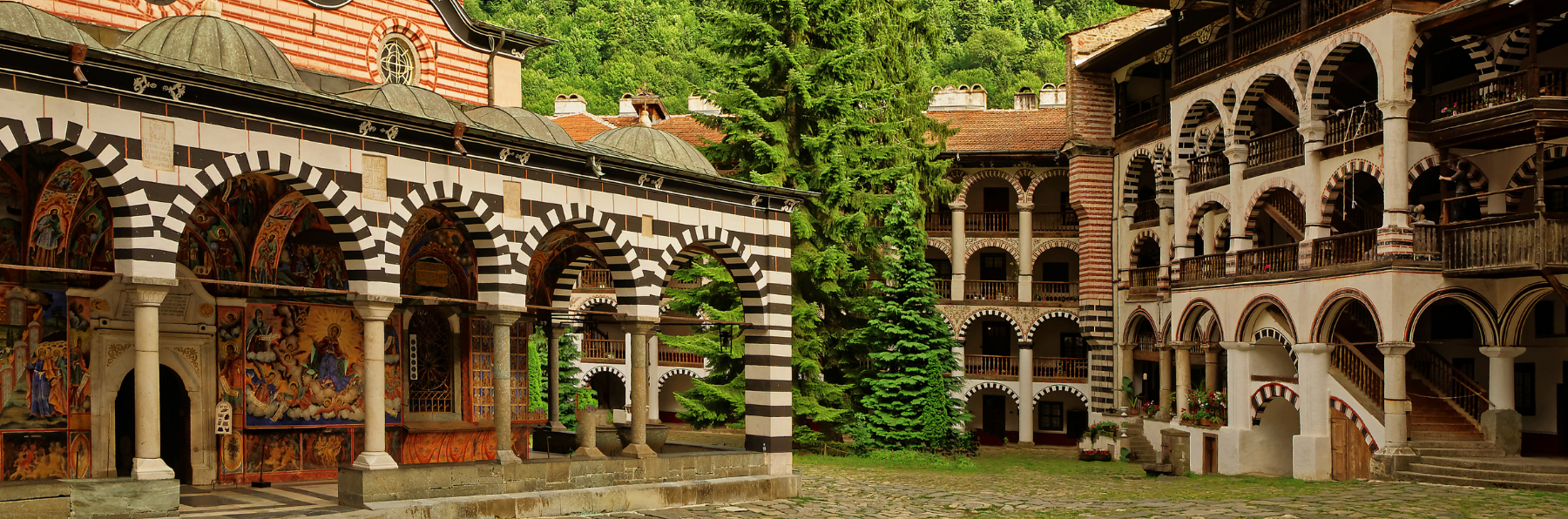
The medieval Bulgarian elite vanished — converted, emigrated or eliminated. What survived was the Orthodox peasantry and the monasteries: Rila, Bachkovo, Troyan, Rozhen. That’s why monasteries matter so much in Bulgarian identity: they were the only Bulgarian institutions the Ottoman Empire allowed to remain for five centuries.
The popular culture froze: dress, songs, textiles, rural traditions you’ll see today in the southern Pirin or the Rhodope are literally what the Ottoman couldn’t assimilate.
National Revival (1762 — 1878)
In 1762 the monk Paisius of Hilendar wrote the Istoriya Slavyanobolgarskaya — a history of Bulgaria that reminded Bulgarians of their imperial past. The manuscript circulated from monastery to monastery for decades. It was the cultural trigger of the Bulgarian National Revival (Vazrazhdane).
Between 1762 and 1878 hundreds of new churches were built, Bulgarian-language (not Greek) schools were founded, books were printed. Cities like Koprivshtitsa, Plovdiv (the Revival old town) and Tryavna preserve whole neighbourhoods from this period — two-storey houses with overhangs, painted windows, interiors decorated with floral motifs.
Independence came with Russian blood: the Russo-Turkish War of 1877-78 liberated Bulgaria. The Treaty of San Stefano (March 1878) created a Greater Bulgaria reaching the Aegean. The European powers, alarmed by the size of the new pro-Russian state, shrank it at the Congress of Berlin (July 1878). Two-thirds of the promised territory was lost. Resentment over San Stefano marked half a century of Bulgarian politics.
The three modern kingdoms (1878 — 1946)
Bulgaria was an Ottoman vassal principality (1878-1908), an independent kingdom (1908-1946) and chose poorly in both world wars — German-aligned twice. The Balkan Wars (1912-13) gave it Macedonia and then took it away. World War I left Bulgaria defeated and smaller.
Tsar Boris III (1918-1943) manoeuvred through World War II with complex cunning: allied with the Axis but saved Bulgaria’s 48,000 Jews from deportation, under pressure from the Orthodox Church, parliament and the people. It’s one of the morally cleanest episodes of the entire war. Boris died in 1943 mysteriously after meeting Hitler.
Communism (1946 — 1989)
The Red Army occupied Bulgaria in 1944 meeting no real resistance. In 1946 a (fraudulent) referendum abolished the monarchy. Todor Zhivkov ruled from 1954 to 1989 — the longest-lasting communist leader in the Soviet bloc. Bulgaria was the most loyal Moscow satellite, with a regime relatively benign compared to Romania or Albania but oppressive in civil liberties.
The dark episode was the “Revival Process” (1984-89): forcing the Turkish-Bulgarian minority (800,000 people) to change Muslim names for Bulgarian ones. It triggered a mass exodus in 1989 — 350,000 Turkish-Bulgarians emigrated to Turkey. It’s the least healed wound of the communist era and Bulgaria has not yet completed a full reconciliation.
Transition and EU (1989 — today)
After 1989, Bulgaria entered a brutal transition: hyperinflation in 1996-97, mafia and industrial collapse. Recovery was slow. EU since 2007, NATO since 2004. Land Schengen since 2024 (slow).
Today Bulgaria is a full EU member but the poorest per capita in the Union, with persistent emigration (population has dropped from 9 million in 1989 to 6.5 in 2024). The internal debate is about corruption, oligarchies and the ambiguous bond with Russia — culturally and religiously close, politically European.
Why this matters to the traveller
Understanding this changes everything you see:
- Rila isn’t “a pretty monastery” — it’s where the Cyrillic alphabet survived five Ottoman centuries.
- Veliko Tarnovo isn’t “picturesque medieval city” — it’s the capital of an empire that rivalled Byzantium.
- Plovdiv Revival aren’t “cute houses” — it’s the cultural resurgence of a people on the edge of losing its language.
- Panagyurishte isn’t “ancient jewellery” — it’s Thracian goldsmithing technically superior to classical Greek gold.
- Cyrillic on the signs isn’t an exotic detail — it’s an alphabet invented here.
The complete Bulgaria guide from Far Guides dedicates a whole section to history with maps of each empire and context for each city visited.
More on Bulgaria
Keep reading.
Other pieces from the same destination.


Next step
Ready for Bulgaria?
The guide is for travelling.
Interactive maps & itineraries and everything that doesn't fit in an article. Always the latest published version.
Get the Bulgaria guide