Introduction to Uzbekistan
Everything you need to know before you go: flights, basics and how to use this guide
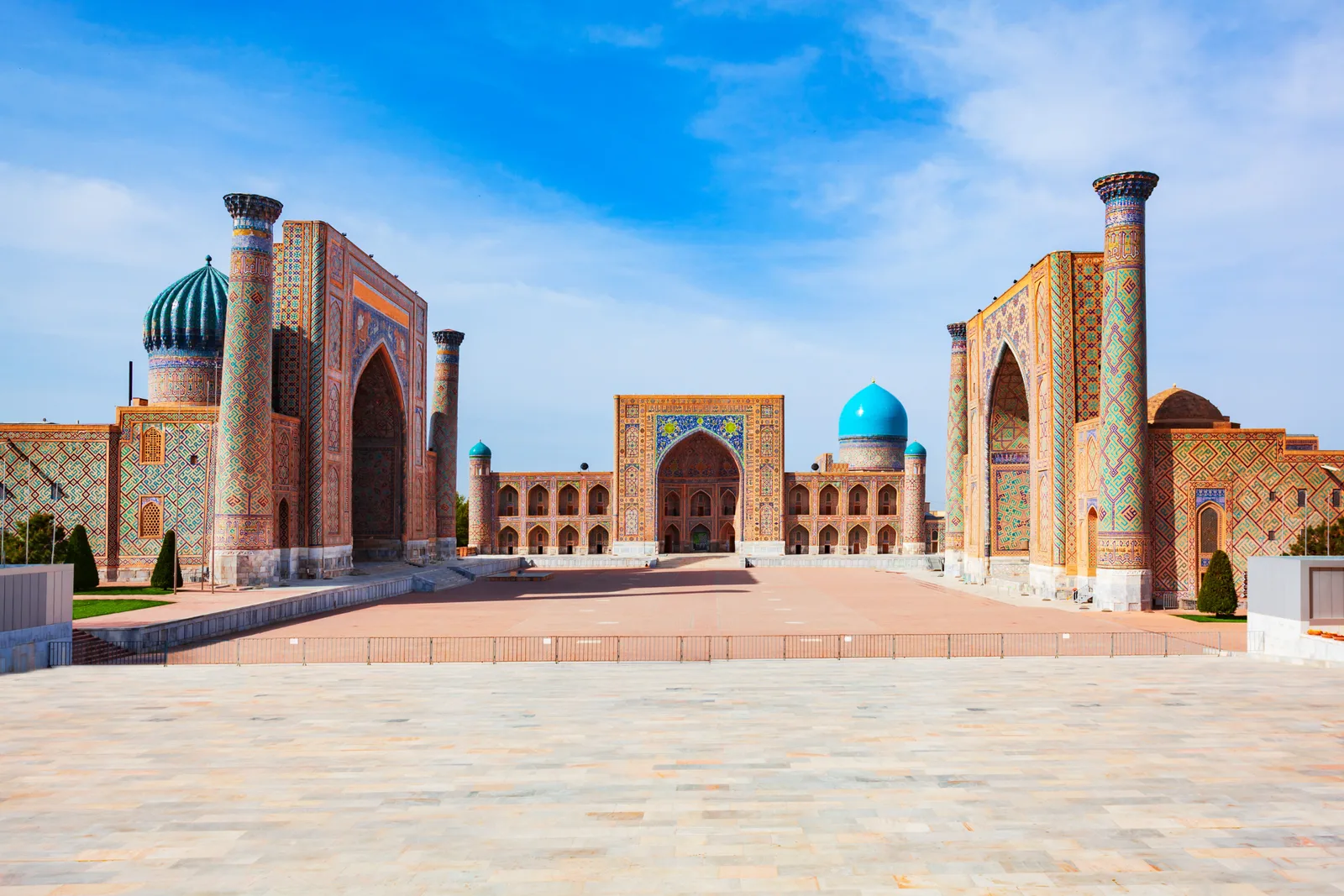
Uzbekistan is not a destination people stumble upon. You choose it deliberately — usually after seeing a photograph of the Registan at dusk, three madrasas, turquoise domes, the kind of architecture that makes you question whether you've been wasting your travel years on the same ten European cities.
- Capital Tashkent
- Currency Uzbek som (1€ ≈ 13,600)
- Visa Visa-free up to 30 days
- Best time Apr-May · Sep-Oct
The country you didn’t expect
Then you start researching. Then you realise the photograph didn’t do it justice.
Uzbekistan is the result of twenty-five centuries of civilisation at one of the world’s most contested crossroads: the Silk Road, medieval Islam, the Mongol conquest, the Timurid Empire, Russian colonisation, the Soviet experiment, and finally an independence barely three decades old. Each of those chapters left something in the stone, the language, the way people receive you when you appear at their door.
The result is a country of 36 million people that holds some of the most extraordinary architectural ensembles on the planet, a hospitality that surprises by its consistency, and a historical and political complexity that deserves more than a surface reading.
Essential facts
| Capital | Tashkent |
| Official language | Uzbek; Russian widely spoken |
| Currency | Uzbek som (UZS) — 1€ ≈ 13,600 som (2026) |
| Time zone | UTC+5 (no daylight saving) |
| Visa | Spain/EU/UK/US: visa-free up to 30 days |
| Population | ~36 million |
| Area | 448,978 km² |
| Predominant religion | Sunni Islam |
Getting there
Turkish Airlines via Istanbul
The most consistent option from Western Europe. There are direct connections to Istanbul from most major European cities. The Istanbul–Tashkent leg adds around five hours. Flights arrive in Tashkent at three typical times: 01:00, 04:30 and 08:00 — worth choosing the one that fits best with your hotel transfer.
A warning about the connection: Istanbul Airport is enormous. With a connection of less than three hours, any minor delay can mean missing the next flight. Book connections of at least three and a half hours.
Other airlines
- Emirates via Dubai — mainly from Madrid, London, Paris and other major hubs
- FlyDubai — budget option from cities with Dubai connections
- LOT Polish Airlines via Warsaw — a solid alternative with scheduling flexibility
- Uzbekistan Airways — direct flights from several European cities (network expanding since 2016)
When to go
| Season | Temperature | Assessment |
|---|---|---|
| April–June | 18–28°C | Ideal: mild weather, fields in bloom |
| September–October | 20–30°C | Excellent: harvest markets, autumn light |
| July–August | 35–42°C | Possible but demanding due to heat |
| November–March | -5–10°C | Quiet, cheaper, cold |
The spring window coincides with Nowruz (the Persian new year, around 21 March), when Uzbeks celebrate the end of winter with music, food and open-air markets. If you can time your visit to overlap, don’t pass it up.
Traveller’s tip: Book flights at least three months in advance, especially for April–May and September–October. The supply of seats to Tashkent is still limited, and prices rise quickly as availability falls.
Getting around
The country is large but the main tourist routes are well connected.
High-speed trains: The Afrosiyob trains connect Tashkent–Samarkand (2h10) and Tashkent–Bukhara (3h). Comfortable, punctual and affordable — around €15–20 per journey. Book tickets at eticket.railway.uz in advance: trains fill up.
Shared taxis: For routes without train service (Bukhara–Khiva, Khiva–Nukus), shared taxis are the standard option. Organise them at bus stations or through your accommodation. Price per seat: 50,000–100,000 UZS depending on the route.
Domestic flights: The Tashkent–Urgench route (for Khiva) is the most common. Uzbekistan Airways and Centrum Air operate regular flights. Duration: ~90 minutes. Price: €70–120 booked in advance.
Tashkent metro: One of the world’s finest by design. More than a means of transport, it’s an underground museum of the Soviet era. Ticket: 1,600 UZS per journey.
City taxis: Abundant and cheap. Yandex.Taxi works well across all major cities.
Money
The Uzbek som has been freely exchangeable since 2017 — before that, a black market system made budgeting chaotic. Change euros or dollars at banks, official exchange offices or hotels. Banknotes must be in good condition: no tears, no writing on them.
ATMs exist in the main cities but are not fully reliable. Always carry enough cash to cover two or three days of expenses, especially when you move away from major cities.
Credit cards (mainly Visa) are accepted in mid-to-high-end hotels and restaurants. At bazaars, in taxis, small guesthouses and local establishments, cash is the only option.
Spending reference: A decent guesthouse night in Bukhara costs €20–35. A local restaurant lunch: €3–6. Entry to major monuments: €3–6. Shared taxi between cities: €3–8 per seat. Uzbekistan is significantly cheaper than Western Europe.
How to use this guide
The guide is organised by destination, with a history section at the start and a practical information section at the end. There are no “Day 1 / Day 2” itineraries — you decide how much time each place deserves. What this guide provides is the historical context that makes what you see meaningful, the practical information that saves time and money, and the specific details that most guidebooks skip.
The most useful reading order: start with the history chapter before you arrive in the country. It takes fifteen minutes and makes everything else make sense. Then read each city section before visiting it. Consult the practical information when organising logistics.