Introduction to Thailand
A country that contradicts every expectation
Thailand has the strange gift of feeling familiar right up until the moment it stops being so. A kingdom of over a thousand years, the only Southeast Asian nation never colonised, with Bangkok as the most unpredictable city on earth. It throws you off. And it throws you off well.
Thailand has the strange gift of feeling familiar right up until the moment it stops being so. The images that circulate online — white-sand beaches, golden temples, saffron-robed monks at dawn — are real. But those images capture a surface that, if you stay long enough, begins to reveal a far more complex architecture: a kingdom with over a thousand years of continuous history, the only nation in Southeast Asia never colonised by a foreign power, a state where Buddhism is not merely a religion but the organising principle of public life, and a capital — Bangkok — that is probably the most unpredictable city on earth.
That is the first adjustment worth making before you arrive: Thailand is not an exotic destination in the passive sense of the term. It is not a backdrop. It is a country with a highly developed culture, a sophisticated intellectual and political elite, a monarchical system that has run under the same dynasty for 240 years, real social tensions, and a relationship with mass tourism that deserves to be understood rather than ignored. More than thirty million visitors per year before the pandemic made tourism Thailand’s largest economic sector. That has visible consequences — in Koh Samui, in Pattaya, along Khao San Road. But there is another Thailand, harder to see, slower, quieter, that coexists with that noise and persists with remarkable tenacity.
This guide tries to reach both layers.
What this country demands
To understand Thailand, you need to understand Theravada Buddhism not as a tourist curiosity but as cultural grammar. Ninety-five per cent of the population identifies as Buddhist, but that figure does not capture the density of practice: there is a temple every five hundred metres in the cities, monks receive offerings at dawn every single morning of the year, and the lunar cycle governs the calendar of festivals with a precision no tourist itinerary can afford to ignore. The relationship between the state and the sangha — the community of monks — has been the vertebral axis of Thai identity since the thirteenth century, since the kingdom of Sukhothai minted the model of Buddhist monarchy that every subsequent dynasty would inherit and refine.
Bangkok, the capital since 1782, deserves particular attention. Not because it is the most beautiful city in the region — it was once, and some vestiges of that beauty survive in Rattanakosin and along the Chao Phraya — but because it is the Southeast Asian city where the urban experience is most genuinely unstable. Within three city blocks you can move from a flower market that has been running since three in the morning to a glass skyscraper where an international consultancy occupies fifteen floors. The metro and the tuk-tuk coexist without apparent tension. Spirit shrines appear in shopping-centre lobbies. Monks accept alms outside convenience stores. There is an internal logic to all of this, but it is not the logic a European instinctively recognises. That is what makes Bangkok fascinating: it forces you to look differently.
Geography as argument
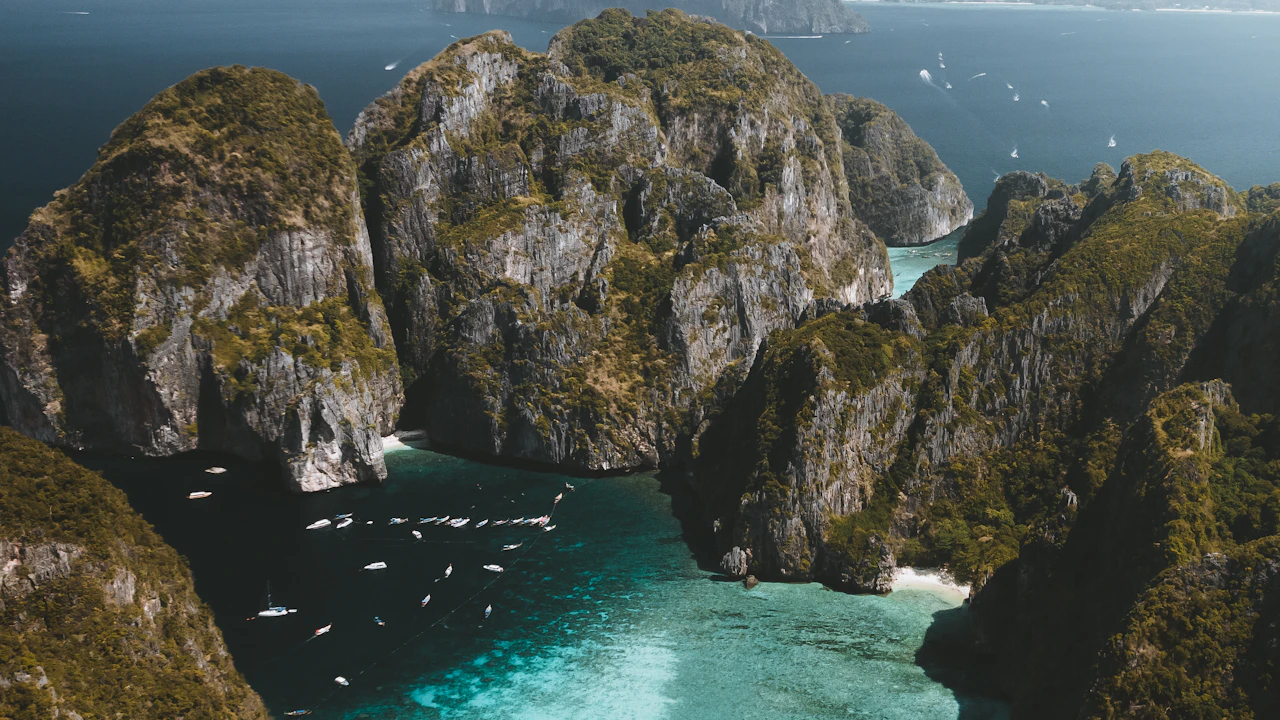
Thailand’s territory has a shape that Thais themselves compare to an elephant’s head: a continental mass in the north and centre, and a long tail descending along the Malay Peninsula toward the south. That geography is not a minor detail. The north — Chiang Mai, the Golden Triangle, the mountains bordering Burma and Laos — has a cultural identity distinct from the Bangkok-dominated centre. The northeast (Isan) is the poorest region, with Khmer cultural influences and its own distinct cuisine. The south is Thailand of the islands: the Gulf of Thailand to the east, the Andaman Sea to the west, and between them a variety of coastal ecosystems ranging from pristine coral reefs to beaches levelled by decades of intensive tourism.
The question “which island should I go to?” has an answer, but not a single answer. Koh Lanta is different from Koh Tao, which is different from Ko Pha Ngan, which differs from the Similans, which vary among themselves depending on the time of year. This guide devotes a dedicated section to helping you choose based on what you are looking for, which month you are travelling, and the level of development you are willing to accept — because in Thailand there are islands where the tourist infrastructure has destroyed almost everything that made the place interesting, and islands where you can still arrive by ferry and find something resembling stillness.
The structure of this guide
The guide is organised in ten sections. The first four cover history: the kingdom of Sukhothai and the first Thai states of the thirteenth century; Ayutthaya, the capital that for four centuries was one of the largest cities in the world and that the Burmese razed to the ground in 1767 over fifteen days; the transformation of Siam into Thailand during the nineteenth and twentieth centuries, with kings Mongkut and Chulalongkorn navigating between colonial empires to preserve the kingdom’s independence; and contemporary Thailand — the economic miracle of the eighties and nineties, the military coups (twelve since 1932), and the society that has emerged from all of it.
The following sections cover the main mainland destinations: Bangkok with its organised chaos, Chiang Mai and the north, Ayutthaya as a day trip, and Kanchanaburi. Then come the islands, with that orientation section mentioned above. Finally, practical culture — how to get around, what to eat, how much things cost, when to go — and itineraries for different types of journey: one week, two weeks, the long trip.
Why Thailand still matters
In a world where globalisation has standardised the travel experience to the point of near-interchangeability, Thailand maintains an identity that is recognisable but not reducible to clichés. Theravada Buddhism produces a visual culture, an architecture, a social ethic and a relationship with time that are genuinely unlike anything a Westerner encounters at home. The food — and this is not a trivial claim — is probably the most complex and nuanced in all of Asia. The relationship between the ancient and the modern is not a tension Thailand has resolved: it is a tension it inhabits openly, with an energy that turns each day of travel into something you did not predict the night before.
That, in the end, is what matters: Thailand disorients you. And it does so well.