Greece
The cradle of Western civilisation: why it deserves far more time than the cruise ships allow
There are countries that introduce themselves and countries you have to decipher. Greece is, deceptively, one of the former: everyone thinks they know it before they arrive.
- Islands +6,000 (200 inhabited)
- Population 10M residents · +30M tourists/year
- When May · October (ideal climate, no crowds)
- Layers Pagan · Christian · Ottoman · Venetian
The Acropolis, Santorini’s blue domes, ouzo, souvlaki. Those images are real. They are also, in many cases, exactly what obscures the Greece that deserves far more time than the cruise ships and seven-night packages allow. The challenge of travelling here well is not finding the right places — it is finding the right layer of each place.
Every city, every archaeological site, every village church is the accumulated product of at least three or four distinct civilisations that occupied the same ground at different times, each leaving its mark on top of the last. The Parthenon was a pagan temple, then a Christian church, then an Ottoman mosque, then a Venetian gunpowder store, before becoming the universal symbol you recognise today. That is not an archaeological curiosity. It is the key to understanding everything else.
The four Greeces
Talking about “Greece” as a single destination is like talking about “Italy”: the label groups together realities so different that they require not just separate planning, but genuinely different mindsets.
Athens and Attica
The capital is a city of 3.5 million people that has spent three millennia being at the centre of something. It is not an easy city — the traffic is chaotic, August heat turns the Attic basin into a stone oven, and the economic crisis left visible wounds in certain neighbourhoods still healing — but it has an energy that very few Mediterranean cities still possess. The contrast between the floodlit Acropolis at night and the political graffiti of Exarcheia, between the National Archaeological Museum and the flea market chaos at Monastiraki, is not a contradiction: it is the argument. Athens has been functioning continuously for three thousand years and, unlike Rome or Cairo, has not turned itself into a stage set of its own past. It is still a real city.
The Aegean islands
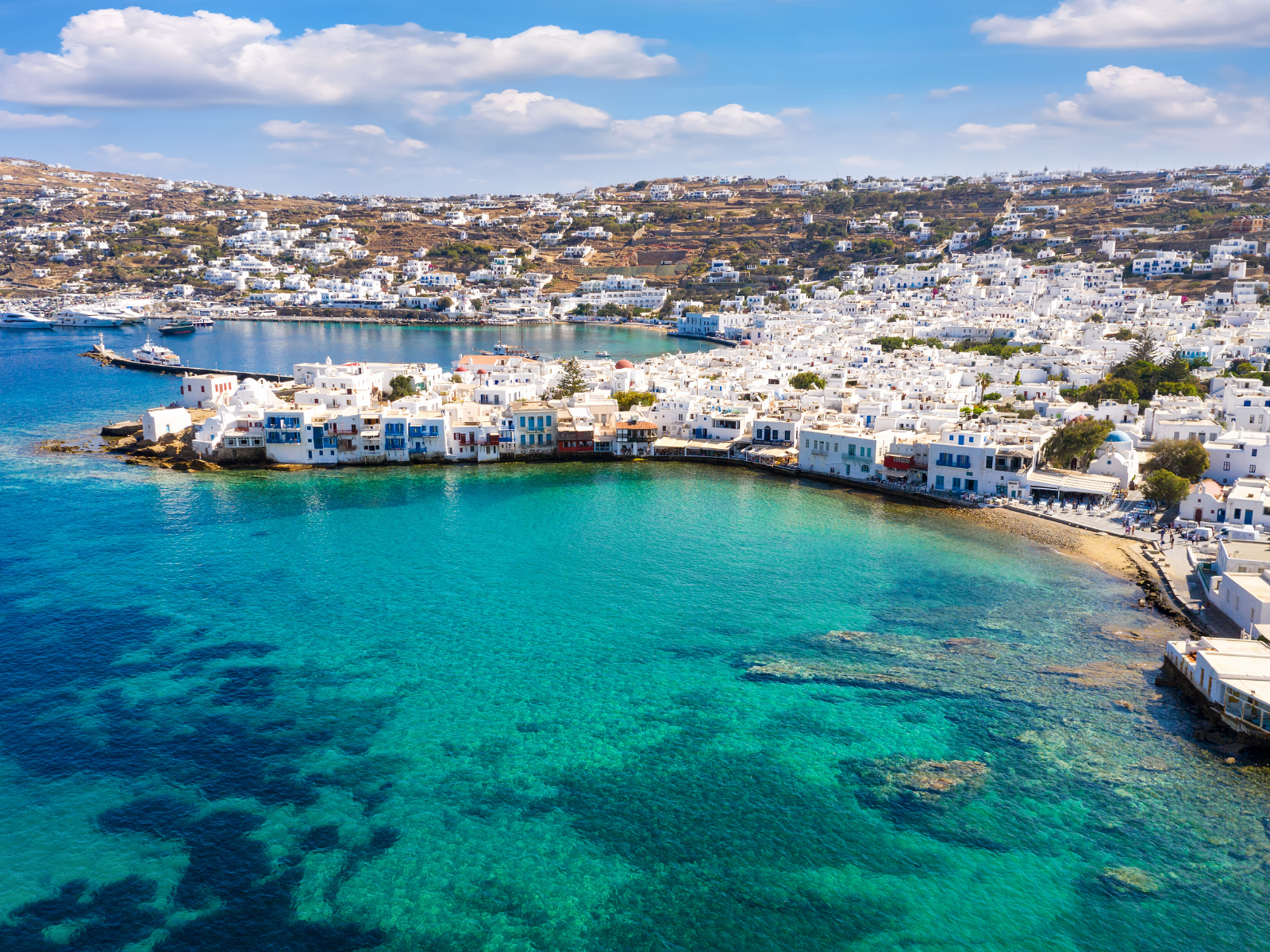
The Greek archipelago has more than 6,000 islands, around 200 of which are permanently inhabited. The novice traveller’s trap is confusing the most famous with the best. Santorini and Mykonos are extraordinary under certain conditions — explained in their respective chapters — and entirely skippable under others. The Cyclades offer dozens of alternatives with less tourism and more character: Naxos has fine-sand beaches and Minoan and Venetian remains; Folegandros has an old town perched on a cliff that seems from another era; Milos has a volcanic coastline of remarkable visual strangeness. The Dodecanese — Rhodes, Kos, Patmos — carries a history shaped by the Knights Hospitaller and the Ottoman Empire that has nothing to do with the classical Aegean. The Ionian islands face Italy, not the Aegean, and feel distinctly different in architecture, food and temperament.
The Peloponnese and mainland Greece
The Peloponnese — the great peninsula south of Athens, technically an island since the Corinth Canal was completed in 1893 — is the Greece that many tourists drive through on their way to a ferry port. That is a mistake. Within a territory the size of a mid-size region, you have Mycenae, Epidaurus, Olympia, Monemvasia, Mystras and the Mani: a compendium of Greek history from the Bronze Age through the Byzantine Empire that no other part of the country can match. Northern mainland Greece — Macedonia, Epirus, Thessaly — is practically unknown to most foreign tourists and holds the monasteries of Meteora, perched atop columns of rock in a landscape that geology took sixty million years to sculpt.
Crete
The largest island in the eastern Mediterranean deserves its own category. It is not particularly large for an island — 8,335 km², smaller than Wales — but it has a historical, gastronomical and geographical density that sets it apart from everything else. The Minoan civilisation, the oldest in Europe, flourished here for almost two millennia before mainland Greeks had a writing system. Cretan cuisine was the model that twentieth-century nutritionists exported to the world as the “Mediterranean diet”. The landscape shifts from turquoise beaches in the north to savage cliffs in the south in less than fifty kilometres.
When to go
| Season | Months | Advantages | Drawbacks |
|---|---|---|---|
| Peak | July–August | Everything open, frequent ferries, long days | Extreme crowds, high prices, intense heat |
| High shoulder | June, September | Good weather, manageable crowds | Prices still elevated |
| Low shoulder | April–May, October | Ideal climate, reasonable prices | Reduced services on smaller islands |
| Low | November–March | Empty sites, minimum prices | Islands nearly deserted, scarce ferries |
In July and August, Greece receives around eight million tourists in those two months alone. The ratio of visitors to residents — ten million inhabitants — has no equivalent in any other European country. The consequences are concrete: one night in a hotel overlooking the Santorini caldera can cost in August what three nights in the same hotel would cost in October. The Acropolis at eleven in the morning in August has more people than a shopping centre.
Traveller’s tip: If you have to travel in July or August to the most popular islands, booking accommodation three or four months in advance is not an exaggeration — it is the minimum. Properties on Santorini and Mykonos sell out weeks before the season. This is not the kind of trip where you can improvise.
Mass tourism: the unfiltered reality
Greece receives more than 30 million tourists a year in a country of 10 million inhabitants. That three-to-one ratio has consequences worth knowing before you arrive. Prices on the most famous islands in high season are comparable to any expensive European capital. Service in some tourist-facing establishments is mechanical, calibrated for throughput rather than experience. There are corners of Oia where the scenery is extraordinary and the experience, surrounded by thousands of people taking the same photograph, is that of a theme park.
This does not mean you should avoid the famous destinations. It means you should understand how they work in order to visit them well. The Acropolis at dawn and the Acropolis at noon in August are two different places with the same name. Oia before the cruise passengers arrive and Oia at five in the afternoon in July are two experiences that have nothing in common except the geography. This guide exists to give you the tools to find the good version of each.
What you will miss if you only look where everyone else is pointing
The Greece that deserves most attention is almost always the Greece that competes with the Acropolis in the collective imagination and loses. Thessaloniki has more early-Christian and Byzantine monuments per square metre than any other Greek city and almost no foreign tourists visit it. The Peloponnese concentrates within one peninsula the most important Bronze Age sites, the theatre with the best acoustics in the ancient world, and the ghost city where the Byzantine Empire drew its last breath for fifty years — and almost nobody crosses the Corinth Canal to see them. Mystras, seven kilometres from Sparta, has fourteenth-century art that historians compare to the early Italian Renaissance and receives a fraction of Epidaurus’s visitors.
It is not that those places are better than the Acropolis. It is that they have shorter queues, they help you understand what the Acropolis means, and they make the trip something you can talk about with nuance when you return.
The practical information — ferries, budget, transport — is in the final chapter of this guide. Start here, with the why. The logistical details make sense once you know where you want to go.