

Romania · 18 May 2026
Dracula and Romania's castles: what's myth and what's history
Bran, Poenari, Corvin: the castles tied to Vlad Țepeș and Bram Stoker's Dracula. Separating the historical figure from the Gothic myth.

Few tourist myths in Europe are as commercialised as Dracula in Romania. And few are as problematic: the literary Dracula of Bram Stoker (1897) and the historical Vlad Țepeș (1431-1476) have thinner connections than the tourist industry suggests. This post tries to sort things out: which castles really matter, what real relation they have with Vlad, what imaginary relation with Stoker, and how to visit them without falling into the tourist trap.
Vlad III, the real figure
Vlad III Drăculea (called Țepeș, “the Impaler”, posthumously) was prince of Wallachia — the southern Romanian principality, not Transylvania — in three periods between 1448 and 1476. Grandson of king Sigismund of Hungary, raised at the Ottoman court as a hostage. Known for his brutality: he impaled thousands of Ottomans, rival boyars and suspects. Also for his defence of Christendom against the Ottoman Empire, which made him a Romanian national hero centuries later.
“Drăculea” means “son of the dragon”: his father, Vlad II Dracul, was a member of the Order of the Dragon (Holy Roman anti-Ottoman chivalric order, 1408). “Dracul” in old Romanian = dragon. In modern Romanian it also means “devil”, which in the 19th century helped the semantic leap Bram Stoker exploited.
Vlad Țepeș never lived in Transylvania except briefly. Born in Sighișoara (Transylvania, because his father was voivode there), but his political rule and adult life were in Wallachia, south of the Carpathians.
Bran: the most famous, the least authentic
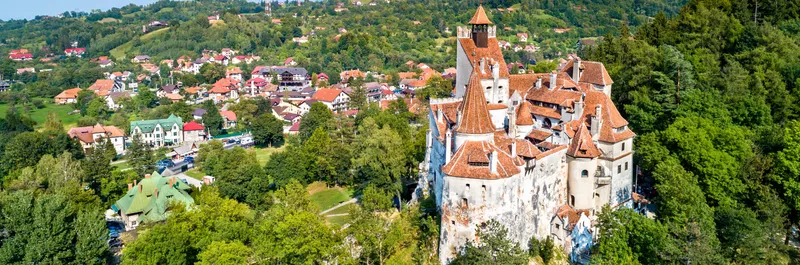
Bran Castle (30 km from Brașov) is the one the tourist industry sells as “Dracula’s castle”. In reality:
- Vlad Țepeș likely spent a few weeks here as a prisoner (1462) during one of his exiles, but no source confirms it with certainty.
- Bram Stoker never visited Romania nor drew on Bran. His fictional castle is set near the Borgo Pass, in the northern Carpathians, not central Transylvania.
What Bran actually is: a 14th-century customs castle, well preserved, with interiors featuring Queen Marie of Romania’s furniture (she used it as a summer residence in the 1920s). Visually dramatic: towers, stone walls, narrow windows over a cliff. Worth seeing for what it is — not for what the “Dracula” branding suggests.
Entry 70 lei (14 €). 30 km from Brașov, 40 min by car. In summer, 1-2 h queue: go early or late.
Poenari: Vlad’s real castle
Poenari Castle (Argeș, 160 km from Brașov, on the Transfăgărășan road) is Vlad Țepeș’s true castle. He rebuilt it himself in 1459, using rival boyars as forced labour — some worked to death. From here he resisted Sultan Mehmed II in 1462 before going into exile.
Today it’s in ruins. To reach it you must climb 1,480 steps from the road. No museum, no wristband: just stone walls, vertiginous views over the Argeș valley and the real sense that someone stood here fighting for his life. Symbolic entry (10 lei, sometimes free if the caretaker is away).
It’s the castle to visit if you’re interested in the historical Vlad. Combinable with the Transfăgărășan if going in summer (the castle is just off the road).
Corvin (Hunedoara): the spectacular Gothic castle
Corvin Castle in Hunedoara (100 km south of Cluj, 280 km west of Brașov) is the finest example of Gothic military architecture in Romania. Built in the 15th century by John Hunyadi, Hungarian voivode of Transylvania and father of the future king Matthias Corvinus. Enormous, impressive, with towers, drawbridge, knights’ hall.
Vlad Țepeș was imprisoned here for 7 years (1462-1469) by order of King Matthias. It is, in fairness, the castle most connected to Vlad that survives as a building. But it barely appears in tourist tours because the industry standardised Bran.
Entry 60 lei. 2.5-3 h visit. Highly recommended.
Sighișoara: the birthplace
The alleged birthplace of Vlad Țepeș in Sighișoara (Strada Cositorarilor 5) is a tourist restaurant today, with a room dedicated to him on the first floor (complete with wax mannequin). Nothing special, but the Sighișoara citadel itself is worth it. Context: Vlad’s father was voivode there during the Wallachian exile of the 1430s-40s, and it’s plausible — not proven — that Vlad was born there around 1431.
Authentic 5-day “Dracula” route
- Day 1-2: Sighișoara (birthplace, medieval citadel).
- Day 3: Brașov + Bran.
- Day 4: Brașov → Poenari (Transfăgărășan in summer).
- Day 5: Poenari → Hunedoara (Corvin). Back to Bucharest (or Cluj).
Halloween tourism
On the night of 31 October, Bran becomes the epicentre of Dracula tourism: tours with Gothic dinner, themed parties, lights. Funny and enjoyable atmosphere if you like the genre, ridiculous cliché if not. Bookings months in advance for that date.
What about the literary Dracula
Bram Stoker’s Count Dracula is a Hungarian-Transylvanian vampire with very few traits of Vlad Țepeș. Stoker took the name “Dracula” from a Wallachia travel book he read in London, and combined it with Balkan strigoi folklore (traditional Romanian vampire). The real Vlad and Stoker’s Dracula share a name, an approximate land and little else.
The strigoi folklore really is Romanian: dead who return to drink the blood of relatives, stake rituals, garlic, magical objects. If you’re interested in authentic vampiric lore, the reading is Emily Gerard, “Transylvanian Superstitions” (1885), the ethnographic source Stoker used.
Far Guides’ complete Romania guide includes separate themed routes for the historical Vlad and for the literary Dracula, with bibliographic context.
More on Romania
Keep reading.
Other pieces from the same destination.


Next step
Ready for Romania?
The guide is for travelling.
Interactive maps & itineraries and everything that doesn't fit in an article. Always the latest published version.
Get the Romania guide