Albania · 12 October 2026
Bunk'Art, Bunk'Art 2 and Albania's communist memory
The two bunker-museums in Tirana, the House of Leaves and Hoxha's legacy: what to see in Albania to understand its dictatorship, the most isolated in Europe.

Albania lived through the longest and most isolated communist dictatorship in Europe: 47 years of Enver Hoxha and his successor Ramiz Alia (1944-1991), successive break with the USSR (1961) and China (1978), construction of 170,000 anti-aircraft bunkers scattered across the country, an absolute ban on religion from 1967, death penalty for attempted escape, autarkic economy to the point of collapse. To understand Albania, there is no avoiding that legacy. And to see it with your eyes instead of reading about it, three museums in Tirana tell the story better than any book.
Bunk’Art 1: Hoxha’s bunker
On the slope of Mount Dajti, on Tirana’s eastern outskirts, the regime built between 1972 and 1978 an atomic bunker of 106 rooms on five underground floors, meant to house Hoxha, his general staff and the Party of Labour in case of nuclear attack. It was never used. In 2014 it opened to the public as Bunk’Art 1, a museum-route with art installations, photographic archive, Hoxha’s own reconstructed offices, and a staging that combines historical documentation with contemporary art.
Seeing Bunk’Art 1 takes 2-3 hours. Entry 500 LEK. How to get there: Dajti Ekspres cable car (the lower station is near the bunker) or Bolt from the centre (500-700 LEK). It is physically impressive — the concrete galleries, the armoured doors, the windowless halls — and emotionally heavy. Not a museum to take small children to; there are rooms on the Sigurimi that include methods of interrogation and reprisal.
Bunk’Art 2: the Interior Ministry bunker
Bunk’Art 2 is right in the centre, beneath the Interior Ministry building, a smaller bunker that served as a command centre for the Sigurimi — the secret police — in case of emergency. It opened to the public in 2016 and is more compact: 24 rooms along a central corridor, all devoted to the communist security apparatus: persecution of dissidents, internment camps, labour camps, Spaç prison, the failed 1991 flight from the Italian embassy.
1.5-2 hour visit. Entry 500 LEK. It’s 5 minutes walking from Skanderbeg Square, so it’s the logical option if you only have time for one. For those wanting depth, it complements Bunk’Art 1.
The House of Leaves
Less well known but equally relevant: Shtëpia e Gjetheve — the House of Leaves — on Musine Kokalari street, behind the Orthodox cathedral. For decades it was the Sigurimi’s surveillance and wiretapping building: the nerve centre from which phones were tapped, conversations recorded, opponents catalogued. It opened as a museum in 2017.
It’s the soberest of the three. No dramatic effects: rooms with original microphones, surveillance cameras, personal files of citizens monitored for years. The exhibit explains with data how the control apparatus came to have 10% of the population as informants, and shows real files of famous people under surveillance (actors, writers, Hoxha’s own daughter-in-law). Entry 700 LEK, 1.5 h.
Why see them together
Each tells a different layer:
- Bunk’Art 1: the regime from above (the elite, Hoxha, the Party).
- Bunk’Art 2: the repressive apparatus (camps, prisons, dissidents).
- House of Leaves: ordinary surveillance (wiretapping, informants, everyday life).
Seeing just one gives a partial view. The three in one intense day (there’s no combined ticket; about 1,700 LEK total) offer the most complete portrait of Albanian communism available anywhere in the country, even in the original camps.
To dig deeper: the south and the north
Outside Tirana, two places speak to the same period:
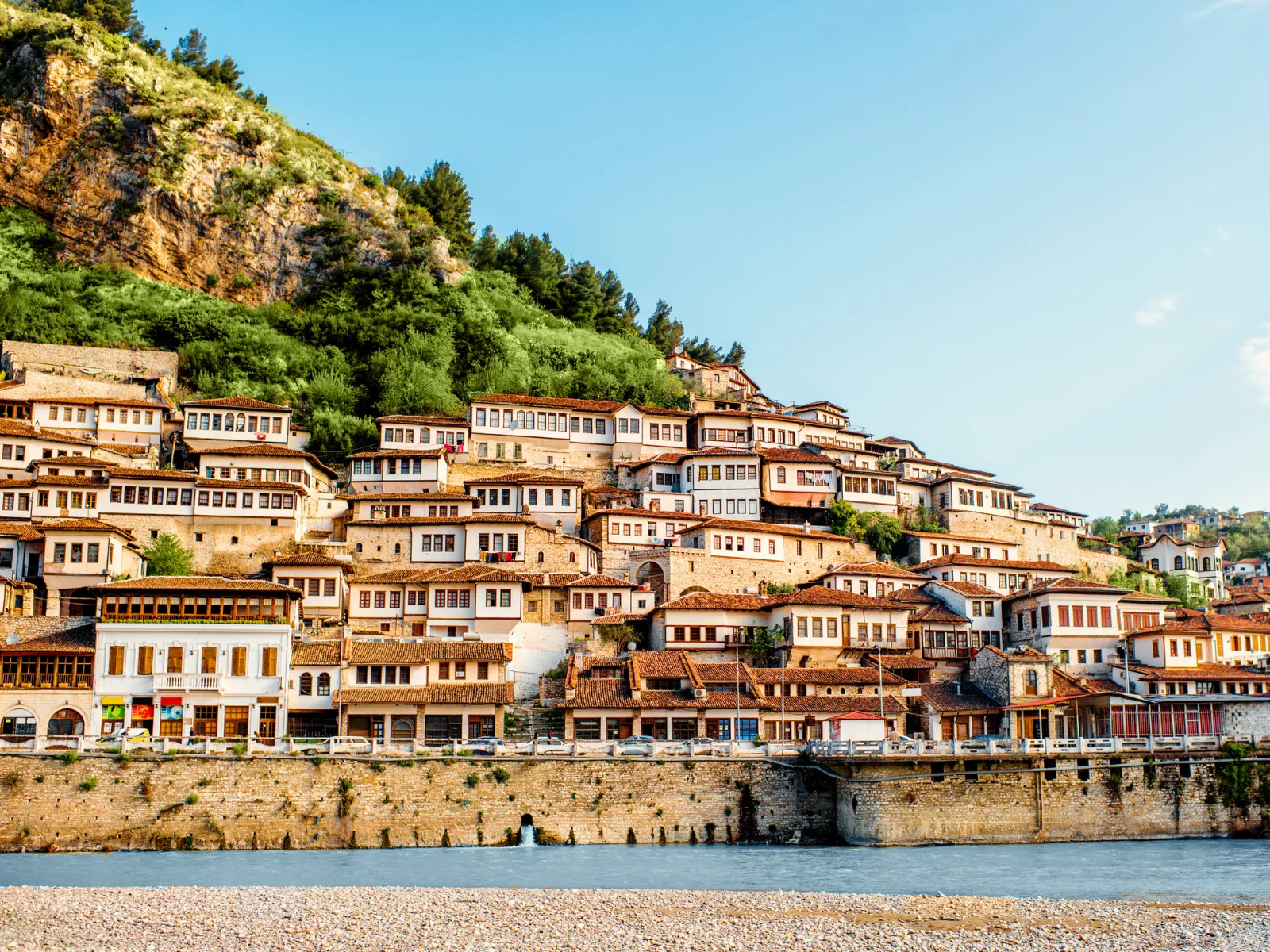
Gjirokastra: the American spy plane in the castle is a story of Hoxha’s anti-Westernism, and the city itself — whose historic centre was “frozen” by decree in 1961 — is a product of the regime’s heritage policy.
Spaç: the regime’s harshest political prison, 3 hours north of Tirana (Mirdita). Accessible only by own car or organised tour, it’s still open ruin without an official museum but with commemorative plaques. For those who want to see the system’s lowest rung, Spaç is the reference.
Far Guides’ complete Albania guide includes a detailed route through Tirana’s three museums with real timings, a recommended order and extended historical context on the Hoxha regime.
More on Albania
Keep reading.
Other pieces from the same destination.


Next step
Ready for Albania?
The guide is for travelling.
Interactive maps & itineraries and everything that doesn't fit in an article. Always the latest published version.
Get the Albania guide